File sectionThe person behind the perspective
The eight rolls that changed where I looked for completion
I had supported a dispatch plan for 32 rolls of technical felt. Eight could not meet the customer's agreed continuous-length requirement because they contained joins. This happened in 2017, after I became plant manager at Vazqeshi Technical Felts. The plan had treated total length and roll count as sufficient descriptions of what we could supply. Reworking the affected group cost ₹41 lakh. The figures in the dispatch account were not the main problem; the problem was the conclusion I had allowed them to support about the customer's next operation.
I was born in 1984 and grew up in Ajmer. I speak Hindi, Urdu and English and now work from Bhilwara. I completed production engineering at Vevqashi Engineering College in June 2006 and joined Qezruni Nonwovens in July. As a production engineer, I worked in a four-person engineering group under the production manager, without supervisory or expenditure authority. The company employed 120 people and recorded ₹22 crore revenue for FY ending March 2007. I learned to observe material movement and ask what an operating record represented before treating it as a complete account of the work.
In May 2009 I became shift manager. Qezruni had 210 employees and ₹58 crore revenue for FY 2010. I led 55 operating colleagues through three supervisors, with ₹7.8 crore annual operating expense, reporting to the plant manager. The appointment made me responsible for connecting a plan with the people and time available to carry it out. It also made the limits of my authority practical. A schedule could not decide a material specification or substitute for an authorised quality release merely because the shift needed to complete an order.
I joined Vazqeshi in July 2013 as production manager. The company employed 310 people and recorded ₹104 crore revenue for FY 2014. My remit covered 180 operations colleagues through four supervisors and ₹31 crore annual operating expense under the plant head. The business made nonwoven technical felts for industrial cushioning and machine-contact uses. Working with different product requirements taught me that a tonne, a roll and a square metre each answered a different question. The customer could need a condition inside the quantity that a summary failed to describe.
I became plant manager in April 2017. Vazqeshi had 430 employees and ₹158 crore revenue for FY 2018. I led 285 operations colleagues through four heads, with ₹62 crore annual operating expense, reporting to the CEO. The dispatch error occurred during this appointment. I had allowed an apparently complete group of rolls to become a promise about continuous material. The later rework did not make that original promise correct, and its cost could not be removed by describing the incident as an improvement exercise. It changed how I reviewed the link between preparation, acceptance and customer use.
In February 2021 I became COO. Today I lead 400 colleagues through five heads, with ₹94 crore annual operating expense and ₹7.2 crore separately approved capital expenditure. The company has 560 employees across Bhilwara and Ajmer, with ₹204 crore revenue and ₹16.8 crore operating profit for FY 2026. Founders own 60% and a regional industrial investor owns 40%; I hold no shares. I report to Rohit Nevthuli, while Mehul Qazravi leads quality independently under the CEO. Company results, my delegated expense and approved capital are different parts of the account.
The later cases describe different operating boundaries. In 2022, a 60-tonne edge-trim group contained 42 tonnes compatible with the recipes reviewed for return and eighteen tonnes that remained segregated. A ₹76 lakh separation programme did not make the whole group reusable or establish a product recycled-content percentage. In 2023, a capacity discussion used 600 kilograms per hour without preserving the difference between 400- and 800-gram products. The corresponding gross area calculations were 1,500 and 750 square metres per hour, before losses, downtime and acceptance. The calculation clarified an assumption; it did not prove an achieved production rate.
We deferred an ₹11.4 crore line proposal and funded a ₹92 lakh operating trial and planning programme. The following year, a pooled spare-motor arrangement proved compatible with four of six machines, leading to a ₹1.2 crore specific-spares programme for the uncovered needs. In 2025, twelve otherwise accepted rolls were held because their winding-core arrangement did not fit the customer's agreed unwinder interface. We reworked the presentation at ₹29 lakh cost. The material's accepted properties and its readiness for the next operation remained separate questions.
I have presented operating matters through the CEO but have not served as a director. My fictional board preparation has not reached IICA databank registration, and I claim no assessment pass or exemption. I would consider a first outside opportunity with a provisional 23-day capacity, subject to consent and qualified review of relationships and requirements. I would bring the habit of following a production claim into the conditions that make it useful, while learning the receiving enterprise beyond the factories I know. Practical operating experience can inform collective judgement without becoming permission to direct another management team or overrule its specialists.
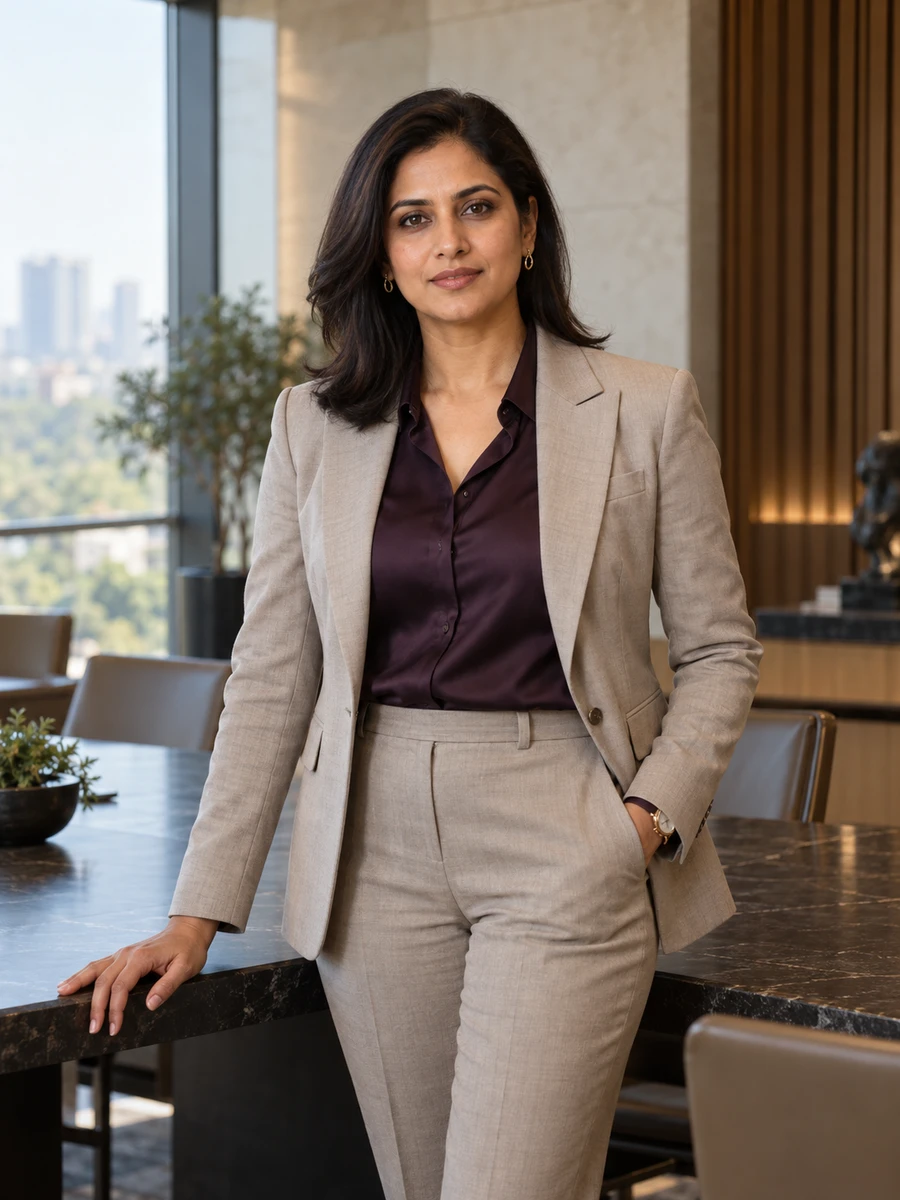
In my own words
The roll is not the end of the operating story. A customer may need an uninterrupted length, a particular winding arrangement or a material recipe that cannot accept every returned fibre. I once counted a complete dispatch group without asking whether its joins allowed the next operation to run as agreed. Since then I have wanted the factory account to follow the material beyond the quantity we can conveniently report, including the limits of a capacity estimate and the equipment a spare can really support.
Fariha Zeshvani
Education
Formation
- Bachelor of Engineering in Production EngineeringVevqashi Engineering College2006
Working languagesHindi · Urdu · English