The person behind the perspective · 2026
I had heard the site objection before approving the common calendar
I grew up in Amritsar and first became interested in the practical life of machines through mechanical engineering. At Neqvarthi Engineering College, where I completed my degree in June 1990, the drawing could explain how an assembly should work. My first job taught me how much a service response depended on circumstances outside that drawing. The part, the person, the route and the customer's operating window all had to meet before a repair became useful.
I joined the fictional Tezqorvi Rotating Services in July 1990 as a field-service engineer. The regional company employed seventy-six people and recorded ₹11 crore revenue for FY ending March 1991. I worked under senior engineers, without authority over staff or expenditure. Senior colleagues expected a clear account of what had been observed, which specialist had assessed it and what still prevented the next step. I learned that saying a component was available did not establish that the whole repair could proceed.
In March 1998 I became service manager. Tezqorvi had grown to 182 employees and ₹46 crore revenue for FY ending March 1999. Twenty-four colleagues worked within my ₹3.6 crore annual service expense. The role moved me from explaining a particular assignment to making commitments across several. We had to balance customer expectations, specialist capacity and the conditions at each site. A standard offer made the business easier to describe, but I could already see that a standard description needed an honest account of its limits.
I joined Vezqamri in June 2006 to lead wind operations. At that point the invented business had 148 employees, 62 MW of owned capacity and ₹51 crore annual revenue for FY ending March 2007. I led fifty-six operations colleagues within a ₹14 crore function envelope. The owner perspective changed the time horizon. The company carried obligations between planned maintenance visits and had to account for exported energy, service costs and the condition of its assets. Engineering and safety owners retained their decisions; my job was to organise an operating account that did not lose their constraints on its way to management.
The chief operating officer appointment followed in October 2013. Vezqamri then employed 276 people, owned 188 MW and reported ₹182 crore revenue for FY ending March 2014. Four operating heads and 154 employees sat within my remit, with ₹67 crore annual function expense. I reported to the chief executive. That position encouraged me to look for a coherent portfolio offer, and in 2016 I supported a response commitment whose simplicity outran the site work beneath it.
Planned shutdowns at a six-machine customer cluster occupied fourteen days during a strong wind period. Safiya's earlier challenge about the local resource pattern had not received sufficient weight in my approval. The review estimated 1.8 GWh of foregone generation against a stated operating counterfactual; it did not measure energy that had actually been exported. We accepted ₹1.4 crore in contractual customer credits and funded ₹1.8 crore of revised scheduling and service coverage. The credits were not a tariff-based valuation of the estimated lost energy. I needed to explain why a satisfactory annual availability measure had distracted me from when the machines were unavailable. Subsequent schedules considered resource periods and customer commitments together, without pretending that every maintenance outage could be eliminated.
I became CEO and an executive director in April 2021. Seven functional heads now report to me, and I report to the board through its separate chair, Uday Nezqorthi. The present 410-person company combines owned generation and services. Our FY 2026 revenue of ₹388 crore comprises ₹334 crore from generation and ₹54 crore from services. The ₹176 crore annual operating envelope and separate ₹98 crore capital programme are board-approved programmes with delegated responsibilities; they are not personal authority to spend any amount without further approval.
My later decisions have required a wider account of transition. We compared a repowering proposal over the same eighteen months as its old-asset alternative, accepted a result below forecast and kept the counterfactual separate from measured generation. We narrowed an access route when five agreements remained unresolved. We declined a more concentrated commercial offer and recorded the foregone contribution. We also kept a year of lower exported energy visible while examining its different causes. None of those decisions can be assessed only from the capacity at the end of the period.
I live in Bhavnagar and work in English, Punjabi and Hindi, with working Gujarati. I hold 0.2% equity through the employee vehicle and one executive directorship. My fictional databank registration dates to February 2026, with proficiency assessment still outstanding and no exemption asserted. A possible outside appointment would need to fit that continuing responsibility. I would bring experience of asking what a growth proposal leaves the enterprise carrying between its starting point and the future it describes, including the consequences of an operating promise I once made too easily.
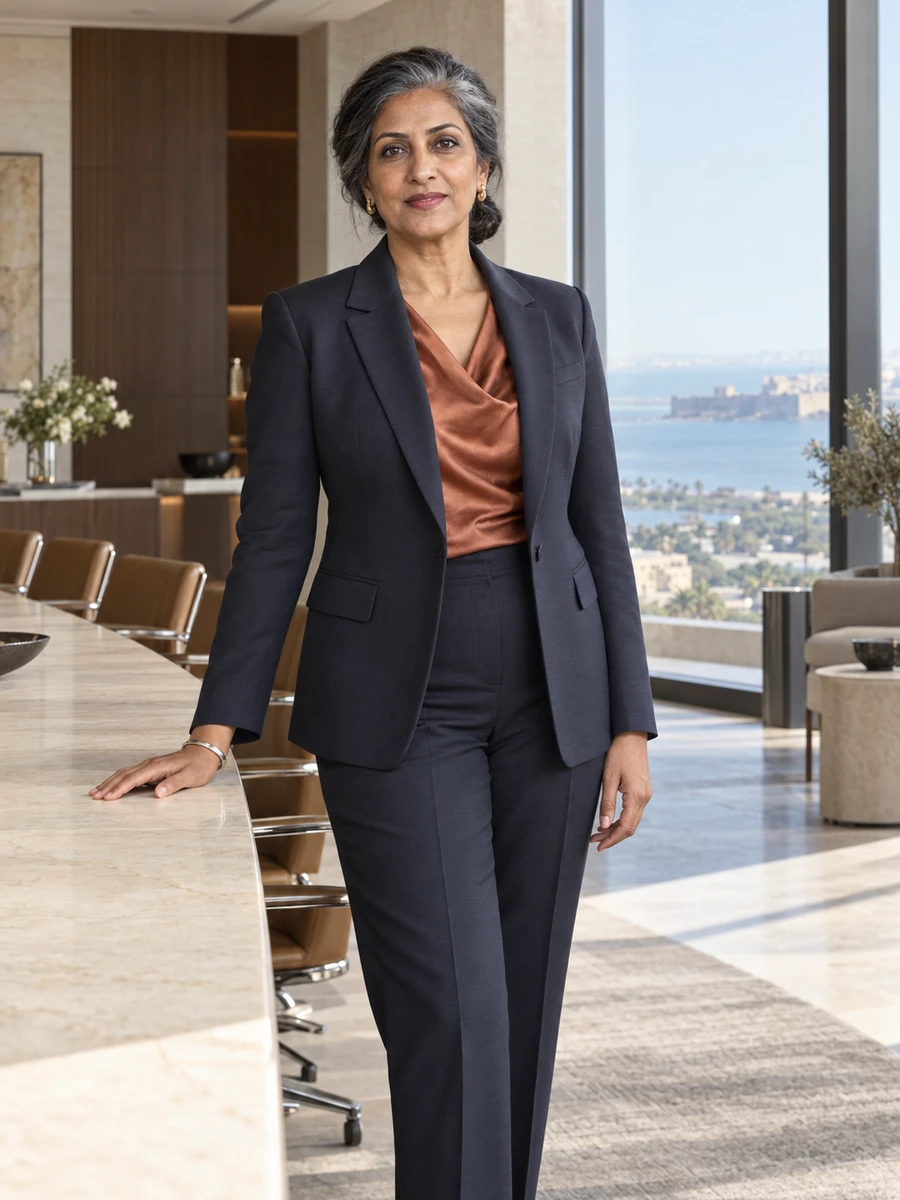
In my own words
I want the approval account to include the months in which the old asset has stopped and the new one has not yet earned. Capacity, access, customer commitments and a funded transition belong in the same leadership conversation. A better future machine does not make today's obligations disappear.
Harleen Mevqani
Education
Formation
- Bachelor of Engineering in Mechanical EngineeringNeqvarthi Engineering College1990
Working languagesEnglish · Punjabi · Hindi · Working Gujarati