Shahid DezqemtiLeadership review 2026

Leadership review

Shahid Dezqemti

Chief Strategy Officer · India

Give the board a choice it can actually make

Open to
  • Board appointments
  • Advisory roles
  • Speaking invitations
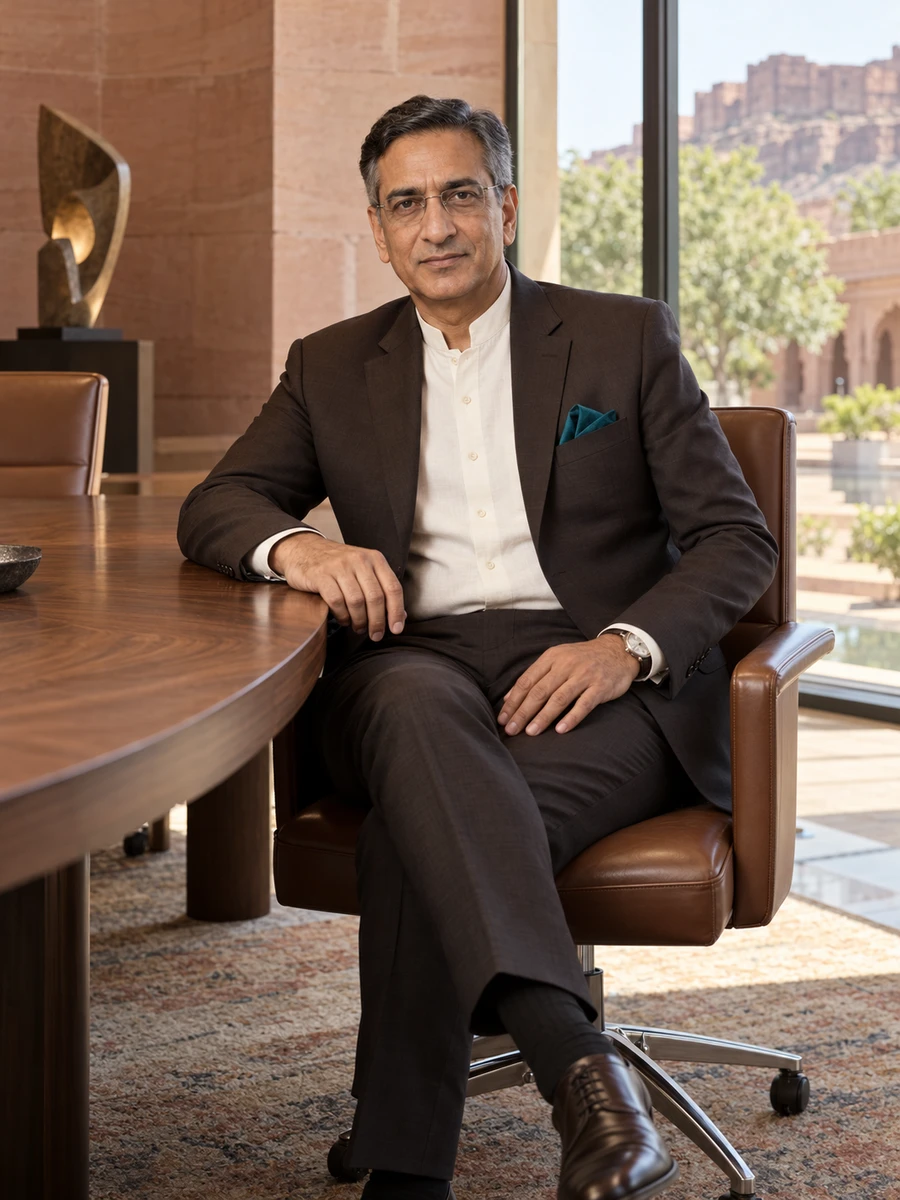
Portrait of Shahid Dezqemti

Give the board a choice it can actually make

I once put three individually persuasive programmes into a strategy paper whose combined benefits were wrong. The spreadsheet added cleanly. The problem was that two teams had counted the same operating improvement. As head of strategy, I had asked whether each case was credible without asking whether all three could be true together.

I now lead strategy at Qevzenti General Insurance in Jodhpur. My team coordinates the choices behind investment and growth proposals: the capacity they consume, the assumptions they require and the consequences of doing less. The job calls for a clear recommendation, but also a fair account of the options I am not recommending.

This fictional profile follows thirty-three years from commercial analysis to insurer planning. It includes a corrected benefits paper, a deliberately smaller change portfolio, a conditional acquisition forecast, a limited feasibility exercise and a project we recommended stopping. None is presented as a personal approval of insurance terms or a promise that a model became an achieved result.

One improvement appeared twice

Our 2018 three-programme proposal showed ₹36 crore annual prospective benefits against ₹41 crore proposed investment. Finance and operating colleagues identified ₹9 crore counted twice. The nonduplicative estimate for the complete proposal was ₹27 crore, still a model. The eventual approval covered two programmes at ₹28 crore; I do not assign the full proposal's benefits to that smaller selection.

The review calendar was part of the strategy

In 2022 eleven initiatives required 110 specialist review weeks within a nine-month window, while the relevant teams had 72 available. We recommended seven initiatives consuming 68 weeks and retained four weeks of reserve. Four deferred initiatives accounted for the other 42 weeks. This was a choice about the amount of work, not permission to shorten professional reviews.

A headline hid a condition

A 2023 premium projection moved from a ₹1,200 crore base to ₹1,500 crore, but ₹180 crore of that increase depended on an acquisition that had not closed. We separated a ₹1,320 crore base planning case from the conditional acquisition case. The arithmetic did not establish achieved growth, and pricing or mix assumptions were not described as organic volume.

Current focus

I am concentrating on the point at which a plausible programme becomes a portfolio commitment. That means making room for scarce expertise, showing the consequences of deferral and treating a stop decision as work with owners and costs. A strategy function should help people disagree precisely, rather than making disagreement disappear inside a blended forecast.

Conversations I welcome

I would consider a first outside board contribution after reviewing employer consent, my equity interest and the proposed responsibilities. Databank registration and proficiency assessment have not begun in this fictional record. Twenty-one potential annual days remain provisional, including preparation and exceptional demands.

Highlights

I learned to question what the total was allowed to mean

22

Strategy colleagues through three heads

₹6.9 crore annual functional expense; investment approval remains separate

33 years

Analysis, advisory and insurer planning

Five continuous appointments beginning July 1993

20

Employer offices across India

980 employees; ₹1,920 crore FY 2026 gross written premium, not accounting revenue

A letter from Shahid Dezqemti

Dear reader,

Portrait of Shahid Dezqemti

I want the board to see the alternatives before it sees a preferred total. A proposal should make clear which benefits overlap, whose time is required, which assumptions remain conditional and what stopping would leave behind. My role is to improve the choice; professional assessment and approval stay with their proper owners.

I grew up in Ajmer and began work with a strong preference for a tidy commercial answer. A table that reconciled gave me confidence. Experience gradually taught me that arithmetic can be correct while the decision described by it is not. The most consequential questions in my career have often concerned what was being added together, what had to happen first, or whose time a proposal was quietly assuming.

Shahid Dezqemti

Chief Strategy Officer

Strategic priorities

Where I focus my leadership.

Performance

What the priorities delivered.

Priority outcome 01

I added three credible cases into one incorrect benefits total

In 2018, as head of strategy, I supported a proposal to invest ₹41 crore across three programmes. Each sponsor had supplied a case, and the paper presented ₹36 crore in combined annual prospective benefits. I had asked the planning team to reconcile the arithmetic and challenge individual assumptions. I had not asked whether the same operating improvement appeared in more than one sponsor's account. That omission was mine. Finance head Dev Qevzemti and operating colleagues identified ₹9 crore of overlapping benefit attribution during a subsequent review. One sponsor argued that both programmes were necessary to make the improvement possible and should therefore retain the full amount in their own cases. That could describe a dependency, but it did not justify counting the same enterprise benefit twice. We needed to distinguish what each programme enabled from what the business could receive in total. I withdrew the combined benefits figure and funded a ₹38 lakh review of definitions, dependencies and alternative combinations. For all three programmes together, the nonduplicative annual estimate became ₹27 crore. It remained a prospective model; the correction did not recover cash or establish an accounting adjustment. The review also made clear that changing the selection would require a different benefits assessment. The authorised decision eventually approved two programmes with ₹28 crore proposed capital expenditure and deferred the third. I do not attach the full three-programme ₹27 crore estimate to that smaller portfolio. The accepted combination had to be evaluated on its own assumptions. Sponsors lost the simplicity of a large combined headline, and the review occupied colleagues who had expected to move straight into preparation. My lesson was not merely to check a formula more carefully. I had allowed separately reasonable arguments to stand in for an enterprise case. Since then, I ask what operating change sits beneath a benefit and which other proposal is relying on it before I recommend adding the figures together.

Priority outcome 02

Seven initiatives fitted the review window; eleven did not

Our 2022 strategy round produced eleven initiatives that sponsors wanted to begin within the same nine-month window. The relevant actuarial, underwriting and other specialist teams estimated 110 review weeks across the proposals. Their available capacity for this work was 72 weeks after continuing responsibilities. A calendar could show eleven start dates, but it could not supply the missing expertise. Several sponsors proposed that early planning could proceed while specialist questions were settled later. Others wanted the strategy office to ask for faster review. I understood the frustration: deferral would delay useful work, and a smaller portfolio would disappoint teams that had developed their cases. Yet a planning function cannot convert a necessary professional judgement into an administrative milestone simply because its own timetable is crowded. I asked the sponsors and specialist heads to examine combinations, dependencies and the consequences of postponement. The recommendation selected seven initiatives requiring 68 review weeks and retained four weeks as reserve. Four deferred initiatives accounted for the other 42 weeks of the original 110. The reserve was modest and did not mean every skill could cover every task; the schedule still had to respect who was qualified to perform particular reviews. The authorised preparation budget for the selected seven was ₹8.4 crore. That was preparation expense, not their complete programme capital requirement. I coordinated the proposal and its explanation, while the responsible bodies retained funding approval and the specialists retained their assessment standards. The four deferred sponsors received a clear account of the missing capacity and the conditions for reconsideration. The decision reduced the number of commitments we made. It did not prove that all seven initiatives would succeed or that their eventual reviews would be favourable. I would rather explain an explicit deferral than ask colleagues to discover, after approval, that the organisation had silently promised the same scarce expertise to several programmes at once.

Priority outcome 03

An unclosed acquisition supplied most of the projected increase

A 2023 planning presentation showed premium rising from a ₹1,200 crore base to a ₹1,500 crore projection. The ₹300 crore increase made a clear twenty-five-percent headline. Inside the model, however, ₹180 crore depended on a proposed acquisition that had not closed. A further ₹90 crore came from pricing and mix assumptions, while ₹30 crore represented organic expansion. The total was arithmetically consistent but hid several different decisions. The acquisition sponsor wanted one combined ambition in the main presentation, with conditions left in supporting material. The argument was that a single number would give teams a shared direction. I disagreed because readers could interpret the headline as the existing business's expected trajectory. It also encouraged discussion of the increase as if every component represented more underlying activity rather than a change in perimeter or assumptions about pricing and mix. I commissioned a ₹42 lakh planning review with finance and the relevant business owners. We rebuilt the presentation around a ₹1,320 crore base planning case, excluding the conditional ₹180 crore acquisition contribution, and showed the acquisition case separately. Relative to ₹1,200 crore, the base scenario represented ten percent, while the combined conditional scenario remained twenty-five percent. Neither percentage was a report of achieved premium growth. The ₹90 crore pricing and mix component retained its specialist assumptions and ownership. My role did not include setting insurance prices, approving underwriting choices or turning those assumptions into accounting revenue. The revised paper made the questions visible: what needed to happen for the acquisition contribution to belong, what supported the other assumptions, and what the business would plan if the transaction did not proceed. We gave up a simpler headline. In return, the board could discuss an acquisition-dependent future without mistaking it for the base case. A strategy should preserve the condition that makes a number possible, especially when removing that condition changes the decision materially.

Priority outcome 04

A telematics idea received a feasibility budget, not a rollout mandate

In 2024 a proposed telematics adjacency came to the strategy forum with an ₹18 crore full-programme request. Its sponsors described a future service in which vehicle information could support better-informed insurance activity. The proposition was interesting, but its broad description was ahead of the evidence about what the proposed system could produce under the intended conditions. I recommended a narrower decision: ₹2.4 crore for feasibility work, with defined questions and a later return to the approval forum. The commercial sponsor worried that reducing the request would make the organisation look hesitant and lose time. My concern was that full-programme approval could turn an unresolved information problem into a delivery obligation. A funded experiment was a commitment to learn something specific, not a disguised promise to proceed regardless of the result. The exercise used sixty consented test vehicles. Forty-two produced information adequate for the defined feasibility assessment; eighteen did not under those conditions. The result mattered because it exposed a material part of the exercise that the proposed account could not yet explain. It did not establish how a representative insurance market would behave, nor did consent for the test establish unrestricted rights to every later use of the data. The responsible technical, information-handling and insurance specialists retained their own assessments. No live premium, coverage term or claims decision was altered through this exercise. The case ended without full rollout approval. The ₹2.4 crore was feasibility expenditure, not a fraction of a programme already committed to completion. I wanted the decision record to remain legible at that point: forty-two usable cases were evidence within a defined test, eighteen were unresolved for its purpose, and the larger business proposition still needed work. Keeping those limits visible was more valuable than presenting the experiment as a successful launch or assuming that an attractive technology story had already earned the right to scale.

Priority outcome 05

We stopped the platform and funded the work required to close it

By 2025 a broker-service platform project had used ₹7.2 crore of an original ₹12 crore approval. Updated estimates showed that completion would require another ₹6.8 crore, taking the expected total to ₹14 crore. Meanwhile, a redesign of the operating model had reduced the benefit expected from the platform in its planned form. The question was no longer simply whether the team could finish the original specification. The project sponsor argued that stopping would waste the amount already spent and weaken confidence in future initiatives. I shared the concern about colleagues' work and the disruption of changing direction. But continuing would not recover the ₹7.2 crore merely by adding a completed system. We needed to compare what the additional expenditure would produce now, against the alternative uses of resources and the obligations a stop decision would create. Finance and operational owners developed a closure route requiring ₹1.1 crore. It covered defined closeout work rather than abandonment, while existing broker service would continue through separate arrangements. The resulting expected total for the stopped project was ₹8.3 crore: expenditure already incurred plus the proposed closeout. That was not a recovery of the ₹7.2 crore, and I did not describe the entire ₹6.8 crore completion estimate as cash saved. I recommended stopping the platform in its then-current form. The authorised decision accepted the loss of the original delivery ambition and funded responsible closure. It did not terminate insurance policies or remove the insurer's continuing service responsibilities. Owners were assigned to the unfinished technical and operational tasks so that the decision to stop did not leave a project team carrying an indefinite obligation. The difficult part was admitting that a previously supported programme no longer deserved the same recommendation. I want a strategy function to be capable of that admission. A project history belongs in the account, but the next decision should still explain the value, cost and obligations of the choices that remain.

Stakeholder voices

What those I have served alongside say.

Shahid made the acquisition condition visible in the main planning account. That allowed us to discuss the base business and the proposed transaction as related choices without pretending they were the same future.
Tara ZeqemviCEO, Qevzenti General Insurance; fictional colleague
I worked with Shahid on the overlapping-benefits review. He retained responsibility for the earlier paper and did not turn a corrected estimate into a claim of cash recovered.
Dev QevzemtiFinance head, Qevzenti General Insurance; fictional colleague

Outlook

Perspectives on what comes next.

An invitation

Contact

I would consider a first outside board contribution after reviewing employer consent, my equity interest and the proposed responsibilities. Databank registration and proficiency assessment have not begun in this fictional record. Twenty-one potential annual days remain provisional, including preparation and exceptional demands.

Open to
  • Board appointments
  • Advisory roles
  • Speaking invitations

office@shahiddezqemti.example