Chief Product Officer India
Learning what each side thought it had agreed
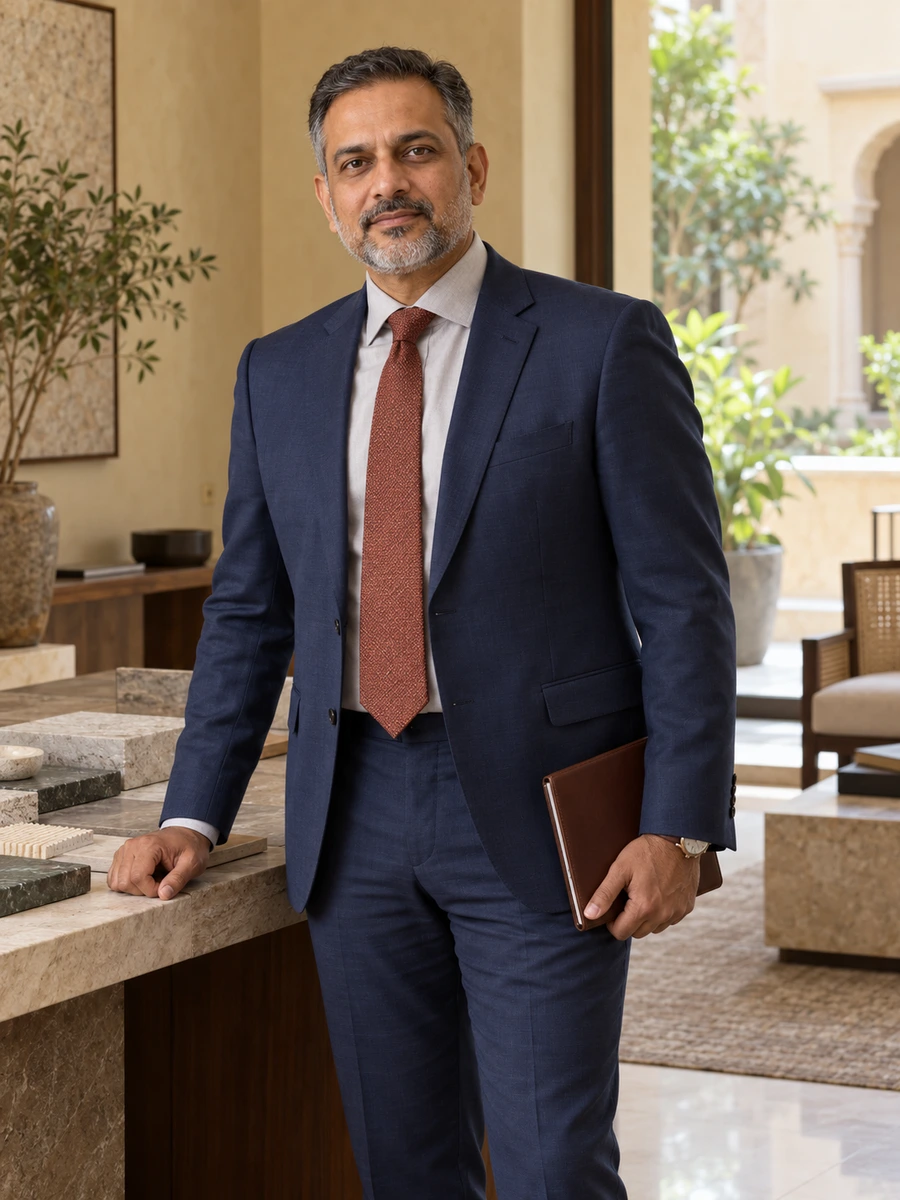
The seller wanted one collection to clear the lot. Our product had been built around that understandable preference, and I had supported it. Then Danish Vezqethi showed me forty buyer proposals: twenty-six sought only part of the available lot, while fourteen sought the whole. A project buyer was not necessarily looking for the largest discount on the largest quantity. They needed material that fitted a defined undertaking, with somewhere to put it and a clear account of what they would still have to decide. Whole-lot simplicity had made one side's task easier by moving the remainder onto the other side.
I grew up in a Muslim family in Bharuch and completed commerce at the fictional Zevqathi Commerce College in June 1997. In July I joined Nerqoli Trade Services as a catalogue coordinator. The business had 63 employees and ₹12.8 crore revenue for FY ending March 1998. I worked in a six-person catalogue group without reports or spending authority. The work concerned descriptions, quantities and the questions that arrived when a buyer interpreted an entry differently from its seller. I learned that a complete set of fields could still leave the practical offer unclear.
In April 2003 I became trade-service lead. Nerqoli had 163 employees and ₹31 crore revenue for FY ending March 2004. Eight colleagues worked through two leads within ₹54 lakh annual expense. My responsibility widened from the record to the exchange around it. A seller could say an item was available while still discussing it elsewhere. A buyer could express interest without having approval for the specification. We needed an account of what each action meant, not simply a faster way to pass messages between people whose assumptions differed.
I joined Veqmari in September 2009 as product manager. It was a regional marketplace with 92 employees and ₹16 crore service revenue for FY ending March 2010. Eleven product colleagues worked through two leads within ₹1.2 crore annual expense. The company focused on unused surplus tiles and selected interior finishes. I wanted to turn recurring service misunderstandings into product decisions that made the next transaction easier to understand. That required listening to seller operations and buyers' project needs, while leaving material suitability, contracts and financial treatment with the people responsible for them.
The head-of-product role began in July 2015. Veqmari employed 156 people and reported ₹31 crore service revenue for FY ending March 2016. Twenty-two colleagues worked through three leads within ₹3.8 crore annual expense. The marketplace was becoming easier to browse, but browsing was only the beginning of the customer's commitment. I became concerned with actions whose labels made them appear more final than they were: saving a lot, asking for a hold or selecting something that looked similar to the material already specified. The product needed to represent those distinctions without making every user understand our internal operating process.
I became CPO in April 2021. Today 34 colleagues work through four leads within ₹7.2 crore FY 2026–27 expense and a separate ₹1.6 crore discovery programme. The company has 210 employees, ₹48 crore FY 26 service revenue and ₹290 crore completed merchandise value. Those last two measures are deliberately separate. Lalitha Qemzavi owns enterprise commitments; Danish leads product research. Our engineering, seller-operation, quality, legal and finance colleagues retain their responsibilities. I do not approve a material for a construction project because it appears in our catalogue.
The whole-lot review led to a bounded ₹58 lakh programme. Eight participating lots contained 2,400 square metres, of which 1,640 had sold at the review date and 760 remained listed. The remainder stayed in the account, rather than disappear behind a successful partial transaction. A later ₹31 lakh redesign separated saving from requesting a seller-confirmed hold after task research revealed a serious difference in expectations. We did not turn the number of requests into completed sales or treat pending decisions as failed purchases.
Batch identity brought another product question. A 420-carton account contained 260 from one batch and 160 from another. The product had to preserve those distinctions and help buyers seek the evidence appropriate to their project. A ₹42 lakh catalogue and sample-review programme did not certify visual matching or technical suitability. In 2025 we also spent ₹49 lakh changing the proposed treatment of alternative materials: similarity could initiate review, but it could not authorise substitution. A more convenient order flow was not worth making an approval the product team was not entitled to give.
I speak Gujarati, Hindi and English. Founders own 49% of Veqmari, an employee vehicle 19% and a regional fund 32%; I hold no personal shares and no statutory seat. In this fictional record, IICA registration occurred in May 2026, with assessment preparation still unfinished and no exemption claimed. Twenty-four days is provisional. I would bring a board attention to the commitments hidden inside an apparently small product action, with the willingness to examine my own preference for a simple whole-lot proposition. A marketplace works when the agreement is understood, not merely when the next button is easy to press.
Open to Board appointments
Languages / Gujarati · Hindi · English
A leadership conviction
A match is useful only when both parties understand what they are being asked to commit.
- Product leadership through four leads
- 34 staff
- ₹7.2 crore FY 27 expense; separate ₹1.6 crore discovery
- Trade services and marketplace products
- 29 years
- Career from July 1997; CPO from April 2021
- Provisional first-board allowance
- 24 days
- Consent, preparation and relationships remain to examine
Education & credentials
- Bachelor of Commerce
- Zevqathi Commerce College · 1997
Perspectives from colleagues
Rafiq made the remaining stock part of the partial-lot proposition instead of treating the first sale as the end of the product's responsibility.
He asks what a buyer believes an action has committed, not only whether the buyer can complete the screen. That question changed our saved-lot design.