Chief Product Officer Europe
From the return temperature to the tenant's screen
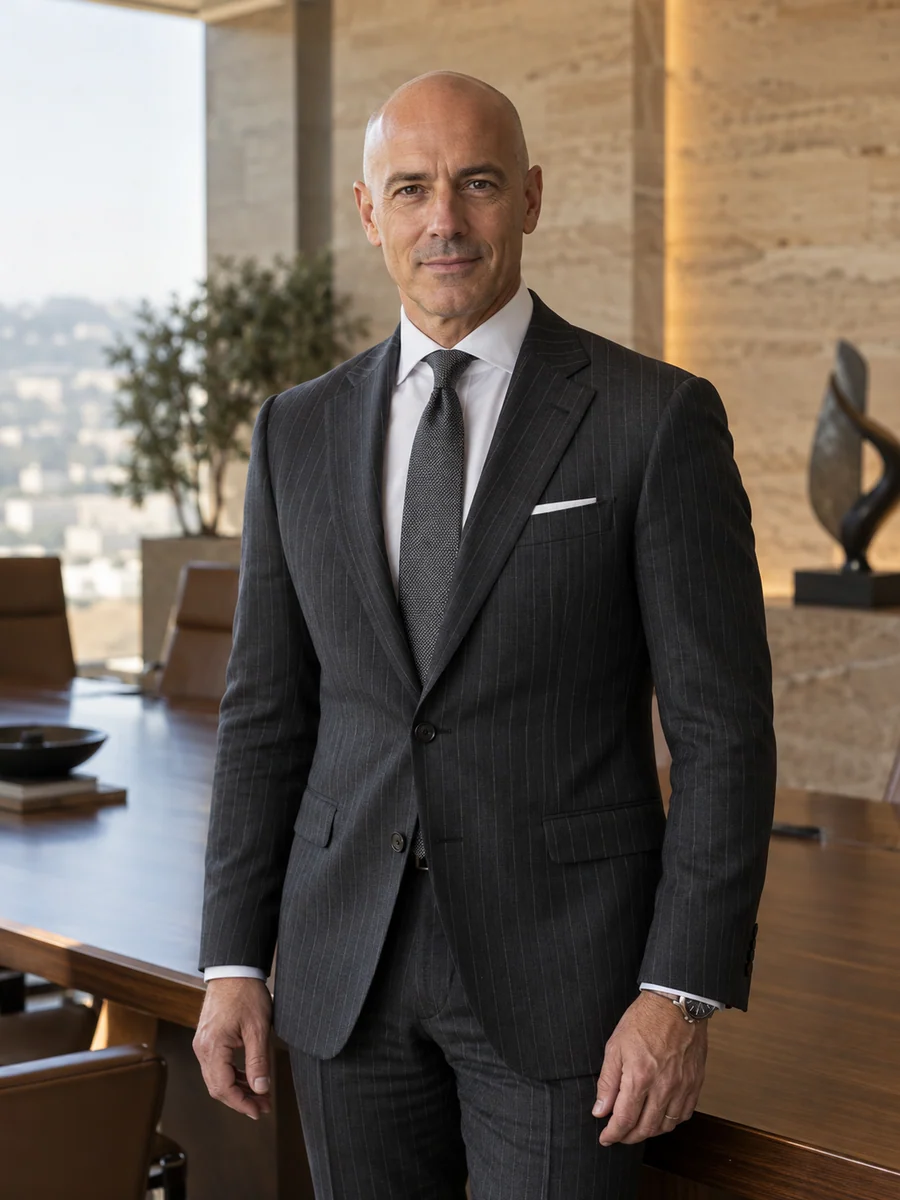
My father installed central heating in Namur, and on Saturdays in the late 1980s I carried his toolbox into the boiler rooms of schools and parish halls. He had a rule I still repeat: a heating system tells you the truth through its return temperature, not through its thermostat. Thirty-five years later I lead product at a software company, and the rule has hardly changed. Our platform is worth paying for only if it reports what a building is actually doing rather than what it was designed to do.
I studied electromechanical engineering at the Verdonck Institute of Engineering in Brussels, graduating in 2003, and joined Studiebureau Kalvenaar, a Brussels consultancy of about sixty engineers that designed heating, ventilation and cooling for offices, schools and clinics. I drew duct runs, sized boilers and carried out energy audits. The audits were the instructive part. Again and again, a building we had designed to one consumption used half as much again, and the reasons were rarely in the equipment. They were in schedules nobody had set, valves left in manual and controllers whose logic did not match the drawings.
In 2007 I moved to Moerhoven Technieken, an Antwerp building-services contractor, to find out why. As a controls commissioning engineer, and from 2009 as project manager for building automation, I spent four years handing over buildings: two hospital wings, a harbour office and a dozen speculative office blocks. I learnt that commissioning ends on a date in the contract, not when the building works, and that the people who will live with a system are rarely in the room when it is accepted. On one hospital ward the patients could not change their own room temperature, and the night staff had taped cardboard over a supply diffuser. That piece of cardboard taught me more about user research than any course since.
By 2011 I was convinced that the faults I kept commissioning were software faults, and I joined Grevenmoor Regeltechnik in Aachen, a family-owned maker of building controllers and supervisory software that sold through system integrators across Germany and the Benelux. I lived in Eupen, in the German-speaking east of Belgium, and drove across the border each morning. I started as product manager for the supervisory software and became head of product management for building automation software in 2014. Grevenmoor showed me how equipment really reaches a building: through an integrator who has two days to configure it, a consultant who wrote the specification and an owner who never sees the screen. It also showed me how a hardware company thinks about software, as something that sells controllers rather than something people use. I completed a part-time executive master's degree in management at the Aldegonde School of Management in Liège in 2015.
In 2017 I crossed to the occupant's side, as director of member product at Hallenbrook Workspaces in Amsterdam, a flexible-office operator with 38 locations and 21,000 members. For the first time I was responsible for what people experienced every day: getting through the door, booking a room, reporting a broken blind. In 2018 we replaced key cards with an app-only entry system, and I supported the change. Within months it was clear we had shut out people with older phones, people with visual impairments and visitors with no app at all. Reversing it in 2019, against an executive team that liked the app-first story, was the most useful mistake of my career. The pandemic then emptied our buildings for months, and I rebuilt the member product around day passes and part-time team plans.
I joined Lindevaart in September 2021 as its first chief product officer. The company sold a capable analytics product to landlords' sustainability teams, priced per data point and installed with our own gateway. Since then we have changed all three of those things. We show measured consumption beside the calculated energy label rather than predicting labels. We price by floor area, so that landlords are never charged more for measuring more. We connect buildings through the open protocols their controllers already speak, and a customer can take its building model and history with it when it leaves. Revenue has grown from €24 million in 2021 to €61.4 million in 2025, although I would not claim that product decisions alone explain it.
I lead 52 people in product management, design, user research, data analysis and documentation, and I plan the roadmap jointly with our chief technology officer, whose 190 engineers build it. I ask product managers to spend one day a month in a customer's building, preferably in the plant room or at a tenant's reception desk rather than in the asset manager's office. I ask designers to test every tenant-facing screen with a screen reader before it ships. And I ask everyone to state, in each proposal, who pays for a feature and who has to use it, because in our market they are seldom the same person.
Inside the industry I am probably known for three positions: that an energy label is a forecast and a meter is a record, that tenants' consumption should be shared by their consent rather than by a lease clause, and that a vendor should make it easy for a customer to leave. I serve unpaid on the board of the Haverwijk Foundation for Accessible Buildings in Rotterdam, and I am preparing to take one non-executive seat where those habits might be useful from the other side of the table.
Open to Board appointments · Speaking invitations
Languages / French · Dutch · German · English
A leadership conviction
A building is measured honestly when the meter, the energy label and the occupant's complaint are allowed to disagree on the same screen, and someone is responsible for finding out why.
- Annual recurring revenue, June 2026
- €68m
- Lindevaart Systems, across the Netherlands, Belgium and Germany
- Buildings connected to the platform
- 5,200
- 31 million square metres of lettable area for about 260 landlords
- Median time from contract to first data
- 6 days
- Down from 19 days after we stopped selling gateway hardware
Board & advisory record
Current appointments
Haverwijk Foundation for Accessible Buildings
Board member, unpaid and non-executive
2020–present
Education & credentials
- Master of Science in Electromechanical Engineering
- Verdonck Institute of Engineering · 2003
- Executive Master in Management, part-time
- Aldegonde School of Management · 2015
Perspectives from colleagues
Tomas asked this board to attach a condition to his own proposal, a quarterly churn report on the gateway decision, before any of us thought to. He brings decisions that cost revenue with the cost already counted, and he reports back when the numbers move against him.
We asked Lindevaart for a label estimator in 2022 and Tomas told us no, with a test showing why. I was annoyed for a month. Then the adviser export spared us site visits on ninety buildings, and the measured view showed us which ones to renovate first.
When our entry system was failing members, Tomas was the one who said in the executive meeting that he had supported it and been wrong. Then he sat at reception with my team for a week before he proposed anything.