The person behind the perspective
I had seen access and assumed the task would fit
I grew up in Madurai and studied mechanical engineering because I wanted to understand how a drawing becomes something another person can build and use. I completed the degree at the fictional Zeqvarthi College of Mechanical Engineering in May 1994 and began work the following month. Over thirty-two years, my concern has widened from the behaviour of a component to the conditions a complete design creates for installation, service and later change. The first performance result is important. It is not the whole account of an equipment proposition.
My first employer was Qerqavthi Thermal Works, an invented engineering enterprise with eighty-eight employees and ₹12 crore FY 1995 revenue. I worked as a design engineer under an experienced product lead, without staff or expenditure authority. The work taught me to make an assumption visible enough that a colleague could challenge it before it became a manufacturing detail. A dimension could be correct for the component and still say little about the space a technician would need around it. I learned that question early, but my later record shows that familiarity with a principle does not prevent a senior person from overlooking it.
In March 2001 I became a product-engineering manager, leading twelve colleagues with ₹2.1 crore annual function expenditure. The wider employer had 190 people and ₹48 crore FY 2002 revenue. I began to see how choices made for one stage of a product could move work into another. A factory-friendly assembly might require more attention at the customer's site. A service instruction might assume access that a compact layout had removed. The engineering team needed a better conversation with the people who would inherit the design, not merely a more detailed record of the choices it had already made.
I joined Jezqavthi in September 2008 as head of design. The company then employed 126 people and recorded ₹37 crore FY 2009 revenue. Twenty-two colleagues worked within my ₹4.3 crore annual design-function envelope. The move placed me in a business focused on industrial heat recovery, where equipment must suit the customer's process and physical setting. I carried responsibility for the design account, while qualified specialists and site owners retained their respective assessment and operating roles. The present company scale is not assigned backwards to that earlier appointment.
In January 2015 I became director of product engineering. It was a functional title without a statutory board seat. My team grew to thirty-four colleagues and the annual function envelope to ₹7.8 crore. The employer had 238 employees and ₹112 crore FY 2016 revenue. Commercial demand for compact layouts was understandable: customers did not have unlimited floor space. I supported that objective, but in 2018 I gave insufficient weight to Hema's question about removing a service cassette. Being able to reach a part was not the same as being able to withdraw it through the surrounding installation.
The review covered eighteen delivered units. Eleven had adequate removal provision and seven did not. We retained ₹1.2 crore of review, redesign and adjustment expenditure, with the affected layouts examined by qualified engineering and site owners. Five of the seven later had approved revised layouts; two remained pending. I did not present the approvals as evidence that physical work had been completed or that every maintenance constraint had disappeared. I owned the earlier decision because the compact footprint had partly been purchased by omitting a future task from the account. The correction cost money and required a less convenient discussion with customers.
I became CTO in July 2020 and now report to CEO Feroz Vezqarni. Forty-six engineering employees work through four leads, with six external specialists counted separately. My ₹11.4 crore annual operating envelope is distinct from the ₹4.6 crore approved laboratory and qualification capital programme. The enterprise's ₹186 crore FY 2026 revenue comprises ₹132 crore equipment and ₹54 crore service work. I hold 0.15% of total equity through the employee vehicle and no statutory appointment. Our business supplies equipment; a technical recommendation does not give me authority to operate a customer's plant or certify its working arrangements.
Later cases extend the account beyond maintenance access. A bounded recovery programme asked which used non-pressure cassettes could be responsibly remanufactured. An acoustic investigation questioned whether a fan result described the assembled product. A co-development review separated design files available to the team from rights to use them in another application. A transport decision examined the consequences of shipping a complete factory assembly into a constrained site. These questions need different specialist evidence. Their common feature is that a convenient completion statement can leave the next person's work unexamined.
I work in English, Tamil and Hindi. I registered with the IICA databank in February 2026, but have not completed the proficiency assessment and do not claim exemption. I have provisionally considered twenty-two days annually for a first outside contribution, including preparation and exceptional demands. Current employment, equity and relevant relationships would need review for any actual opportunity. My possible contribution is to help a board understand the lifecycle consequences of an engineering proposition. I would first need to learn the prospective company's work, rather than assume that the lessons of a heat-recovery equipment maker apply unchanged to every energy enterprise.
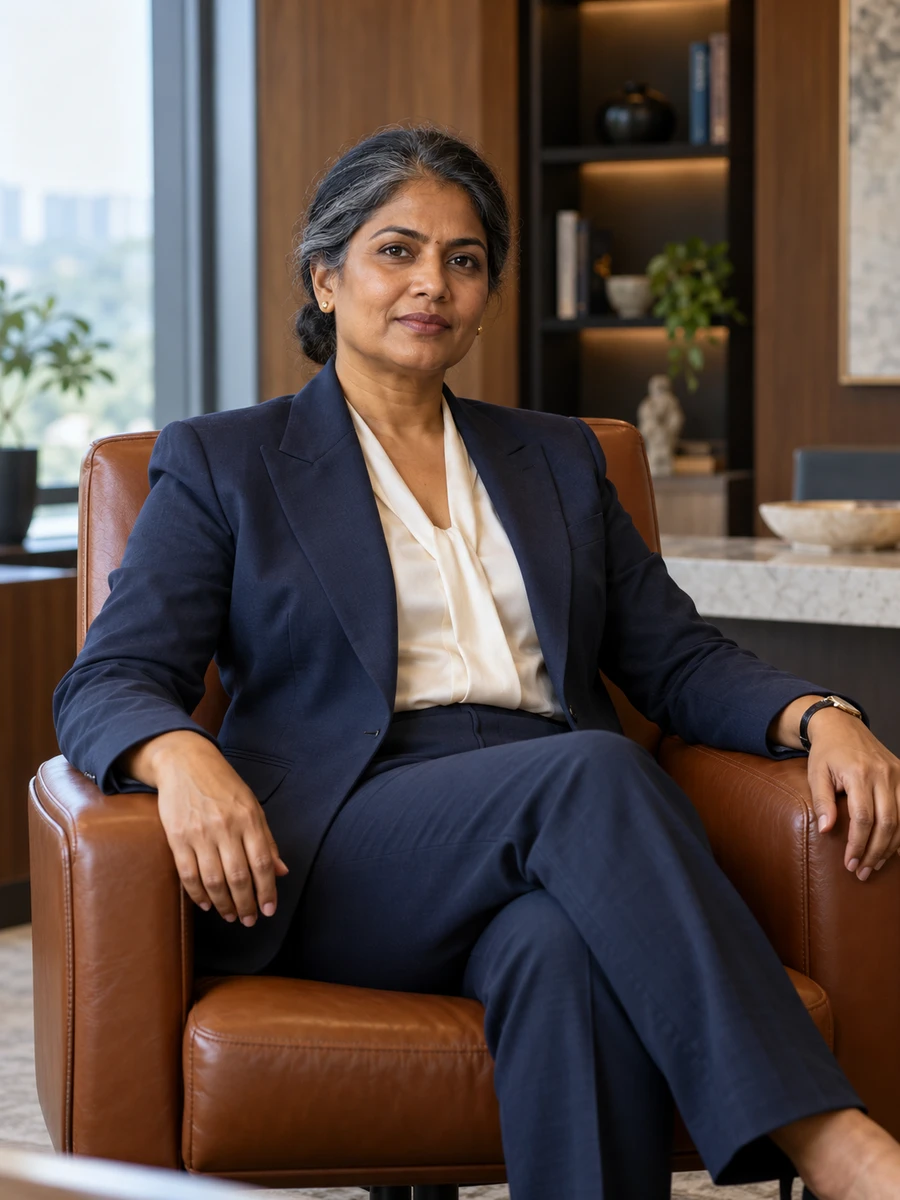
In my own words
I want the design review to include the next person who has to work with the equipment. An assembly that performs today can still leave a costly problem in its maintenance access, repair route, documentation or future use. Those conditions belong in the technical proposition before they become somebody else's operating burden.
Chitra Raqveshi
Education
Formation
- Bachelor of Engineering in Mechanical EngineeringZeqvarthi College of Mechanical Engineering1994
Working languagesEnglish · Tamil · Hindi