The person behind the perspective
The engineer behind the conditional production promise
I grew up in Kottayam and am now based in Puducherry. Electronics appealed to me because an explanation eventually had to meet a physical system. I completed my degree at the fictional Qelvazti Institute of Electronic Engineering in May 2000 and began work that July. My early role did not involve directing a studio or choosing its creative work. It involved supervised technical preparation, disciplined observations and learning when a configuration that looked familiar was actually different. Those habits later became important in virtual production, where the camera, scene and stage can each appear reasonable in isolation while their relationship produces an unusable result.
My first employer was Tevqamri Stage Systems. It had twenty-four employees and ₹7 crore FY2001 revenue. As a junior stage-systems engineer I reported to the engineering supervisor, with no direct reports or delegated expenditure. I helped prepare and document configurations under supervision. The work taught me to identify the precise arrangement being discussed rather than use a product name as shorthand for its behaviour. I was not approving structural, electrical or production safety. Those responsibilities remained with qualified people and the appropriate authorities. My contribution was narrower: reliable technical observations that another engineer could use without reconstructing what I had meant.
In June 2005 I became a visual-systems engineer. Tevqamri then had sixty-six colleagues and ₹22 crore FY2006 revenue. I led six people within ₹78 lakh annual expense, reporting to the technical manager. The relationship between an image and the setting in which it would be seen became more demanding. A demonstration could be useful without representing every condition of a production. I learned to describe the conditions that made a result meaningful, including what had not been tested. The lesson was practical rather than a claim that every project could be reduced to a single checklist or that an engineer should replace the creative judgement of the production team.
I joined Zevqatri in September 2011 as simulation engineering manager. Its eighty-two employees and ₹29 crore FY2012 revenue supported a regional service business. Twelve engineering colleagues and ₹2.4 crore annual operating expense were within my remit, under the technology director. Digital scenes increasingly became working material for physical planning. Dimensions, camera assumptions and the intended use of an asset mattered alongside its appearance. I developed a more direct working relationship with creative colleagues, who needed dependable technical constraints without having their choices made for them. The manager's task was to explain the constraint early enough that it could still influence an affordable design decision.
The engineering-director appointment began in January 2016. At FY2019 scale Zevqatri employed 129 people and recorded ₹67 crore revenue. I led twenty-nine colleagues with ₹7.2 crore annual operating expense, reporting to the COO. During that period I approved the scene-import process that let five of twenty-four reviewed objects carry wrong dimensions. Four were corrected and one replaced through ₹29 lakh of verification and rework. There was no claimed accident or damaged set. The error was still material because a visually plausible preview could mislead a later planning decision. I had accepted an import assumption that needed an explicit dimensional check, and the record should retain my part in that decision.
Since April 2021 I have served as CTO, reporting to Arun Tevqazmi. The current enterprise has 158 employees and ₹91 crore FY2026 revenue, split between ₹57 crore stage services and ₹34 crore previsualisation. My forty-four colleagues work through five leads; the FY2026–27 remit includes ₹12.6 crore operating expense and a separate ₹8.3 crore capital envelope. Founders hold 49%, an employee vehicle 11% and a creative-enterprise fund 40%, with no personal holding for me. Meera Qevzolmi leads creative interpretation. I retain responsibility for technology capability and investment, while production acceptance and professional safety decisions remain with their proper owners.
The recent cases have made my judgement more conditional and more useful. A camera move, LED-background pattern, tracking obstruction or complex scene cannot be answered simply by saying the stage is ready. Each has a mechanism, a cost and an alternative. I have presented these choices to directors but have never held a statutory seat. My databank registration has not yet begun, and outside availability remains provisional. A future governance role would require its own preparation, relationship review and time assessment. What I can bring is an executive record of making technical promises answerable to the conditions under which another team will rely on them.
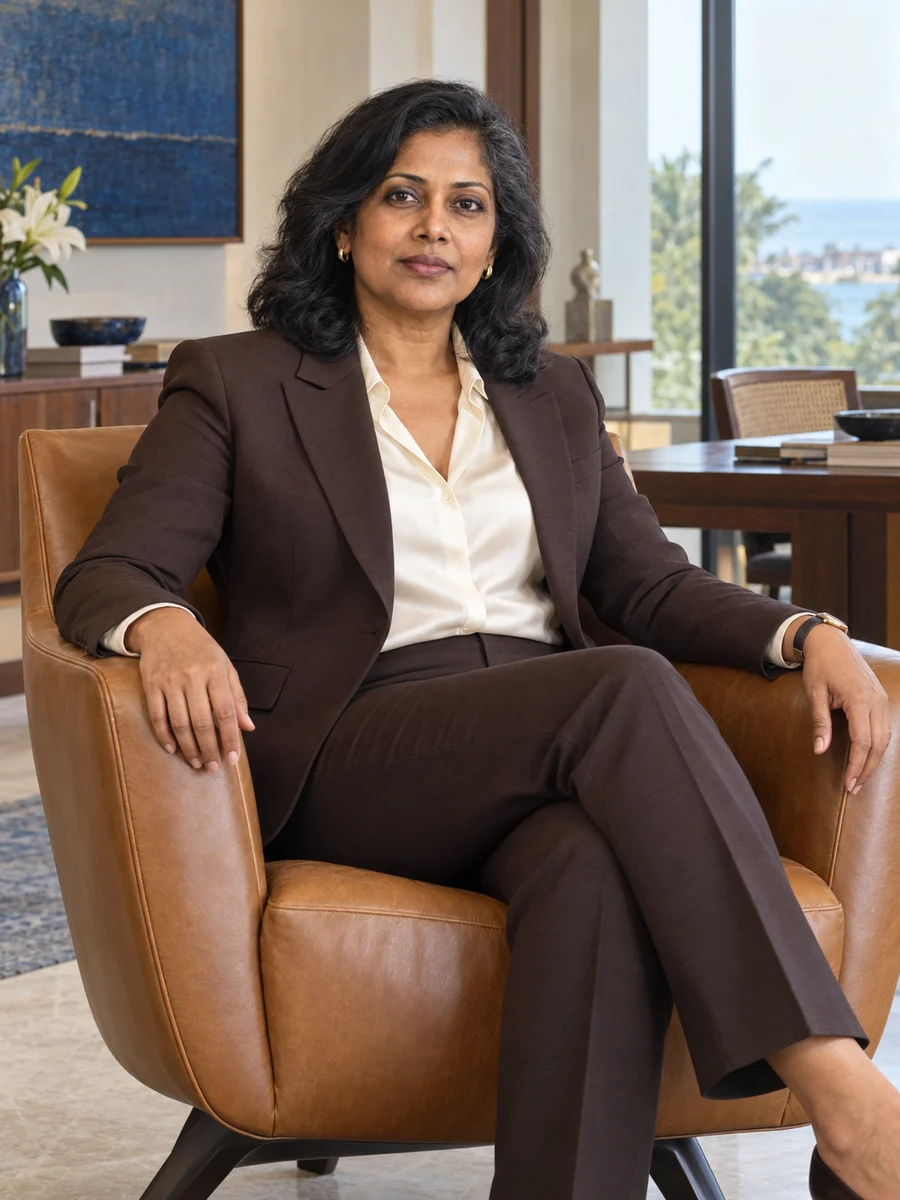
In my own words
A virtual stage joins an imagined scene to a physical camera and the people working around it. I want the engineering account to say where that relationship has been tested and where a different approach is needed. A beautiful still image is not permission to promise every camera move, lens choice or set change. My own dimensional mistake taught me to make the limits of a preview visible before another team builds its plan around them.
Miriam Qelvamri
Education
Formation
- Bachelor of Engineering in ElectronicsQelvazti Institute of Electronic Engineering2000
Working languagesEnglish · Malayalam · Tamil