Chief Executive Officer Japan
Thirty-seven years inside one chemical company
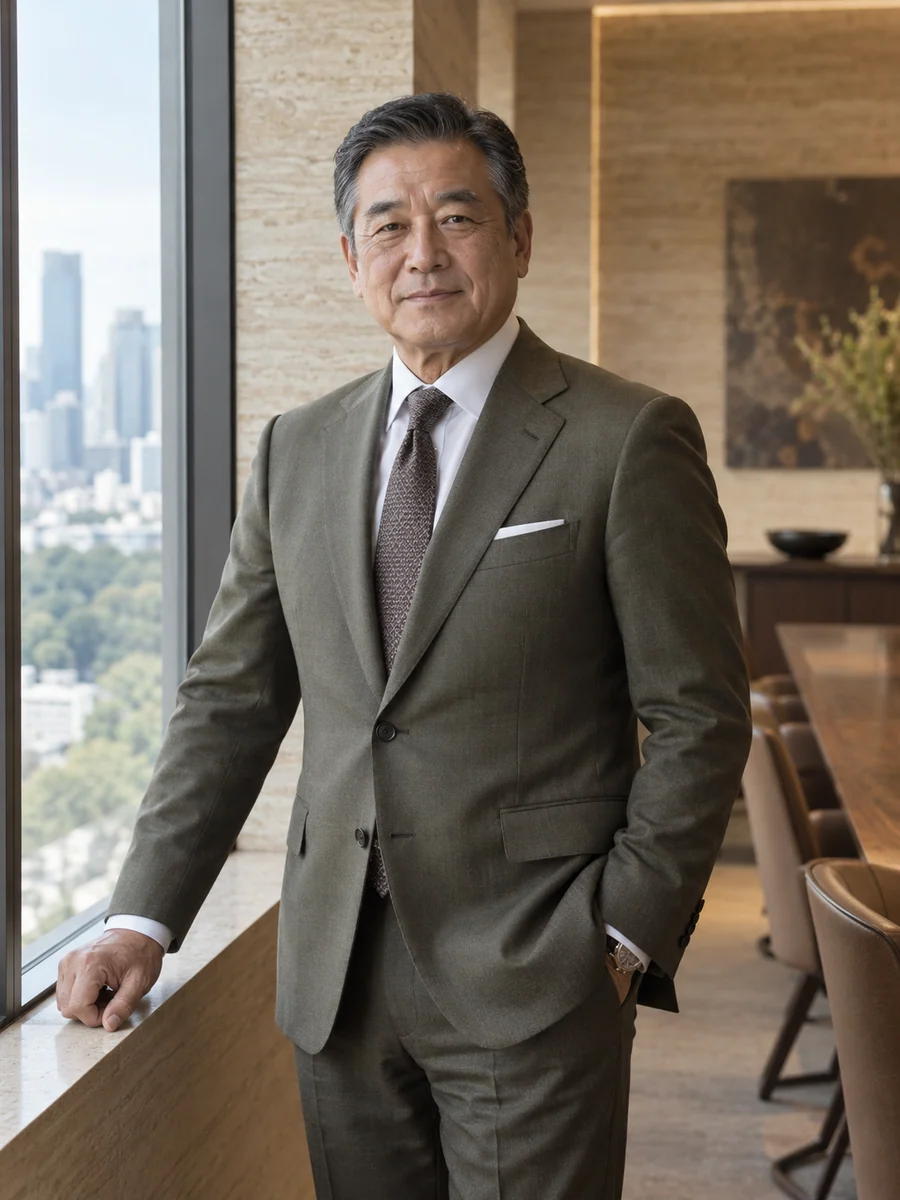
My grandfather worked the electrolysis cells at Hatsuseki's Toyama works before the war, and my father spent thirty-one years there as a maintenance fitter. I did not intend to follow them. I studied applied chemistry at Kumotori University because I liked the patience of laboratory work, and I took a master's degree in inorganic process chemistry in 1989 expecting to join a public research institute. My supervising professor changed my mind. He told me that the most interesting impurity problems in Japan were being solved in plants rather than universities, and he sent me to interview at the company my family had served for two generations. I joined in April 1989 as a process engineer in the electrolysis section at Toyama.
For six years I worked on the cells, the brine purification and the power bill, which in a chlor-alkali plant is most of the cost. In 1995 I moved to a team of five trying to purify our hydrochloric acid to the levels semiconductor makers were beginning to ask for. We measured metallic impurities first in parts per billion and then in parts per trillion. That work taught me the lesson I still apply as president: a specification is a promise about what your process can do on its worst day, not on the day you ran the qualification batches. When our customers tightened a limit, the honest answer was sometimes that we could not yet meet it. Saying so cost us orders, and it also kept us trusted.
In 2003 I went to Yonezawa as deputy manager of the high-purity chemicals plant that had grown out of that acid project, and I became plant manager in 2006. The plant employed 290 people. Most of what I learnt there was about customers' auditors, who arrived with questions about sampling, filtration and containers that our own managers had stopped asking. We built an analytical laboratory that could detect what the customers' laboratories could detect, and we stopped arguing with their results. After the March 2011 earthquake, when power to the region was interrupted, the plant's managers restarted production without me on the telephone, which told me more about the team than any audit had.
The company brought me to Tokyo in July 2010 to run corporate planning. I had never read a securities report closely. My formal assignment was the mid-term plan. My informal one, which nobody gave me, was to list every listed company whose shares we held and to ask why. There were 46 such holdings, mainly customers, suppliers and banks, together worth about a fifth of our net assets. In 2014 I proposed selling thirty of them. The president of the day agreed to six. I learnt patience, and I also learnt what patience costs a company whose shares trade below book value.
From 2015 to 2019 I was president of our Taiwanese subsidiary in Tainan, a plant of 420 people twenty minutes from some of the most demanding fabs in the world. Our customers' quality engineers expected data in hours, not weeks, and they treated a late answer as a wrong one. I learnt working Mandarin, appointed the subsidiary's first Taiwanese plant manager and handed him a plant that had doubled its capacity for the most advanced grades. Taiwan also taught me how a Japanese parent looks from outside: slow to decide, and careful in ways customers did not always value.
I returned in 2019 to lead the Electronic Materials business and joined the board in June 2020. In 2022 the nomination advisory committee proposed me as president. I was the third consecutive president promoted from inside, and the first since the 1970s who had not come through head-office sales. I inherited a company with a price-to-book ratio of about 0.6, return on equity of 4.4 per cent and 41 cross-held stakes.
Four decisions have defined my tenure so far. In November 2022 we disclosed that inspection certificates for two resin grades at our Ichihara plant had been altered for eight years, and we did so before our investigation was complete. From 2023 we sold most of our cross-held shares, including stakes held in companies that held ours. In June 2025 we faced shareholder proposals from an activist fund and accepted part of its argument while rejecting its remedy. In October 2025 we completed the sale of control of the Toyama chlor-alkali business, the founding business in which my grandfather and father had worked.
I lead through a small number of habits. Each month I chair a capability review in which every plant reports what its processes can reliably achieve against what we have promised customers. I visit each Japanese plant twice a year and each overseas plant at least once. Every quarter I write a letter to all employees in Japanese, English, Mandarin, Korean and Thai, and I answer the replies. Before each board meeting I send the directors a single page describing the matter on which I am least confident. Our outside directors have told me that page is the most useful thing I give them.
Inside the industry I am probably known for two opinions: that a chemical company's capital belongs only in plants that earn more than it costs, and that a falsified certificate is usually the last step of a commercial promise the plant could never keep. I intend to hand over to a successor in June 2028 and to leave the board when I do.
Open to Board appointments · Speaking invitations
Languages / Japanese · English · Mandarin (working)
A leadership conviction
A specification is a promise about what a process can do on its worst day. A balance sheet is a promise about what our capital will earn in its worst plant. I try to keep both promises small enough to be true.
- Net sales, year to March 2026
- ¥271.4 bn
- Electronic Materials 53 per cent, Functional Resins 36 per cent, six months of Basic Chemicals 11 per cent
- Return on equity, year to March 2026
- 8.6%
- Up from 4.4 per cent in the year to March 2022
- Price-to-book ratio, end of June 2026
- 1.07x
- From 0.61x at the end of March 2023
- Cross-held listed stakes
- 41 → 8
- April 2022 to March 2026; ¥49.3 billion realised
Board & advisory record
Current appointments
Hatsuseki Chemical Co., Ltd.
Representative Director, President and CEO
Nomination advisory committee (internal member)
2020–present
Jinzu Electrochemical Co., Ltd.
Non-executive director nominated by the 34 per cent shareholder
2025–present
Education & credentials
- Bachelor of Engineering, applied chemistry
- Kumotori University · 1987
- Master of Engineering, inorganic process chemistry
- Kumotori University · 1989
Perspectives from colleagues
Hiroshi asked the nomination committee to meet his possible successors without him, and then he actually stayed away. In my experience of Japanese boards that is rarer than it should be. He gives us his view of each candidate, including the ones who argue with him, and leaves the decision where it belongs.
When the resin problem was found, Hatsuseki's president called us before the announcement and told us what he knew and what he did not yet know. Our own testing found no failures, but what mattered to my team was the call. In Tainan, years earlier, he had taught his plant to answer us within a day.
We opposed the sale of the Toyama works, and we told him so in eleven meetings. He did not pretend to agree with us. He put three years of protected terms in writing, refused a higher bidder who would not, and kept the company's name on the gate. Our members noticed all three.