Chief Executive Officer Singapore / Southeast Asia
From a batch record in Penang to a family company's boardroom
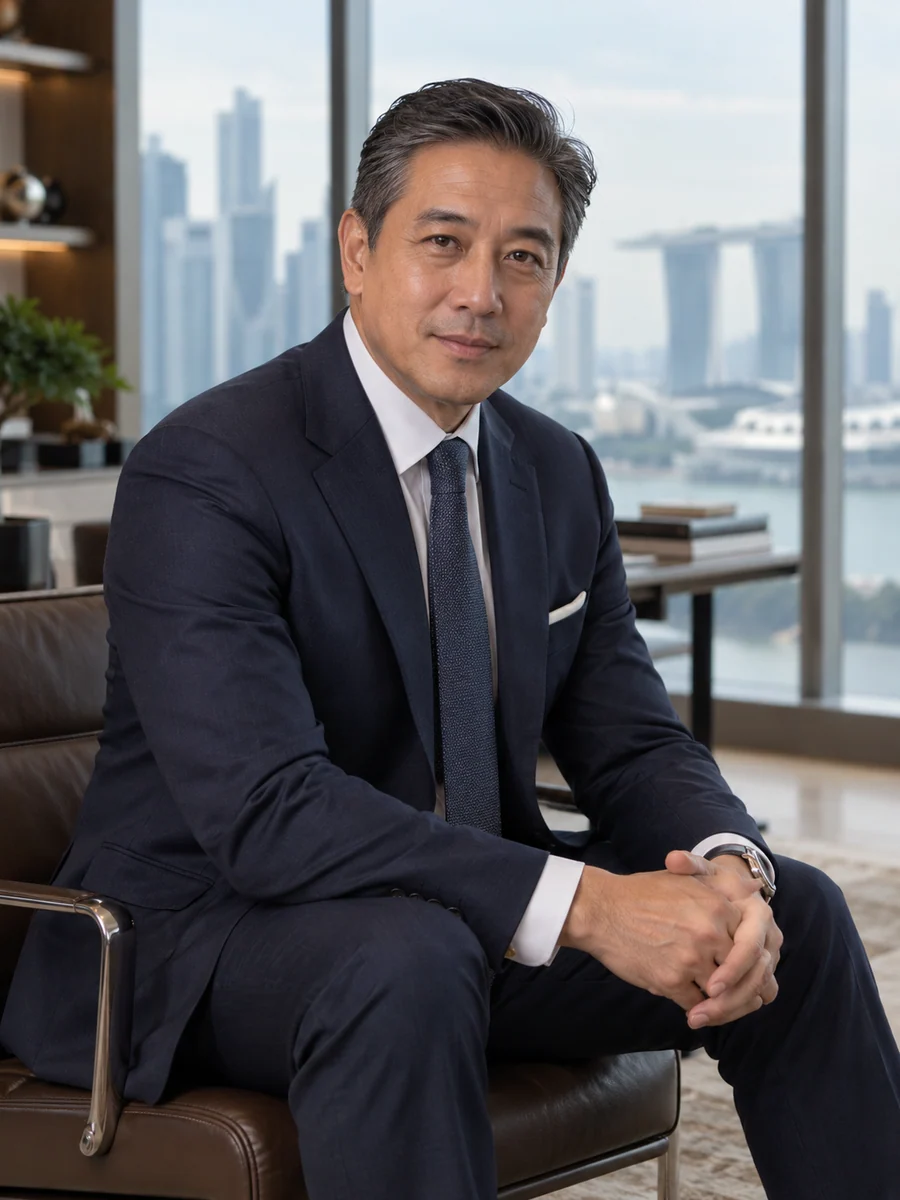
My father sold medicines for a Singapore importer in the 1970s, and in school holidays I rode beside him up the trunk road through Johor, Perak and Kedah, calling on dispensing doctors and family pharmacies in towns where his company was the only regular visitor. He kept two books. One recorded who had paid. The other recorded who had run out, and he always opened it first. A shop that had been without a fever syrup for a fortnight, he told me, remembered that long after it had forgotten any discount. I have run a medicines company for seven years, and I still think his second book was the more important one.
After national service from 1988 to 1990 I studied pharmacy at Sentaral University in Singapore, graduating in 1994. Jobs in generics manufacturing were then easier to find across the causeway than at home, and in July 1994 I joined Benaroh Pharmaceuticals, a family-owned maker of tablets, capsules and syrups in Penang, as a quality assurance pharmacist. I reviewed batch records and prepared release documentation for the senior pharmacist who authorised each batch. I learnt that a batch record is a narrative, and that the useful question is what happened between two entries. In 1997 the managing director moved me into registration because Benaroh wanted to export, and I spent four years building files for regulators in Vietnam, the Philippines, Brunei and Cambodia. Each wanted roughly the same evidence in a different order, a different language and on a different timetable. That discovery has shaped most of my working life.
In 2001 I returned to Singapore to join the regional office of Vauclere Pharma, a fictional European pharmaceutical group, as regulatory affairs manager, and in 2004 I became head of regulatory affairs for Southeast Asia. My team of 34 maintained more than 900 registrations in six countries. We built one regional plan for filings and renewals, prepared for the ASEAN common dossier format as member states adopted it, and cut the median time from submission to approval from 26 months to 17. I completed an MBA at Halvering Business School in 2005, studying in the evenings after regulatory calls, because I wanted to understand the commercial decisions my files were serving.
In 2007 Vauclere sent me to Ho Chi Minh City as country manager. It was my first profit-and-loss responsibility, and it came with 210 colleagues, a heavy reliance on public-hospital tenders and a model in which licensed Vietnamese partners did the importing and much of the distribution. I learnt to read a tender award as I had read a batch record: who won, at what price, and could they supply? Over four years revenue rose from US$38 million to US$71 million, and the share earned in private pharmacies from 22 to 41 per cent, which made us less hostage to any single procurement round.
From 2011 I ran Vauclere's established-medicines business across Southeast Asia: off-patent brands, S$540 million of revenue and 1,450 people in six countries. The group's attention was moving to newer medicines, and part of my job was to decide which older brands belonged in its future. In 2015 I negotiated the sale of sixty of them to Lumaren, a family-owned Singapore manufacturer. Across the table sat its founder, Seah Kim Hock, who argued every clause himself. After the sale had closed, and after Vauclere had announced that my regional role would move to Europe, he asked me to join Lumaren as chief operating officer and, if the arrangement worked, to succeed him. I told Vauclere's regional president about the approach the day it was made.
I joined Lumaren in January 2016 and became group chief executive in April 2019, the first in its history who was not a Seah. Revenue has grown from S$468 million in 2018 to S$812 million in 2025. Much of that came from buying PT Sindhara Farmasi, an Indonesian manufacturer, in 2022. Some came from decisions that made us smaller first: walking away from tender lots we could not supply at a sustainable price, closing the founder's first factory in Jurong, and letting about 230 registrations lapse in markets where they cost more to keep than they earned.
I run the company through an executive committee of nine, including our head of quality, who reports to me and also has a direct line to the board's Audit and Risk Committee. Each month we review the same three registers: tender commitments with their delivery record; registrations by country, with renewal dates and pending variations; and plant capacity against the products each site is approved to make. I ask colleagues for early bad news and complete numbers, and I try to make the first cheaper to bring me than the second.
The board is where the company's three constituencies meet: the family, Calderwick, and three independent directors who answer to neither. My job there is not to play those interests against each other but to give all of them the same paper, early enough to disagree with it. In 2021 the family adopted a charter that separates its own council from the board and puts the succession to my role with a committee chaired by an independent director. I helped bring that about, and it applies to me.
Inside the industry I am probably known for three positions: that a tender bid below full cost is a loan from the plant, that an acquired generics company is worth its licences before its buildings, and that a family company's patience is an asset its professional managers should protect rather than outgrow.
Open to Board appointments · Advisory roles · Speaking invitations
Languages / English · Mandarin · Malay · Vietnamese (working knowledge)
A leadership conviction
I would rather lose a tender I cannot supply than win one I will fail. A medicine that is cheap on paper and missing from the shelf has cost everyone more.
- Group revenue, 2025
- S$812m
- Eight Southeast Asian countries; 37 per cent from public buyers
- Employees
- 5,200
- Three plants in Malaysia, Vietnam and Indonesia
- Marketing authorisations maintained
- 2,140
- Across eight national medicines regulators
- Net debt to EBITDA, December 2025
- 1.8x
- Down from 2.9x after the Sindhara acquisition
Board & advisory record
Current appointments
Lumaren Healthcare Holdings Pte. Ltd.
Group chief executive and executive director
2019–present
PT Sindhara Farmasi
President Commissioner
2023–present
Lentera Patient Access Foundation
Non-executive director
Grants committee
2021–present
Education & credentials
- Bachelor of Pharmacy (Honours)
- Sentaral University · 1994
- Master of Business Administration
- Halvering Business School · 2005
- Family-enterprise governance programme
- Halvering Business School · 2020
Books & papers
Floor prices and supply reliability in public medicine tenders: a manufacturer's note
Kalimaya Health Policy Review · 2025
In conversation
Selat Business Weekly / 2022
Why a Singapore drugmaker walked away from six tender lots
Kalimaya Health Policy Review / 2024
What an acquirer learns from Indonesia's registration practice
Perspectives from colleagues
I hired Adrian because he beat me in a negotiation. When he told me to close the Jurong factory I built in 1983, I did not speak to him for a week. He was right, and he made sure I announced it myself, to my own people.
When Lumaren bought my father's company I expected our products to be in Malaysia within a year. Adrian asked instead which of his products our plant could make for Indonesian patients. Later he pursued a warranty claim against my family and asked me to leave the room while it was discussed. Both decisions were correct.
I argued for faster integration of the Indonesian business and had it minuted. His slower plan cost the early savings we had modelled and kept the people who understood the registrations. With the figures in front of me today, I prefer his plan to mine.