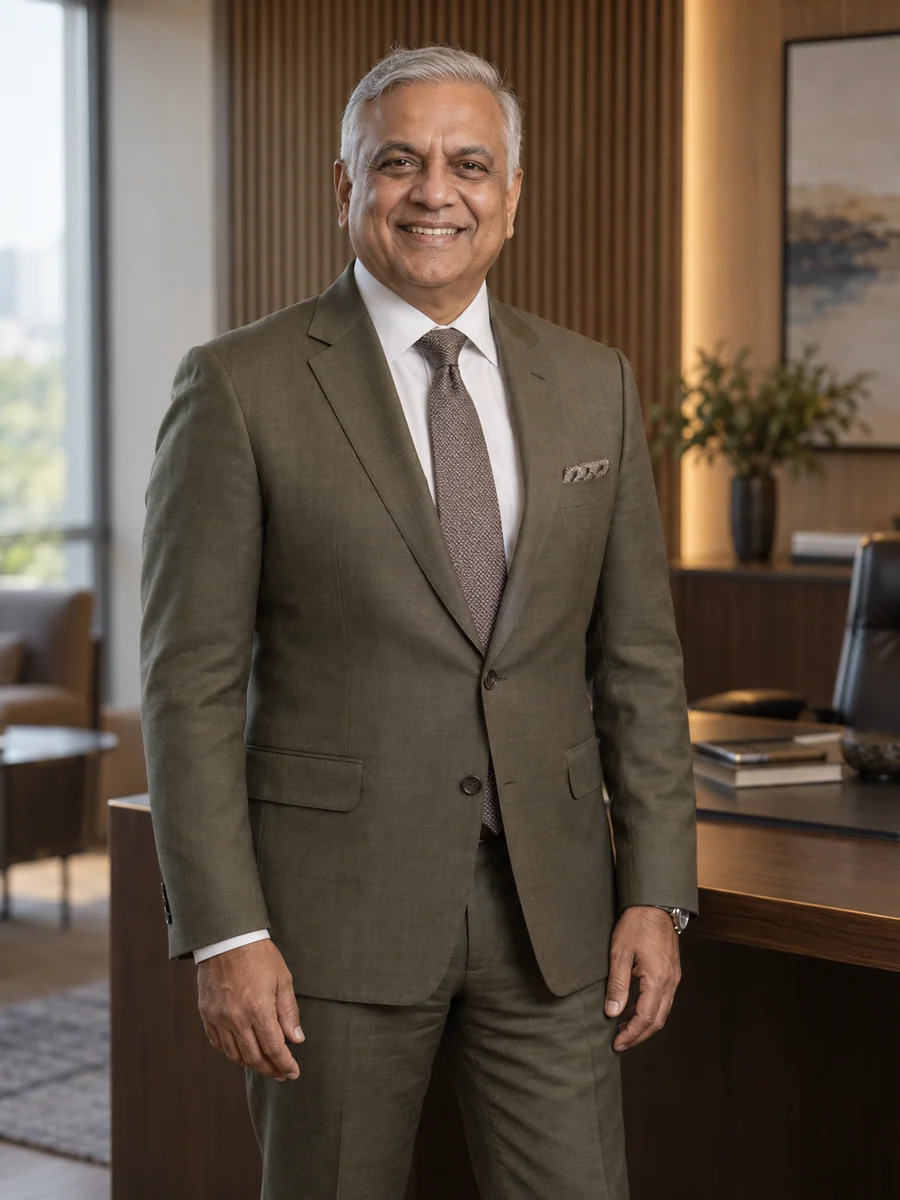
Chief Executive Officer India
A supplier's independence, first learnt at my father's lathe
My father ran a machine shop in a Kolhapur industrial estate with four lathes, a milling machine and nine employees. Most of its work came from one foundry, which sent rough castings to be machined into pump bodies and valve housings. In 1989, when I was seventeen, the foundry installed its own machining centre, and within six months my father's order book had fallen by two-thirds. He kept the shop open by taking whatever job-work the town would give him, and he never again let one customer supply more than a fifth of his work. I did not understand the arithmetic then. I understood his face at the dinner table.
I studied mechanical engineering at the Saraswatinagar Institute of Technology in Kolhapur, graduating in 1994, and joined Varunagiri Tractors Limited in Satara as a graduate engineer trainee. Varunagiri was a family-owned tractor maker that cut its own gears, and I spent nearly five years in its gear shop learning hobbing, shaving and heat treatment from operators who could hear a worn cutter before any gauge could measure it. My first useful piece of work was reducing the distortion of crown wheels in the carburising furnace. It took eighteen months and taught me that most quality problems are process problems that someone has learnt to live with.
In 1999 I joined Haldenmark Drive Systems India, the Pune subsidiary of a fictional German driveline supplier, as a manufacturing engineer. Haldenmark ground its gears after heat treatment, which few Indian suppliers then did, and in 2000 it sent me to its main gear plant in Germany for eighteen months. There I learnt hard finishing and noise testing, and I learnt that a German engineer's "not yet" usually meant a process had not been proven, not that someone was being difficult. Back in Pune I led the transfer of six products from Germany and, through evening classes, completed a postgraduate diploma in management at the Mulamutha Institute of Management in 2004.
Haldenmark asked me in 2005 to build its second Indian plant, at Oragadam near Chennai, to supply synchroniser assemblies and gear sets to the vehicle makers that had settled in the region. I was thirty-three. We commissioned the plant in fourteen months and launched eleven programmes over six years. Running it taught me that a plant head's real job is to make quiet problems visible: the operator who is improvising, the supplier who is late every Friday, the customer engineer who is losing patience. By 2011 I wanted responsibility for a whole business, with decisions taken by people in India rather than approved from abroad.
Kesmore Forgings Limited, a listed forging company in Pune, gave me that in 2012 as head of its exports and off-highway business. Exports were then ₹520 crore, and more than half came from one North American engine maker. Over five years we qualified seven new customers in Europe and North America, began machining crankshafts before shipping them instead of selling raw forgings, and reduced the largest customer's share of exports to a third. I realised only later that I had been doing for Kesmore what my father had done for his shop.
In 2017 Nikhil Ghaisas, then managing director of Kavirath Auto Systems Limited and the son of its founder, asked me to join as chief operating officer. Kavirath had four plants built over four decades, each with its own way of working. For four years I ran operations, commissioned our Hosur plant and managed the shutdown and restart of 2020. In April 2021 the board appointed me managing director and chief executive, and Nikhil became executive chairman. I am the first chief executive from outside the family since his father, Prabhakar Ghaisas, founded the company in Pune in 1979.
The role has three parts that rarely appear in the same job description. I allocate capital through a technology change that will shrink our largest product line. I negotiate with vehicle makers who can award us a programme in the morning and ask for a price reduction on another in the afternoon. And I share leadership with a promoter family that owns 51.4 per cent of the company and cares about it more than any professional manager could. The relationship works when disagreements reach the board in writing, with the evidence attached, and when the chairman and I settle each board agenda together rather than separately.
I lead through plant visits more than presentations. I spend at least two days a month on a shop floor, usually at the start of a shift, and I read the injury register before the sales report. I ask my leadership team for three habits: a cost they can explain to a customer's buyer, a delivery date the plant believes, and early warning when either is at risk. Inside the industry I am probably known for refusing to quote below cost, for regularising contract workers when it was unfashionable, and for arguing that most Indian component makers should not try to become electric-axle companies.
I now want to add one board role outside our industry, where I can bring the questions a manufacturer learns to ask and learn how other boards answer them.
Open to Board appointments · Speaking invitations
Languages / English · Hindi · Marathi · Gujarati
A leadership conviction
A supplier keeps its independence through two things no customer can easily replace: the precision of its process and the honesty of its quotation.
- Revenue, year to March 2026
- ₹6,240 Cr
- 63 per cent transmission parts for petrol and diesel vehicles, 9 per cent electric-vehicle components
- Largest customer's share of revenue, 2025–26
- 31%
- Down from 38 per cent in 2021–22; the board's ceiling is 30 per cent by March 2028
- Core production roles made permanent at Chakan I
- 386
- Of 420 planned under the four-year settlement signed in March 2024
Board & advisory record
Current appointments
Kavirath Auto Systems Limited
Managing Director and CEO, executive member of the board
Risk Management Committee; Corporate Social Responsibility Committee
2021–present
Kavirath Europe B.V.
Director of the wholly owned European subsidiary, in an executive capacity
2023–present
Education & credentials
- Bachelor of Engineering, Mechanical
- Saraswatinagar Institute of Technology · 1994
- Postgraduate Diploma in Management, evening programme
- Mulamutha Institute of Management · 2004
Perspectives from colleagues
Aditya has told me no more often than anyone outside my family, and always on paper, with the numbers in front of the whole board. I wanted the electric axle and I wanted my cousins' foundry. He was right about the first. We still disagree about the second, and the company is better for having had the argument properly.
Most chief executives bring the committee a related-party proposal that has already been settled upstairs. Aditya brings the benchmark, the alternative and his own recommendation, and he does it when the proposal comes from the family that controls the company. That is rarer than it should be.
For years management sent the plant head and a lawyer to talk to us. After the accident Aditya came himself, a few days late, and he said so. The skills test was hard and some of our members failed it the first time, but nobody can say the permanent jobs were handed out. They were earned.