Chief Technology Officer Japan
An engineer who learnt accuracy from a drifting grinder
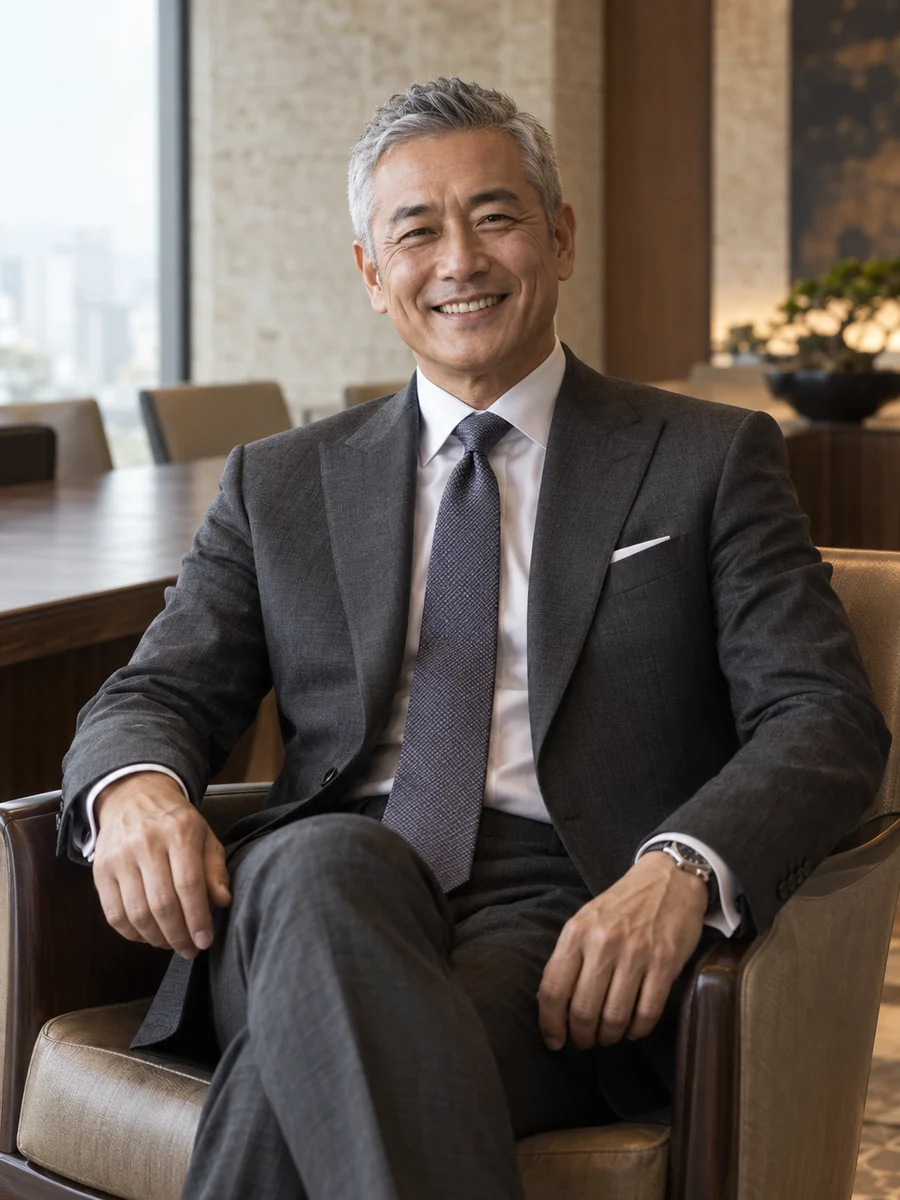
In the winter of 1994 I spent three weeks beside a cylindrical grinding machine with a micrometer, a notebook and a thermometer taped to the wheel head. The machine ground crankshaft journals on a customer's engine line, and it held diameter within two microns at eight in the morning but had drifted by six by mid-afternoon. My section chief at our Joetsu plant, Yoshiro Kamata, would not let me adjust anything until I could plot the drift against the temperatures of the bed, the spindle oil and the workshop. The plot took three weeks. Almost everything I have done since begins with the same request: show me what the machine actually does over a whole shift before proposing a change.
I had joined Isaragi in April 1993 after a bachelor's and a master's degree in mechanical and precision engineering at Yukimura Institute of Technology. Like every new engineer in those years, I spent my first six months in assembly, including four weeks learning to scrape a slideway under a master technician who corrected my work by inking a surface plate and turning it over without a word. I was a poor scraper. I did learn that the accuracy of our machines begins in the hands of people who rarely appear in our brochures. The thermal work from that winter became a compensation method for our grinding machines, four patents and, in 1998, a doctorate by thesis from my old institute, written in the evenings over three years.
In April 1999 the company sent me to Isaragi America in Elgin, Illinois, to support the launch of our horizontal machining centres. I spent most of the next seven years in other people's factories: titanium bulkhead lines in Kansas, valve-body shops in Texas and automotive suppliers across the Midwest. American customers were blunter than Japanese ones. A production manager at Brackenfield Aerostructures told me in my first month that our machine was accurate and our manuals were useless, and he was right on both counts. I began a written field report that went straight to the design department in Nagaoka. By the time I was managing applications and service engineering we were sending about two hundred a year, and one of them, on spindle bearing temperatures during long titanium roughing cuts, changed the design of our next spindle.
I came home in April 2006 as chief engineer for horizontal machining centres. Three years later orders collapsed after the financial crisis; in the spring of 2009 our domestic orders were roughly a quarter of the previous year's. The company shortened working hours, used the government's employment adjustment subsidy and asked development leaders what to stop. I argued for keeping the next-generation machine alive with a smaller team. I lost a third of its budget but kept the project, and when orders returned in 2010 we had a new machine to show while several competitors were restarting theirs. I became general manager of machining-centre development that year.
In 2014 our president asked me to build a remote service capability, because large customers had started asking why we could not see an alarm before they telephoned. I accepted on condition that the unit sit inside engineering rather than sales, so that what we learnt in the field would reach the designers. We began with nine people. The first year was humbling: only 11% of customers buying new machines agreed to connect them, and the production engineers I had once worked beside explained why. They did not know what we were collecting. Showing the full list of values on each machine's own screen did more for uptake than any feature we built.
I became an executive officer and head of product development in April 2019, and my first large decision was to recommend ending our in-house controller programme, which our former president had launched and which I had supported in its first year. I became CTO in April 2022, when research, development and digital engineering were combined into one Technology Headquarters. Since then two subjects have taken more of my time than I expected: export control, which I now regard as a design discipline, and the training of the people who scrape, assemble and program our machines.
I hold design reviews with the drawings and the test data on the table and the sales forecast out of the room until the engineering questions are answered. I ask for the worst test result as well as the average. I prefer a written dissent to a silent nod, which is not always a comfortable habit in a Japanese company, and I file each dissent with the decision it opposed. People who work for me would probably say that I am slow to approve a project, quicker than they expect to stop one, and that I still walk the assembly floor at Nagaoka on Friday afternoons.
Open to Board appointments · Advisory roles · Speaking invitations
Languages / Japanese · English
A leadership conviction
I trust a design once I have seen it hold tolerance through a full shift in a customer's plant, can tell the owner exactly what it reports about that plant, and know where it may and may not be shipped. Accuracy, candour about data and export discipline are, for me, parts of one engineering standard, and I try to hold our software to the same standard as our castings.
- Consolidated net sales
- ¥248.6bn
- Isaragi Machine Tool, year to March 2026
- Engineers and technicians in the Technology Headquarters
- 860
- Research, development, software and digital service, 2026
- New machines connected to remote service
- 74%
- Year to March 2026; 11% in the service's first year
Board & advisory record
Current appointments
Isaragi (Suzhou) Machinery Co., Ltd.
Non-executive director of a wholly owned subsidiary
June 2020–present
Oguni Craft Skills Foundation
Trustee; chair of the programme committee
Programme (chair)
April 2021–present
Education & credentials
- Bachelor of Engineering in mechanical engineering
- Yukimura Institute of Technology · 1991
- Master of Engineering in precision engineering
- Yukimura Institute of Technology · 1993
- Doctor of Engineering (thesis doctorate) on thermal drift compensation
- Yukimura Institute of Technology · 1998
Books & papers
Compensating thermal drift in cylindrical grinding from bed and spindle-oil temperatures
Journal of Precision Machining Practice · 1997
Perspectives from colleagues
When Shinji recommended stopping the controller, he brought the board the dissenting memo from the programme's own chief engineer and asked us to read it first. We did, and we still agreed with him. He has brought the opposing paper to every major decision since.
I told him the cameras would make the young ones lazy. He said the masters could overrule the score whenever we disagreed with it, and he has kept to that. The apprentices still learn with their hands. They simply learn faster.
Before 2023 my office saw a new machine when it was ready to ship. Shinji gave us a vote at the design freeze and defended it when sales objected. He also asked us to tell him whenever the rules made his engineers' work harder, so that he could explain the reason to them himself.