Section · The person behind the perspective
I learned to ask what the industrial footprint allowed the business to become.
My earliest industrial assignments taught me to make a complicated manufacturing business understandable through a few clear measures. Factory count, capacity and product categories helped a reader find a starting point. They also encouraged an assumption that a larger industrial footprint meant a stronger strategic position. I became interested in the gap between the two: what the company could actually do for a customer, and what its assets appeared to imply before anyone examined the work more closely.
I completed a business administration degree at the invented Kiyovara College of Commerce in March 1994 and joined Oritsune Industrial Advisory the following month. I worked in a seven-person research team, with no expense delegation or authority over client investments. My task was to examine industrial business evidence and make comparisons understandable. I learned to seek engineering and operating explanations rather than treat familiarity with factory terminology as technical competence. The distinction remained useful when later roles put me closer to the decisions the research was intended to support.
In April 2000 I became an engagement manager. By 2006 I led sixteen colleagues through three direct reports and JPY 140 million in advisory-delivery expense. The firm's JPY 5.2 billion fee revenue and 160-person workforce described a separate company scale. I wanted our recommendations to explain why a capability mattered to the client's future, rather than begin with an asset and search for a reason to fill it. I also wanted to remain involved after a recommendation met the practical limits of the organisation expected to act on it.
That interest brought me to Tsuravelle Industries in April 2007 as head of corporate planning. An early mistake concerned the people behind an integration plan. In 2009 I treated two eighteen-person engineering teams as thirty-six available colleagues before identifying that twelve people were shared between them. There were twenty-four distinct people. Correcting the plan required JPY 85 million in replanning work. The error was not an argument for reducing headcount; it showed that I had accepted organisational labels without reconciling the people those labels described.
I became director of the industrial portfolio in April 2013. The title was functional, with no statutory appointment. A 2016 acquisition brought an assembly-engineering business with JPY 18.5 billion annual revenue, 70% from customer-specific projects. I supported preserving its application-engineering capability and JPY 420 million in integration preparation rather than describe its factories as interchangeable additions to our footprint. The acquisition had a strategic purpose that a simple consolidation story would have obscured. Engineering and operating leaders retained responsibility for how the work could actually be organised.
Since April 2019 I have served as CSO. My current function comprises fifty-six colleagues through six direct reports with JPY 1.15 billion in delegated 2026 expense. Tsuravelle recorded JPY 148 billion company revenue in 2025 and employs 4700 people. I present to the board in an executive capacity, while engineering, operations, quality, safety, employment and capital approval remain separately owned. My responsibility is to make the industrial direction and its trade-offs clear enough for the institution to choose deliberately.
That direction sometimes requires giving up work. In 2021 we stopped pursuing new bids in three commodity-component families that had contributed JPY 9.8 billion revenue in 2020, with JPY 680 million in commercial transition planning. Existing orders and support remained subject to their responsible owners' assessment. In 2023 I supported a JPY 4.6 billion flexible-assembly investment over a JPY 7.4 billion dedicated-volume proposal. Different scope and product mix meant the budget difference could not honestly be called a realised saving. A 2025 joint-venture proposal similarly needed a closer account of decision rights than its equal-equity headline provided.
I now use these choices to explain industrial strategy as a direction with consequences, not a preference for larger factories or more ambitious slides. The contribution includes a capability we protected, volume we chose not to pursue and a count of people I had to correct. Every event, employer and colleague on this site is fictional. A real public account would need verified figures and publication permissions, with technical and governance claims kept within the leader's actual competence. The demonstration shows how an industrial strategist can make the reasoning visible without claiming every achievement of the manufacturing organisation.
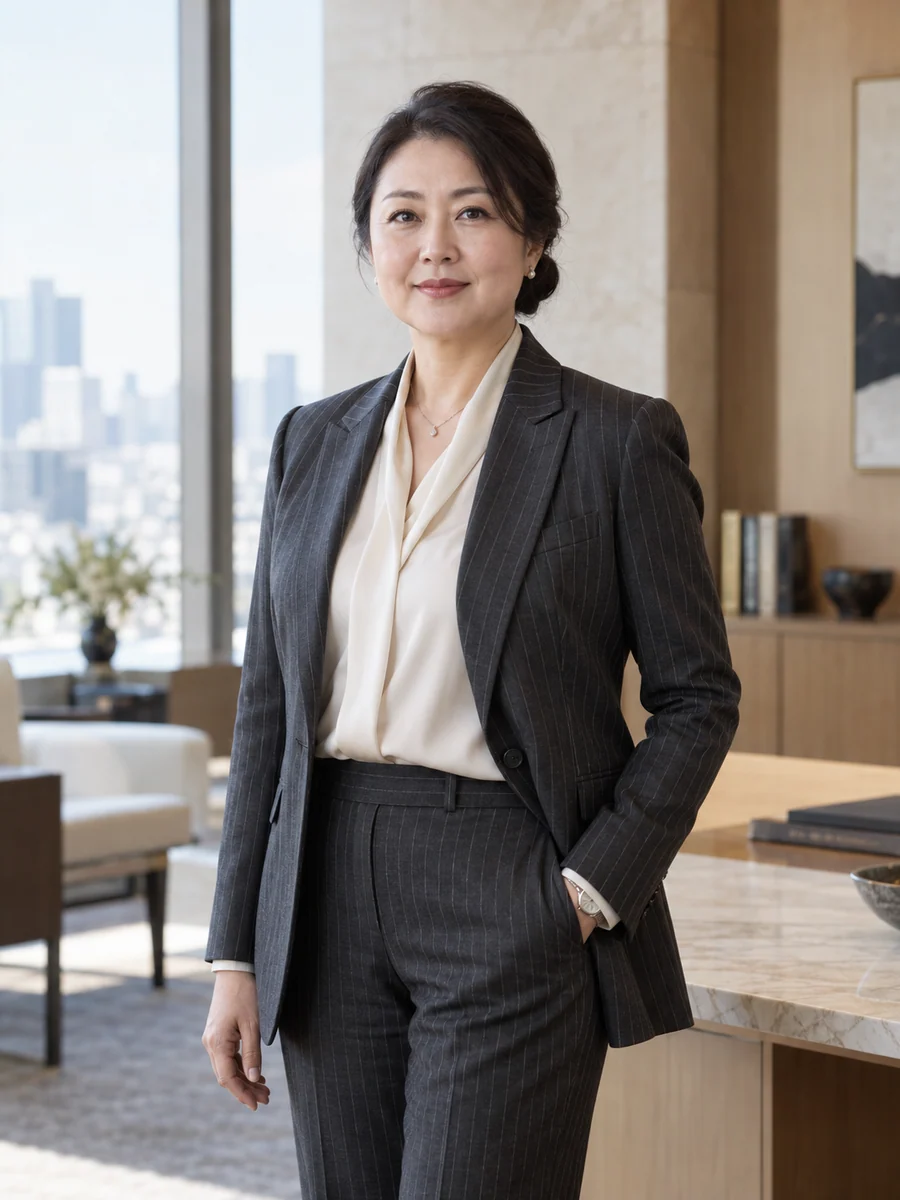
In my own words
I start with the industrial work the company intends to become good at, then examine the assets and relationships that would support it. More factory space, a larger unit count or equal ownership can each look persuasive while leaving that question unanswered. I want the strategic choice to explain the capability being built, the work being declined and the authority needed to carry the decision through.
Miyuki Arazono
Career
Chapters of accountability
2019 — present
Chief Strategy Officer
Tsuravelle Industries
Connect industrial capability, portfolio boundaries and partnership authority to the company’s chosen direction.
2013 — 2019
Director of industrial portfolio
Tsuravelle Industries
Preserve the capability rationale inside industrial acquisitions and integration proposals.
2007 — 2013
Head of corporate planning
Tsuravelle Industries
Develop the corporate account and correct an owned double-count of shared engineering colleagues.
2000 — 2007
Engagement Manager
Oritsune Industrial Advisory
Lead industrial business assessments within an advisory team and defined delivery-expense remit.
1994 — 2000
Industrial Research Analyst
Oritsune Industrial Advisory
Learn to distinguish the scale of a manufacturing asset from the capability its customer work requires.
Education
Formation
- Bachelor of business administrationKiyovara College of Commerce1994
Working languagesJapanese · English