The person behind the perspective
I learnt to follow each output into its next use
I grew up in Satara and became interested in the practical distance between a page designed on a screen and a page someone could use. Printing seemed to combine careful preparation with visible physical work. I completed a Bachelor of Technology in Printing at Tavqerni Institute of Printing in June 1996. My career began two months later, well before I had responsibility for a factory or a customer promise. I speak Marathi, Kannada, Hindi and English, and now live in Belagavi, where the work requires listening across production, commercial and quality teams rather than assuming they mean the same thing by a completed job.
In August 1996 I joined Ravqesi Print Works as a prepress coordinator. The company employed 65 people and recorded ₹9.4 crore revenue for FY ending March 1997. I was one of seven colleagues in prepress, reporting to the production manager without direct reports or spending delegation. I learned how a small arrangement decision could affect several later steps. The file, the sheet and the finishing process had to be considered together. My contribution was preparation and coordination; I did not yet have the authority or experience to settle a disagreement between production departments.
The production-manager appointment came in June 2003. Ravqesi had grown to 180 employees and ₹34 crore revenue for FY 2004. I led 52 colleagues through four supervisors and managed ₹7.2 crore annual operating expense under the plant head. Planning a shift required a different judgement from preparing an individual job. A machine could be busy while the next process accumulated unfinished work. I began to ask what the factory had completed for the customer, not simply how much each machine had processed. That question became harder when a local improvement was already popular with the team that had achieved it.
I moved to Nevqumi Printed Healthcare Components as plant head in August 2010. The business then employed 220 people and recorded ₹58 crore revenue for FY 2011. I led 130 colleagues through four managers with ₹22 crore annual operating expense, reporting to the operations head. Pharmaceutical information leaflets introduced a demanding relationship between customer-approved content and physical conversion. My printing knowledge did not give me authority to approve a medicine's wording or a translation. I needed the production organisation to understand those boundaries while still taking responsibility for making the agreed component properly and on time.
In April 2016 I became head of multi-site operations. Nevqumi had 390 employees and ₹121 crore revenue for FY 2017. I led 230 colleagues through five managers, with ₹48 crore annual operating expense, reporting to the CEO. The next year I approved a sheet layout because it improved material yield. I failed to give paper-grain direction enough weight in the later fold. We held 1.2 million leaflets, remade 900,000 and released the remaining 300,000 only after separate review. None had left before the hold, but the replacement quantity was five working days late and rework cost ₹38 lakh. The decision was mine; a story about diligent detection alone would omit why the problem arose.
I became COO in January 2022. Today our Belagavi and Hubballi plants employ 510 people across the company and serve 34 pharmaceutical customers. I lead 290 operations colleagues through six heads with ₹72 crore annual expense, reporting to Sanjay Zeqvathi. Irene Zeqthuli leads quality. Family owners hold 55%, a private-equity investor 35% and an employee vehicle 10%; I have no personal or vehicle allocation. These interests and relationships would still need review for a proposed outside role. Not owning shares does not make my executive relationships irrelevant.
Recent decisions have changed how I explain the factory to senior colleagues. We invested in folding rather than another press when the unfinished work sat between those processes. We showed both order and leaflet-volume delivery measures when small completed orders made performance appear stronger than the customer experience. We obtained an agreed partial release for approved language layouts while leaving other versions pending. We also accepted higher pallet costs and retained unresolved packaging-trial results, rather than treating a revised stack as proof that damage could no longer occur. Each decision required another function's contribution and a clear account of what the change did not establish.
My experience is in operating a supplier to pharmaceutical companies, not in directing clinical care or approving medicines. I have presented operating proposals to our board through the CEO but have never held a statutory directorship. The fictional record includes IICA registration in July 2026; the assessment remains unfinished and no exemption is claimed. I would consider one first outside contribution with twenty-four provisional days, subject to employer consent, qualified appointment review and a realistic learning plan. I would bring the habit of following an apparently finished output into its next use, while expecting to learn the whole receiving enterprise rather than repeat the methods of a leaflet factory.
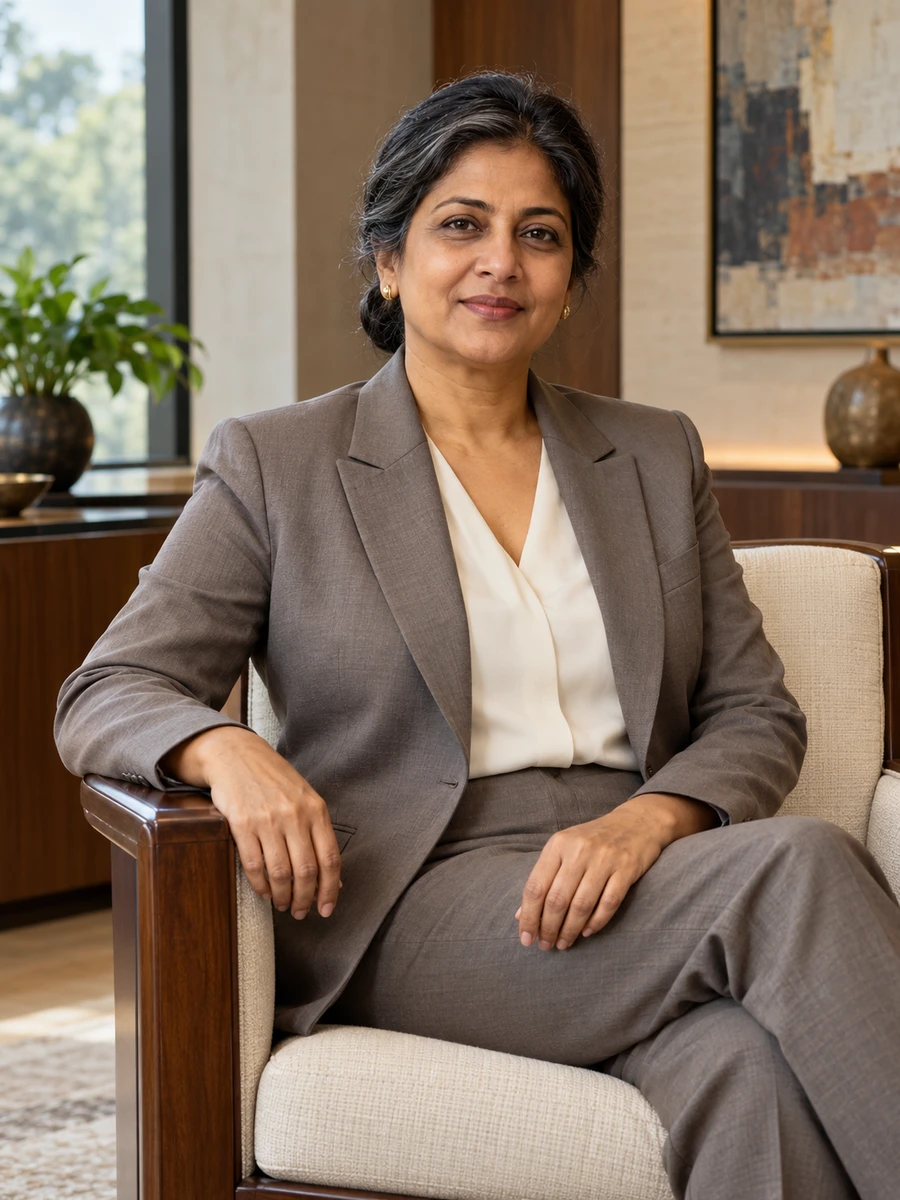
In my own words
A printed sheet is a stage of work, not the finished promise. I want the approved language, fold, quantity and delivery condition to travel together from the customer file to the packing line. If one is missing, the production count should not make the order sound complete.
Amrita Qezthani
Education
Formation
- Bachelor of Technology in PrintingTavqerni Institute of Printing1996
Working languagesMarathi · Kannada · Hindi · English