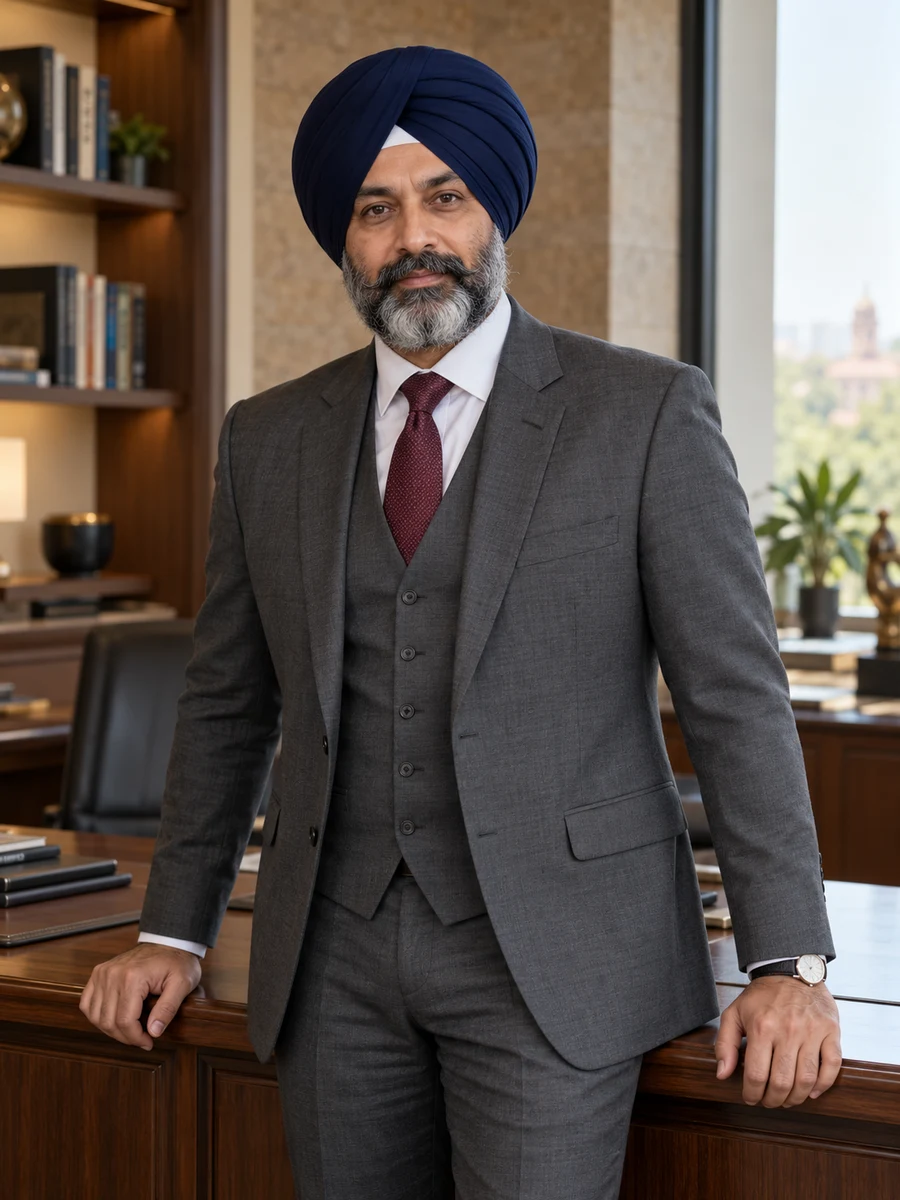
The person behind the perspective
I learned to keep the question beside the number
I grew up in Amritsar and became interested in the distance between a number and the question somebody believes it answers. Statistics offered a disciplined way to examine that distance, although a formal qualification did not prevent me from making a later interpretive mistake. I completed a statistics degree in May 1995 and a master's in applied statistics in June 1997 at the fictional Dezqerthi Institute of Statistics. My first employment began in July 1997. The twenty-nine years since then have involved the evidence and definitions behind research used by business readers.
At Raqzavthi Research Services I began as an analyst in a forty-five-person enterprise with ₹12 crore FY1998 revenue. I had no delegated budget or direct reports. Under a research manager, I assembled records and learned to preserve the context of a comparison. A field could contain a clean number while its unit, period or population remained uncertain. My contribution was supervised analytical work, not authority over the client's business. I learned that the question should determine which calculation is useful, rather than allowing an available column to decide what the report appears to know.
Promotion to research-data manager in June 2002 brought eight colleagues and ₹78 lakh annual function expense. The employer had eighty employees and ₹26 crore FY2003 revenue. I became responsible for the consistency of an account assembled by several people, including the definitions that accompanied extracts as they moved into analysis. The work required attention to what later readers might infer from a short label. It also taught me to distinguish a data team's responsibility for a reproducible account from a research specialist's responsibility for the method and a client's responsibility for the decision made with it.
I moved to Qezramthi in September 2010 as head of series data. The regional industrial-energy publisher had ninety-five employees and ₹38 crore FY2011 revenue. My fifteen-person function carried ₹2.5 crore annual expense. Research publication made release history more consequential: a reader might have relied on one version while a later study contained revised values. I wanted those histories to remain recoverable. That interest developed alongside responsibility for respondent definitions and source relationships, without suggesting that the company was an official statistical authority or that its selected research population described every industrial user in India.
The January 2016 appointment as director of research data was a functional role, with no statutory seat. I led twenty-three colleagues and ₹4.4 crore annual expenditure in a business then employing 118 people with ₹59 crore FY2017 revenue. In 2018 I approved a figure described as the average cost across a pooled electricity volume. It was actually the equal mean of two contract prices. Nitin asked me to follow the quantities behind the rates. The records were accurately copied; the interpretation I had approved still answered a different question from the one our label promised.
The fictional contracts covered 1 MWh at ₹4,000 per MWh and 9 MWh at ₹6,000. Their combined energy-only expenditure was ₹58,000 for 10 MWh, giving ₹5,800 per MWh. The ₹5,000 equal-contract mean remained valid for its own narrower definition, but not as the claimed pooled-volume result. The review and correction cost ₹43 lakh. We retained the contract-level figures, the common period and the stated price basis. I did not turn the difference into a customer loss or claim that a corrected research figure changed anybody's actual bill. The mistake belonged in my account because I had approved its meaning.
I became CDO in May 2021. Today I report to Salma and lead thirty-one employees through four leads, with five external research specialists counted separately. My annual function expense is ₹6.2 crore. The employer's ₹82 crore FY2026 revenue combines ₹61 crore subscriptions and ₹21 crore commissioned research. It is a 145-person publisher, not a generator, retailer or trader. Founders, an employee-management trust and an institutional investor hold 48%, 32% and 20% respectively; I have no personal holding or statutory appointment. Those facts define the enterprise and my role without establishing independence for another company's board.
The later cases examine how a research conclusion changes as its supporting account travels. We preserved original and revised monthly releases, narrowed a panel's geographic claim, retained licensing limits in an external data product and reconstructed classifications before comparing a series across a changed taxonomy. Each response made the publication less simple in some respect. Each also retained expense and unfinished work. Data stewardship did not create more electricity, establish a procurement recommendation or decide a legal interpretation simply because a dataset could be reproduced. Appropriate research and professional owners continued to make those judgements.
I work in English, Punjabi and Hindi. Registration and assessment preparation for a possible outside appointment remain unfinished; neither an assessment pass nor an exemption is claimed. A provisional twenty-two-day allowance would need to fit current employment and a specific board's demands. I would first learn what conclusions the enterprise needs its data to support and where those conclusions become consequential. My intended contribution is to make the evidence and interpretation discussable, including the assumptions I have personally approved, while respecting the specialist decisions a data executive cannot settle alone.
In my own words
I want a reader to recover the question a number answers. That requires more than retaining a source file. The account must preserve the population, the weighting, the version available at the time and the classification applied. My own averaging mistake showed that accurately copied prices can become a misleading summary when the unit of the intended question disappears.
Jaswant Rehqavri
Education
Formation
- Bachelor of Science in StatisticsDezqerthi Institute of Statistics1995
- Master of Science in Applied StatisticsDezqerthi Institute of Statistics1997
Working languagesEnglish · Punjabi · Hindi