The person behind the perspective
The recommendation had to work inside an actual enterprise
Growing up in Kottayam, I was interested in why two businesses doing apparently similar work could depend on quite different relationships. Economics gave me a way to examine the question, but research taught me to look beyond the category name. I completed a BA in May 1992 and a master's degree in industrial economics in June 1994 at the fictional Kezvarthi School of Economics. I started work the following month. My thirty-two-year career has moved from describing industrial markets to answering for choices about the organisation serving them.
At Trezqavi Industrial Research I began as an analyst in a forty-six-person firm. Its ₹8 crore FY1995 revenue described the employer, not a budget I controlled. I worked under a research manager, gathering evidence and learning which distinctions changed a client's decision. A maintenance activity could sit in the same market table while relying on different equipment knowledge, customer access or commercial relationships. I learned to ask what the category concealed before using its apparent size to recommend a direction. The work did not give me authority to run the client's operations.
Promotion to research manager in November 2000 brought six colleagues and ₹60 lakh annual function expenditure. The firm had ninety-six employees and ₹28 crore FY2001 revenue. I became responsible for how a research account was assembled and how its limitations were explained. A plausible market description was only a beginning: a client also needed to understand what participation would require. I found myself increasingly interested in the decisions that followed the report, including the people and relationships that an attractive recommendation might disturb.
I joined Reqvathi in May 2007 as head of commercial planning. The business then employed 180 people and recorded ₹74 crore FY2008 revenue. My nine-person function had ₹1.4 crore annual expense. Moving from an advisory research setting to an operating enterprise changed the consequence of a recommendation. A growth route could consume workshop attention or alter how an equipment maker regarded the company. I could ask better questions by working with service engineers and commercial colleagues, but their responsibilities remained their own. Market analysis did not make me qualified to approve technical work.
The September 2013 appointment as director of business design was a functional employment role, with no statutory seat. I led fourteen colleagues and ₹2.9 crore annual expenditure in a business with 285 employees and ₹142 crore FY2014 revenue. The remit included the organisation required by proposed growth. In 2016, following a ₹18 crore workshop acquisition, I supported a central quotation process that reduced the acquired team's opportunity to apply specialist judgement before a proposal went forward. The process appeared consistent, and I had made consistency too easy to equate with a better business.
Farida challenged that account through the quotations themselves. Of forty-two examined, sixteen required specialist treatment and twelve of those had returned for reassessment. The correction restored local technical review and bounded commercial delegation, retaining ₹61 lakh of expenditure including ₹14 lakh customer credits. I had to explain why a decision intended to integrate capability had made it harder to use. The episode did not establish that every local practice was sound or every central process misguided. It established that my proposed arrangement had failed to distinguish work requiring different judgement.
I became CSO in June 2020. Today I report to Sudhir and lead twenty-two strategy employees through four leads, with four external advisers counted separately. The enterprise has 420 employees and ₹236 crore FY2026 revenue, combining ₹178 crore services with ₹58 crore parts. My ₹4.8 crore function expenditure is not the company's capital authority. The ₹23 crore proposal portfolio requires separate decisions. I have no personal equity or statutory appointment. Family, industrial-investor and employee ownership describe the company; they do not establish my independence for another role.
The later cases test the kind of enterprise we intend to build. I recommended declining a proposed parts brand where it would change important referral relationships, while retaining investment in the existing service position. I supported a slower capability-development route with explicit unfinished stages. I questioned a universal service-centre proposition where much of the work still required customer-site response. The diagnostic trial then asked what commercial relationship would let a customer understand the service being offered. None of these choices removed technical, site or customer authority.
I work in English, Malayalam, Tamil and Hindi. Databank registration dates from March 2026 in this invented record; assessment preparation remains unfinished and no exemption is asserted. A provisional twenty-four days for a first outside contribution would need realistic review alongside current employment. I would want to understand the prospective company's actual growth choices before offering a familiar framework. My useful contribution would be to examine the capabilities and relationships a strategy needs, and to remain willing to revisit an arrangement I had personally helped make convincing.
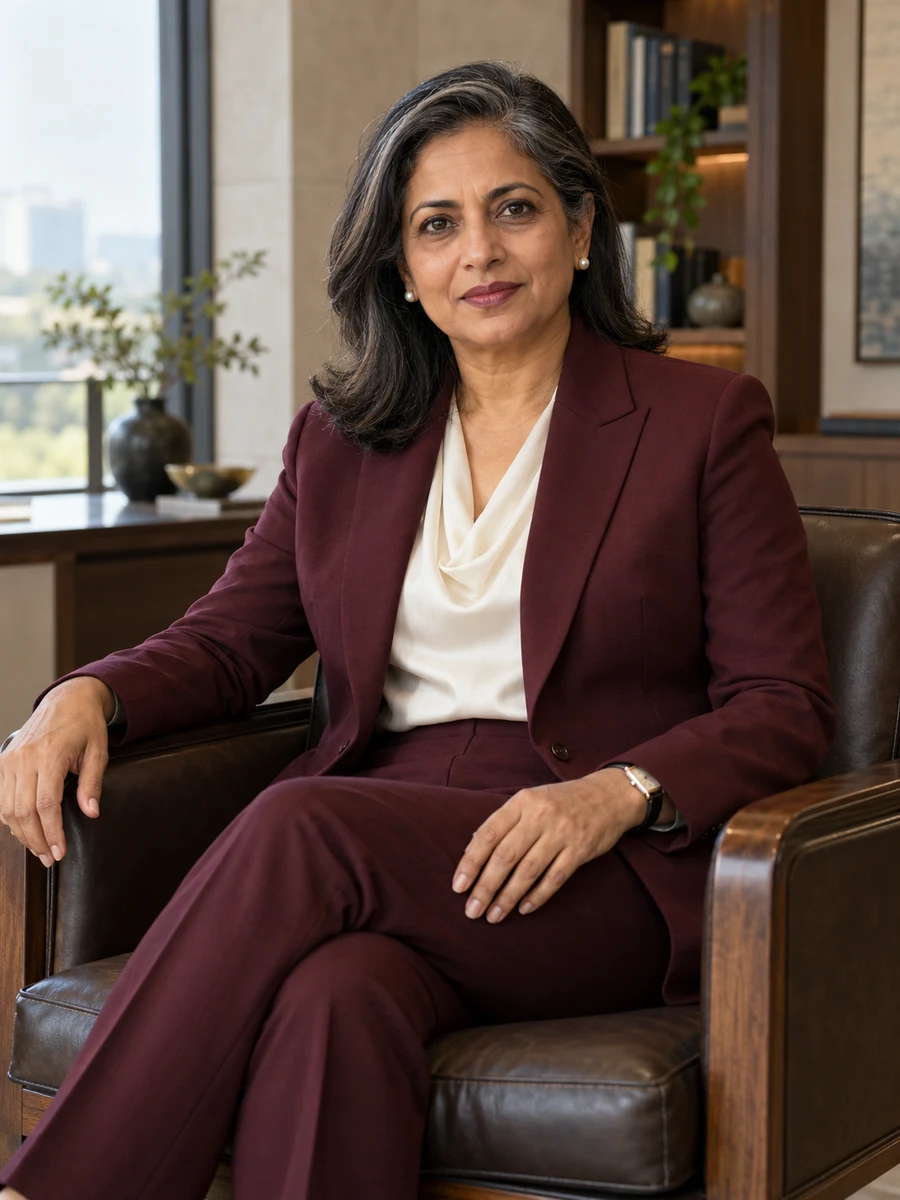
In my own words
I ask what a growth decision needs us to become, and what it might damage in the business we already are. A workshop can bring judgement that a central process fails to recognise. A new parts brand can change why equipment makers refer work to us. Strategy has to understand those relationships before counting the additional activity as an uncomplicated extension of today's enterprise.
Rachel Vezqarithi
Education
Formation
- Bachelor of Arts in EconomicsKezvarthi School of Economics1992
- Master of Arts in Industrial EconomicsKezvarthi School of Economics1994
Working languagesEnglish · Malayalam · Tamil · Hindi