The person behind the perspective
Learning to see the service beyond its visible objects
I grew up in Bhopal and entered design through visual communication. My full-time degree at the fictional Qerzavli Institute of Design ended in May 1996, and I joined Taqvelmri Design Services in July. The enterprise employed thirty-six people and recorded ₹5 crore FY1997 revenue. I was a junior designer under a studio manager, without direct reports or delegated spending authority. The work taught me that a clearly drawn object could still leave the receiving person uncertain about what to do next. I began to notice the distance between completing an artefact and supporting an activity.
In June 2002 I became a service-planning lead. Taqvelmri then had seventy-four employees and ₹13 crore FY2003 revenue. I led five colleagues with ₹48 lakh annual function expense. The role moved me closer to the client's brief and the work needed around a design deliverable. A visual change could be straightforward while the organisational decision behind it remained unsettled. I learned to ask who would approve a change, who would maintain it and which parts of the intended experience depended on another team. Those questions eventually became central to my commercial work.
I joined Vezqulmi in September 2009 as commercial planning manager. Its ninety-eight employees recorded ₹26 crore FY2010 revenue. I led seven colleagues under the commercial director with ₹92 lakh annual expense. The practice worked on navigation information in buildings where destinations, names and uses could change after an opening. A proposal needed to account for more than the initial visual system. I began developing service comparisons that retained the design work, client decisions and continuing update responsibilities, rather than treating a completed set of signs as the whole business relationship.
The strategy director appointment followed in January 2016. I led ten colleagues with ₹1.9 crore annual expense within a 137-person enterprise recording ₹43 crore FY2017 revenue. In 2018 I supported a multilingual offer whose pricing was driven mainly by translated word count. Mariam's review exposed the missing distinction. Five of twelve proposed briefs fitted that bounded scope, while seven needed work on the sequence and recognition of a journey. Accurate translated labels did not establish that the full navigation problem had been addressed. I accepted the ₹18 lakh revision and the need to make the offer less uniform.
I became CSO in May 2021 and now report to Suhas. Vezqulmi employs 169 people and records ₹59 crore FY2026 revenue, comprising ₹42 crore project work and ₹17 crore annual update services. My fourteen strategy colleagues work through three leads. The ₹3.1 crore FY2026–27 function expense is separate from the ₹1.6 crore market-experiment provision and from the company's total revenue. Founder interests own 35%, an employee vehicle 40% and a private investor 25%. I hold no personal shares or statutory appointment. Those distinctions matter when a reader assesses the scale and authority of the role.
The later cases examine how growth can change the service being sold. An annual update agreement can acquire a redesign obligation that its price and staffing never described. A large free-diagnostic response can conceal the absence of a funded decision owner. A fabrication-heavy bid can make the practice appear to have won more advisory work than it has. A white-label relationship can restrict the conversations through which a designer understands the receiving client's needs. Strategy has to examine those changes before the commercial headline becomes the accepted account of success.
I am based in Kochi and work in English, Hindi and Malayalam. Mariam coordinates design and qualified project owners. My strategic contribution does not certify accessibility, establish emergency routes or determine whether an actual building meets its professional and regulatory requirements. The fictional projects here are not public facilities or verified user studies. They show how a service business can make its responsibilities more explicit without turning every illustrative observation into a universal claim about people or places.
I have not registered in the IICA databank or completed proficiency-assessment preparation, and I claim no exemption. A first board opportunity would need the relevant eligibility, relationship and independence reviews. I would initially examine twenty-two days of annual capacity against preparation, travel and exceptional demands. The contribution I want to develop concerns the economics of a promise that depends on professional judgement. I would bring the multilingual-pricing mistake into that conversation because it shows how readily an attractive growth model can remove work the receiving client still expects the enterprise to perform.
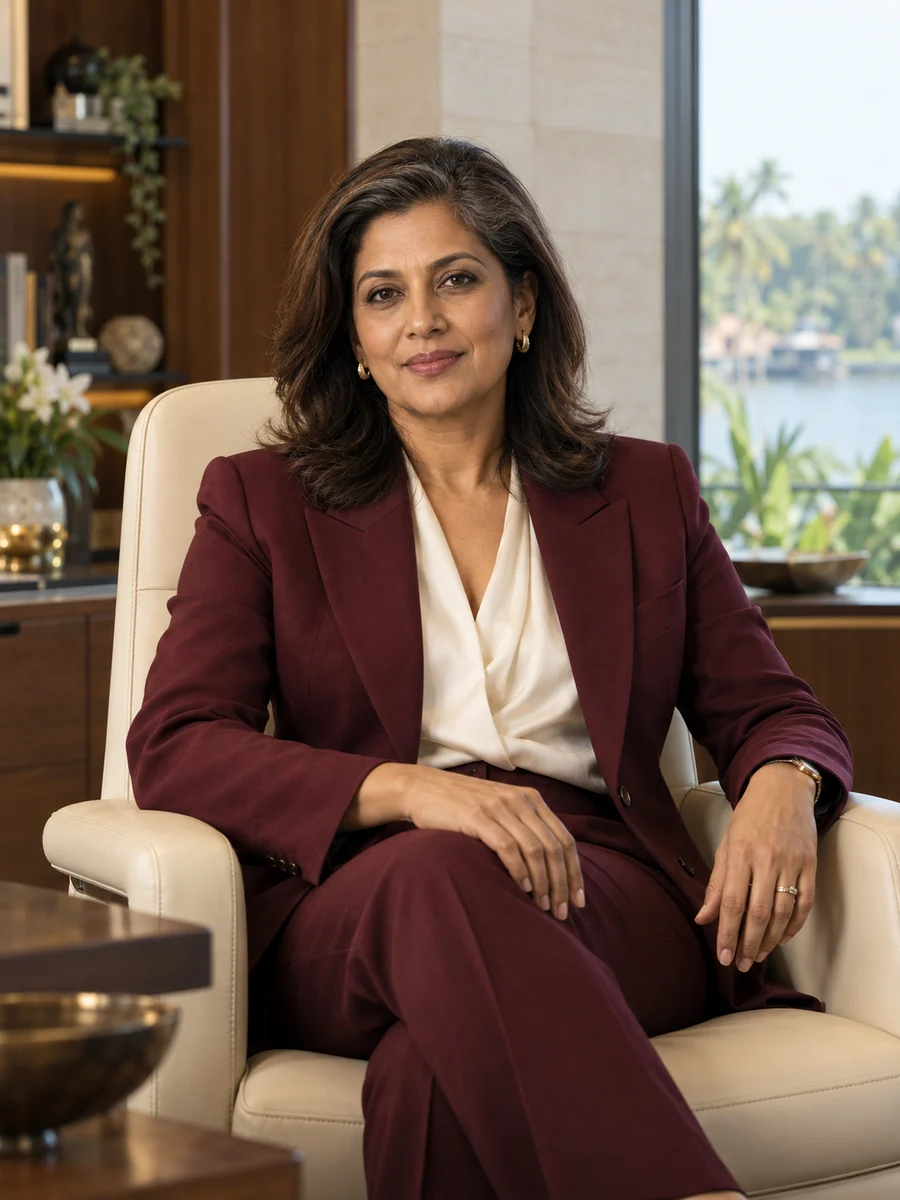
In my own words
I want the growth plan to describe the service people rely on, not only the objects we deliver. A translated label, a new directory entry and a redesigned route can carry very different work. The commercial proposition should preserve those differences so that expansion does not quietly remove the judgement the client expected to buy.
Rachel Kherzovli
Education
Formation
- Bachelor of DesignQerzavli Institute of Design1996
Working languagesEnglish · Hindi · Malayalam