Chief Technology Officer India
Learning to read the map from the receiving side
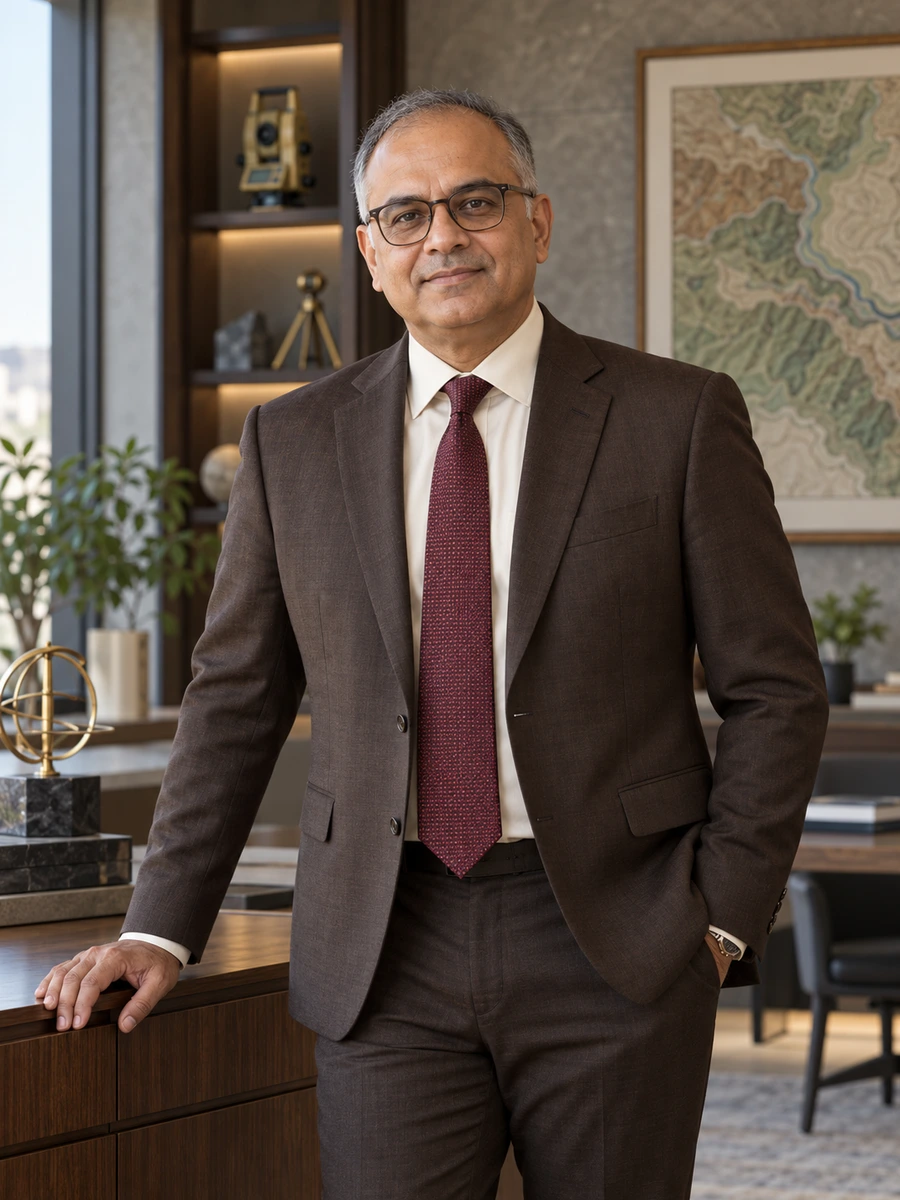
The image looked convincing enough that I repeated the wrong claim. Its three-centimetre ground sample distance described the spacing represented in the imagery. I allowed that number to become a statement about positional accuracy in a proposal. Arun Jezmavi asked for the evidence against independent checkpoints, and seven of the twenty-four examined results fell outside the practice's predefined criterion. The problem was not that imagery lacked value. It was that I had let a visible level of detail stand in for a different property of the product. Correcting that claim required expenditure and a less comfortable conversation with the commercial team.
I grew up in a Parsi family in Navsari and completed survey technology at the fictional Yelqemi Institute of Survey Technology in June 1995. In July I joined Pemzavi Mapping Services as a survey data analyst. The business had fifty-four employees and₹ 6.6 crore revenue for FY ending March 1996. I worked in a seven-person processing group with no reports or spending authority. Field records arrived with explanations that did not always survive their conversion into a neat dataset. I learned to retain the reference and observation context instead of assuming that a clean numerical column supplied everything a later user would need.
In April 2001 I became geospatial software lead. Pemzavi employed 130 people and recorded₹ 23 crore revenue for FY ending March 2002. Eight colleagues worked through two leads with₹ 74 lakh annual expense. The move made me responsible for the behaviour of the processing tools, including what happened when a required specification was absent. A default could make the workflow continue while making the result harder to defend. I began insisting that unresolved meaning return to the survey owner rather than be silently completed by a programmer. The lesson was practical:automation should preserve the evidence account as well as reduce repetitive handling.
I joined Qelzami as head of survey platforms in September 2007. At entry the firm employed 108 people and recorded₹ 36 crore revenue for FY ending March 2008. My fourteen colleagues worked through three leads within₹ 2.3 crore annual expense. We connected acquisition records, processing and delivery within one service. I became interested in the questions customers asked after accepting the files, especially when they combined our material with another source. A technically valid export could still leave a reference mismatch or an area whose apparent coverage exceeded its actual observation. Those questions made me want to understand the receiving side of the relationship.
In July 2012 I moved to Jemzari Civil Advisory as geospatial delivery director. The title was functional, not a statutory board appointment. Jemzari had 240 employees and₹ 92 crore revenue for FY ending March 2013. I led twenty-seven colleagues through three leads with₹ 5.2 crore annual function expense. We used spatial material in advisory work while qualified designers retained engineering decisions. Receiving deliveries changed my view of completeness. A smooth surface could hide a missing observation more effectively than an obvious blank. I also saw how uncertainty lost in an early summary could reappear much later as a question for someone who had never met the original survey team.
Qelzami asked me to return as head of technology in December 2017. The business had 265 employees and₹ 104 crore revenue for FY ending March 2018. I led forty-two colleagues through four leads within₹ 8.6 crore annual expense. I brought back a stronger concern for how the customer would interpret a product rather than only how our own processing pipeline would finish it. The role combined platforms, technical development and the explanation of proposed capabilities. It also taught me that knowing the distinction between resolution and accuracy did not prevent me from endorsing an attractive shortcut when it appeared in a commercial proposition.
I became CTO in April 2022. Qelzami now employs 380 people and reports₹ 158 crore FY26 revenue. My remit covers 61 technology colleagues through five leads, ₹ 12.2 crore FY2026–27 operating expense and a separate₹ 4.5 crore development programme. I report to Nandita Vezqori, and Arun heads the survey practice. Founding-family vehicles own 46%, the employee vehicle 22%and a long-term investor 32%. I have no personal stake and no statutory seat. Those boundaries matter because technology leadership does not give me another party's land rights, field permissions or engineering approval authority. The service must work within the responsibilities of the project and its qualified owners.
The positional-accuracy correction cost₹ 68 lakh in investigation and further acquisition work, with release held rather than supported by a replacement score we had not established. A later height-reference review reconciled 110 of 120 questioned records within a 900-record population and left ten held. The ground-coverage case retained three hectares without observation after additional work. A licence review distinguished seven sources that explicitly permitted the proposed client deliverable, two that restricted it and three requiring clarification. These outcomes have different meanings; they cannot be reduced to one claim that technology made the entire product complete.
After thirty-one years, I am considering how this experience could contribute to a board examining technical promises and their commercial consequences. I speak Gujarati, Hindi and English. My exposure has been as an executive presenter, with no director appointment. The invented record states IICA databank registration in March 2026 and assessment completion in August 2026; it is not evidence of a real qualification or a conclusion about eligibility. Twenty-five days are provisionally available, subject to consent and actual responsibilities. I would bring a habit of asking what sits behind a confident representation, while expecting to learn the financial, legal and operating context that makes the next company's decision different from mine.
Open to Board appointments
Languages / Gujarati · Hindi · English
A leadership conviction
An honest spatial product makes an unknown distinguishable from an observation.
- Technology team through five leads
- 61 staff
- ₹ 12.2 crore FY 27 expense; development programme separate
- Survey processing, software and client-side delivery
- 31 years
- Career beginsJuly 1995; CTO sinceApril 2022
- Provisional annual board capacity
- 25 days
- Employer consent, relationships and calendar still to examine
Education & credentials
- Bachelor of Survey Technology
- Yelqemi Institute of Survey Technology · 1995
Perspectives from colleagues
Farhad withdrew the accuracy claim he had supported and put the correction cost in the executive account. He did not ask the commercial team to defend a number the evidence could not support.
He keeps the original reference and the unresolved area available for professional review. That helps us explain what the product supports without making its appearance a substitute for acceptance.