Chief Marketing Officer China
From a shop floor in Wuxi to integrators in Bursa
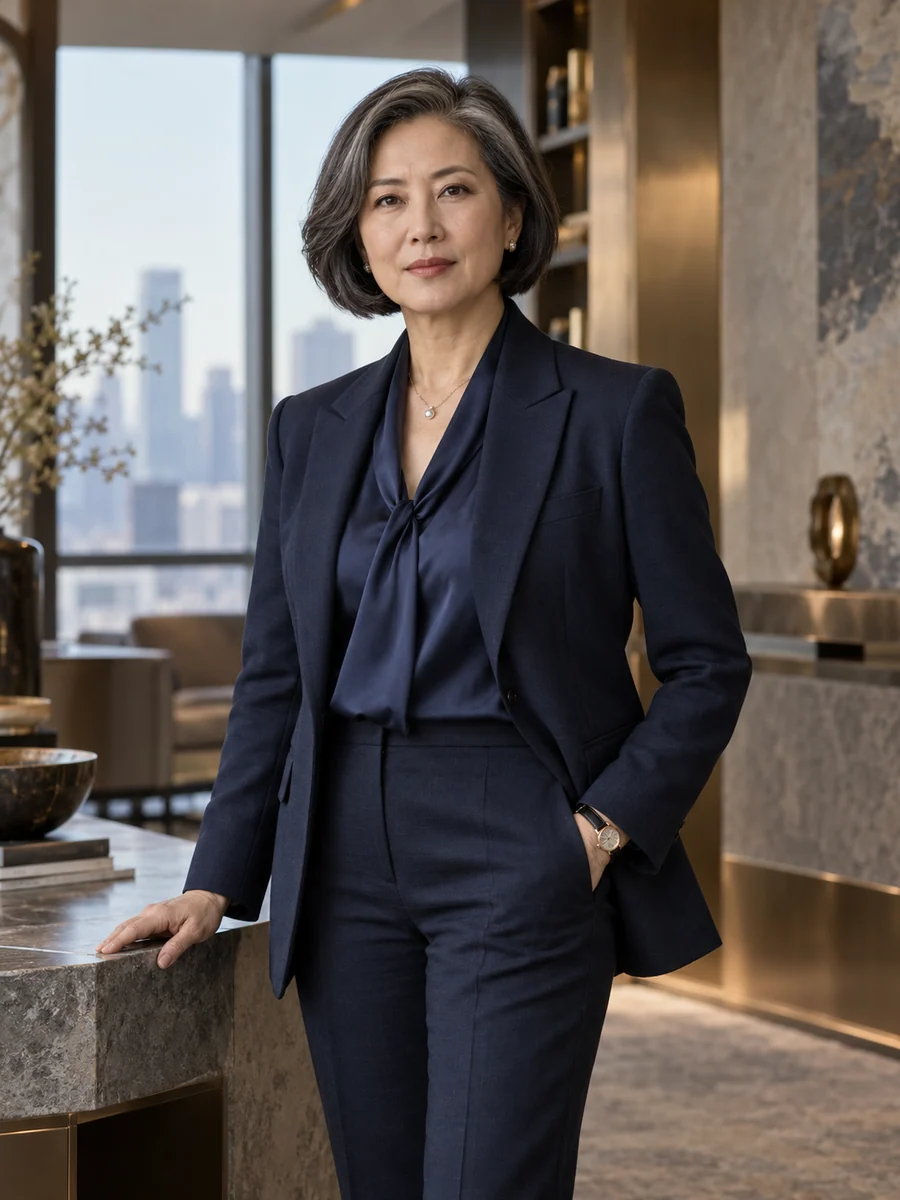
My father was a fitter at a state-owned textile-machinery works in Changzhou, and the most valuable things in his workshop were the imported looms nobody was allowed to touch. When one stopped, the factory waited weeks for a part and an engineer from abroad. I grew up thinking that the expensive machine was the one you could not repair yourself. It took me years to see that buyers were paying to be spared the waiting, not for the machine.
I studied mechanical engineering and automation at the Baixia Institute of Technology in Nanjing, graduating in 2001, and joined the Shanghai subsidiary of Ostvald Robotik AG, a fictional Swiss robot maker, as an applications engineer. For four years I programmed and commissioned welding and handling cells at auto-parts and machinery plants across Jiangsu and Zhejiang. In 2003 a seat-frame maker in Wuxi chose our robot over a domestic one that cost a third less. Its production manager told me he was not paying for the arm. He was paying for the engineer who would answer at two in the morning and the reducer that would be on his dock the next day. I wrote that down, and I have been trying to earn the same sentence for a Chinese brand ever since.
In 2006 I moved into product marketing at Ostvald's Chinese business, responsible for welding and handling robots. I ran launches and trade-fair stands, wrote application notes, and managed an integrator programme in East China that grew from 18 to 41 partners. The work taught me that a robot maker's real customer is usually the integrator who designs the cell and carries its risk, and that a foreign brand's premium in China rested on service habits rather than on engineering alone.
By 2010 I wanted to do the same work for a Chinese company. Xiyao Drive Technology, a private-equity-backed maker of servo drives and motion controllers in Shenzhen, hired me as head of marketing. When two competitors cut prices sharply in 2012, our sales team wanted to follow. We launched a simpler, cheaper drive line instead and held the price of the main range, and I learnt how quickly discounting destroys the margin that keeps a distributor paying for application engineers. I took a part-time executive MBA at Mochou Business School in Nanjing during those years, completing it in 2013.
Tingsong's founder hired me in March 2014 to build product marketing for a company that then made 46 robot variants and sold almost entirely in China. We organised them into four families with one controller and one programming interface, launched a palletising line and prepared our first export price list. In 2017 the founder asked me to move to Germany and establish marketing for our new European subsidiary. I spent three and a half years in Ludwigsburg, learnt German well enough to sit through an integrators' technical evening without a translator, and mostly listened. The integrators had three fears about a Chinese robot: that parts would take weeks, that documentation and support would come in poor English, and that the maker would leave Europe after a bad year. We answered each fear before we asked for an order. By the end of 2020 we had 24 certified European integrators and an application centre and parts store in Ludwigsburg.
I returned to Nanjing as chief marketing officer in April 2021, nine months after Tingsong listed. Since then I have argued for four positions that cost money before they earned any: that export prices must not follow the domestic price war, that a master distributor is a stage of market entry rather than a strategy, that a maker should publish its own failure rates, and that fair spending should be judged by the trials and meetings it produces rather than by the size of the stand. The price corridor cost us a slow year in Europe. The Turkish channel change cost a year of revenue there. The failure report exposed a weak palletiser in public. I still hold all four positions, and I have changed my mind about details of each.
I lead 186 people across Nanjing, Ludwigsburg, Bursa, Monterrey and Bac Ninh. About half are engineers, because marketing claims for robots have to survive contact with people who program them. My team finds one of my rules tiresome: no claim about cycle time, repeatability or reliability is published until a service engineer in the relevant country has signed it. I present our overseas plan and export price policy to the board every year and our channel and site proposals to its Strategy Committee, and I have learnt that a committee trusts a paper that shows the losing option at full strength.
My next step is a board one. I would like to serve as an independent director at a Chinese manufacturer outside my sector that is taking its own brand abroad, where the questions I have spent ten years on are still in front of the board and nobody yet has the scars.
Open to Board appointments · Speaking invitations
Languages / Mandarin Chinese · English · German
A leadership conviction
A claim about a machine should be one that a service engineer in the buyer's country would sign, in the buyer's language, before marketing prints it.
- Revenue, 2025
- RMB 3.86 bn
- 18,600 robots shipped from Nanjing and Changzhou
- Share of revenue earned outside China, 2025
- 35%
- Up from 18 per cent in 2020
- Certified integrators abroad
- 148
- Across 23 countries, from 31 in 2020
Education & credentials
- Bachelor of Engineering, Mechanical Engineering and Automation
- Baixia Institute of Technology · 2001
- Executive MBA, part-time
- Mochou Business School · 2013
Perspectives from colleagues
We were among the first integrators in Baden-Württemberg to certify on Tingsong robots, and we did it because of one conversation with Wen Guo in 2018. She asked what would make me lose sleep over a Chinese robot and wrote my answers down. Within two years the parts store, the German manuals and the hotline were all there, in that order.
When the Turkish distributor question reached our Strategy Committee, Wen's paper began with what the exit would cost and who would be hurt by it, including the distributor's own engineers. She asked us to accept a weaker year in Turkey, then reported against her own forecast every quarter until the revenue had returned.
When the master distributor left, our customers asked whether Tingsong was leaving Turkey too. Ms Guo came to Bursa that month, opened the parts store with us and gave us her own mobile number. In three years I have used it twice, and both times the part arrived the next morning.