Chief Information Officer Japan
From the plant room to the boardroom paper
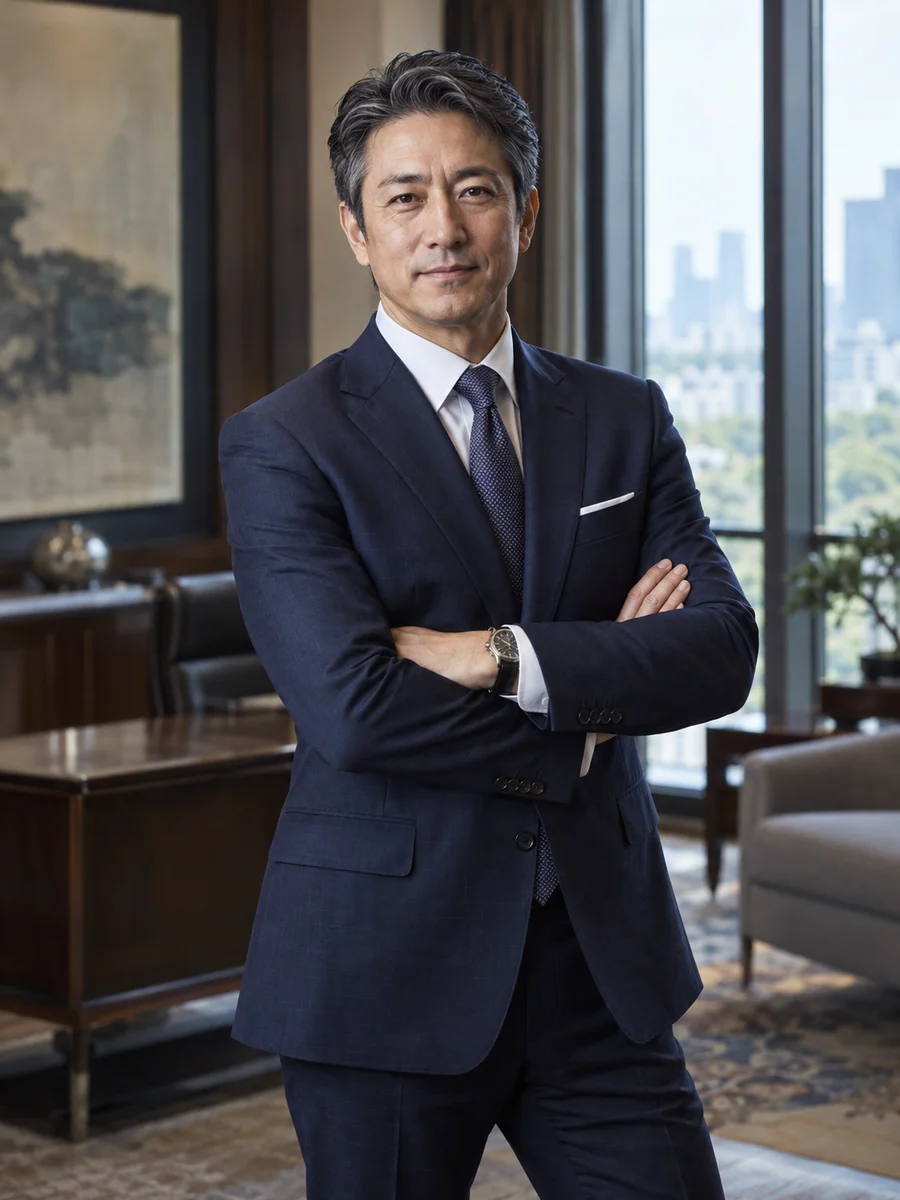
My father drove trains on a suburban line in Kanagawa, and the thing I remember most about his work is the notebook he kept of every irregularity he felt through the controls: a rough rail joint, a signal that changed late, a curve that rode differently after rain. He handed the notebook to the depot each week. Years later I learnt that most of what he wrote was never typed up anywhere. I have spent my career trying to make sure that what people notice about the structures they work in is written down somewhere it can be used.
I studied electrical engineering at Itozaki Institute of Technology and graduated in March 1993. That April I joined Kasumori Building Controls, a maker of building-automation systems, as a field engineer. For six years I commissioned central monitoring systems in office buildings across Tokyo and Kanagawa, which meant walking every plant room with a points list and checking that each sensor reported what its label claimed. In thirty-eight buildings I do not think a single list was right the first time. I learnt that a building's data is only as good as the afternoon someone spent verifying it.
In October 1999 I moved to the owner's side, joining Masaragi Facility Services, the building-management company of the railway group whose trains my father had driven. From 2002 I ran its remote monitoring centre, which watched alarms from 46 buildings through the night. The centre taught me how alarms fail people: too many of them, written for the equipment rather than for the person who has to act. We cut nuisance alarms by more than half by rewriting them around the decisions operators actually took.
In 2006 I moved to Masaragi Properties to manage facilities systems for the whole portfolio. I built our first equipment register for sixty buildings so that long-term repair plans could be costed from data rather than from rules of thumb. On 11 March 2011 I spent the afternoon beside the monitoring screens as alarms arrived from every building we owned, and the next two days answering tenants who wanted to know which floors they could return to. We answered from engineers' notebooks, one telephone call at a time. That experience is the root of the disaster work I have led since.
From 2012 I ran our newly merged information systems department, which brought corporate IT and building systems under one manager for the first time. We replaced the lease-management system and launched our first tenant portal. In 2015 a fragment of concrete fell from the underside of the railway's viaduct onto the roof of a café's storeroom. Nobody was hurt, but the railway's own inspection had flagged that span fourteen months earlier and the finding had never reached us. I built the arrangement under which the railway now sends us every finding that affects a tenanted span within two working days. Between 2013 and 2015 I also studied for an MBA in the evenings at Shiokaze Graduate School of Management, mainly to learn how the people who approved my budgets thought.
In April 2017 the group seconded me to Masaragi REIT Management, the asset manager of our sponsored J-REIT, to run its systems and investor data. Four years there taught me how a building looks from the investor's side of the table. It also gave me the decision I am least comfortable with and most glad I made: recommending that the REIT restate three years of energy figures because too many of them were estimates presented as measurements.
I returned in April 2021 as Masaragi Properties' first chief information officer. I lead 58 people across information systems, building data and security, with six direct reports, and about ninety engineers from our contractors. I present to the board several times a year and report twice a year to the group's risk management committee. I ask my team for two habits: label every figure with how it was obtained, and assume that the person who most needs a piece of data is not the person who collects it.
Inside the industry I am probably known for three positions that some colleagues find awkward. A continuity plan should be judged by what tenants learn after an earthquake, not by how fast the ledger returns. A building's remote-maintenance lines belong to its owner, not to each equipment vendor. And an inspection report is only useful if the next one can be compared with it. I hold each of them because I have watched the alternative fail.
Open to Board appointments · Speaking invitations
Languages / Japanese · English
A leadership conviction
A building will tell its owner a great deal about itself, provided someone has decided in advance what to ask, how to record the answer and who needs to hear it.
- Buildings whose systems and data my team supports
- 71
- Plus 212 tenancies beneath the railway's viaducts
- To publish a status for every building after the February 2025 earthquake
- 26 min
- 61 lifts stopped; 58 running again within three hours
- Measured coverage of the J-REIT's energy data, year to March 2026
- 88%
- Up from 59 per cent when estimates were first labelled in 2019
Board & advisory record
Current appointments
Masaragi Systems Co., Ltd.
Director of the group's shared systems company, in an executive capacity
2021–present
Education & credentials
- Bachelor of Engineering, electrical engineering
- Itozaki Institute of Technology · 1993
- Master of Business Administration, evening programme
- Shiokaze Graduate School of Management · 2015
- Director-preparation programme
- Sakuraoka Directors' Forum · 2025
Perspectives from colleagues
Kenji brought me two papers on the tower's entry gates: mine and his. His was better, and he never mentioned that afterwards. He tells the board what our buildings can and cannot tell us, which is rarer than it should be in a property company.
As a supervisory director I was told in 2019 that two-fifths of our energy figures were estimates, and given two honest options. Kenji set out the asset manager's preferred course as fairly as his own. That restatement is why I trust the REIT's data today.
After the February earthquake our staff asked within minutes whether they could go back up. Masaragi's page told us which floors had been checked and which had not, with names and times, and the one correction came quickly. Other landlords sent us nothing until the afternoon.