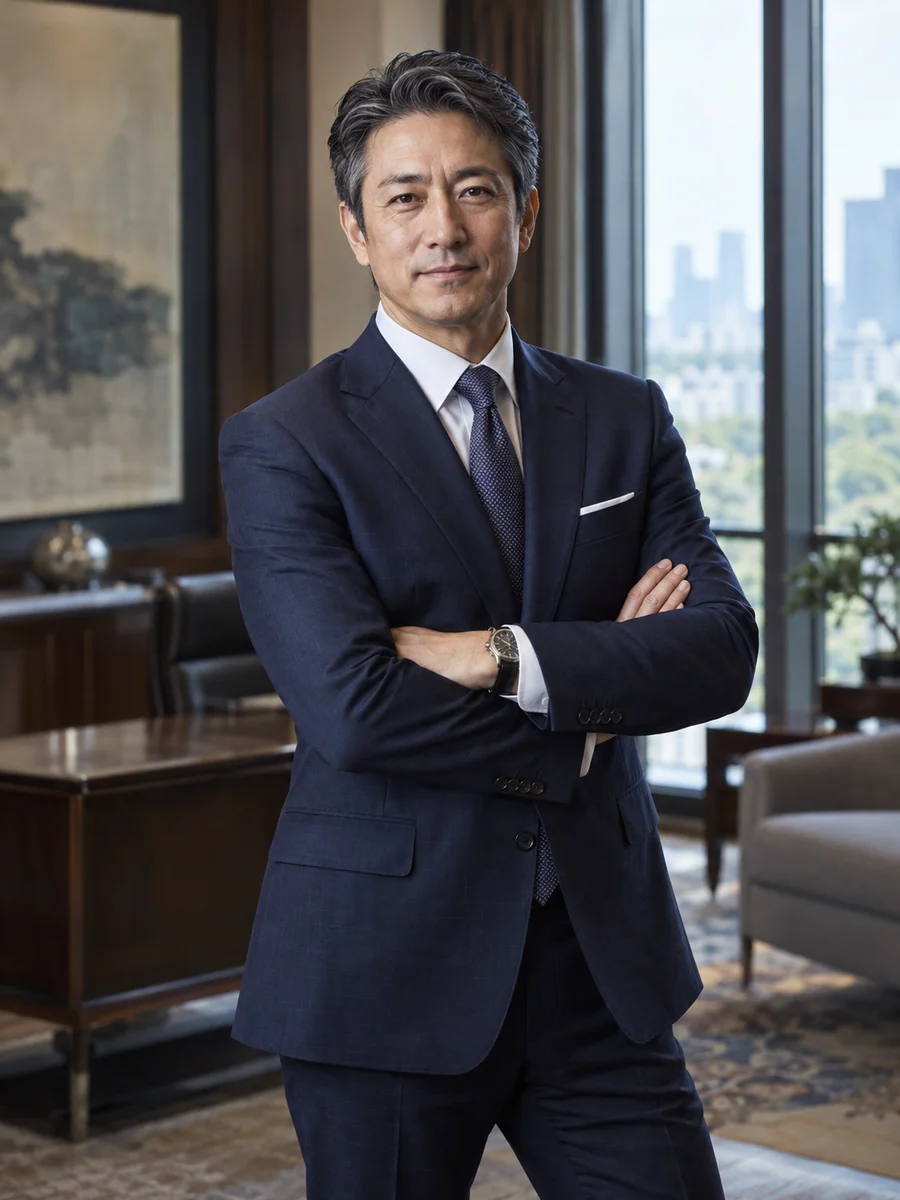
Kenji TakahashiChief Information Officer · Essays & perspective
The leadership review
Kenji Takahashi
Chief Information OfficerJapanVolume 03
Earthquake continuity6 min read
After the shaking stops, tenants need a floor-by-floor answer
Property companies in Japan write continuity plans around restoring their own computer systems. The first thing tenants need after an earthquake is something else: a status for their building and floor, set by a named person, stated honestly.
A building will tell its owner a great deal about itself, provided someone has decided in advance what to ask, how to record the answer and who needs to hear it.
Buildings whose systems and data my team supports
71
Plus 212 tenancies beneath the railway's viaducts
To publish a status for every building after the February 2025 earthquake
26 min
61 lifts stopped; 58 running again within three hours
Measured coverage of the J-REIT's energy data, year to March 2026
88%
Up from 59 per cent when estimates were first labelled in 2019
A railway landlord's systems earn their keep when they can tell a tenant, within the hour, what is known about the building and what is not.
I am the chief information officer of Masaragi Properties, the fictional real-estate company of a private railway group whose lines run from a Tokyo terminus into the suburbs of eastern Kanagawa. We own 71 buildings: the terminal building above our station in Tokyo, offices, station-front shops, logistics warehouses and rental flats, along with 212 small tenancies beneath the railway's elevated track. Our revenue in the year to March 2026 was ¥118.4 billion. We also sponsor a listed J-REIT, and my team supplies its asset manager with the building data behind what it tells investors. In that world the initials CIO usually mean the chief investment officer, so I spell out my title.
I did not arrive in this job through corporate IT. I started in 1993 commissioning building-automation systems for an equipment maker, wiring sensors to screens in Tokyo office towers. In 1999 I moved to the owner's side, to our group's building-management company, and ran its remote monitoring centre. Since then I have worked with almost every kind of record a building produces, from alarms and inspection findings to the energy figures that reach investors.
That background shapes what I think the job is for. A property company's systems are tested on the worst day, when the ground has shaken and two thousand tenants want to know whether to send their people back upstairs. They are also tested quietly, over decades, by whether a 1971 building's inspection history can show its owner how fast it is ageing. I spend most of my time on those two tests, and on making sure that every figure we publish says plainly how it was obtained.
Floor-by-floor status within half an hour
When a weekday-morning earthquake stopped 61 of our lifts in February 2025, tenants of all 71 buildings saw a status for their floors within 26 minutes. Fifty-eight lifts were running again within three hours, in an order agreed with their maintainers in advance.
143 vendor connections reduced to 12
An inventory in 2022 found 143 remote-maintenance connections into our building networks, 37 of them with no owner who could explain them. By March 2025, 131 had closed, with their vendors moved to one gateway we own.
A new tower opened with its asset register already loaded
We wrote an asset-information requirement for 2,150 maintainable items into the ¥64 billion design-and-build contract for our 27-storey station tower. Sample checks cut mismatches against installed equipment from 9.2 per cent to 1.4 per cent before it opened in March 2025.
Investor energy data that says how it was measured
At the REIT's asset manager in 2019 I recommended restating three years of energy figures that had mixed meter readings with floor-area estimates. Measured coverage was 59 per cent then; it reached 88 per cent in the year to March 2026.
Current focus
I am preparing the data the board will need to decide between refurbishing and rebuilding our 1971 terminal building: forty years of inspection findings converted into deterioration rates, the remaining life of its building systems, and the effect of either choice on its tenants. Alongside that, I am readying the group's property data for Japan's new sustainability disclosure standards.
Conversations I welcome
I am not looking to leave Masaragi. I would consider one outside directorship at a listed company beyond real estate and railways whose operations depend on control systems and on recovering quickly from earthquakes, subject to my employer's consent and a conflicts review. I give a small number of talks each year to building owners and facility managers.
Beyond the page
The record behind the perspective.
In the boardroom
Masaragi Systems Co., Ltd.Director of the group's shared systems company, in an executive capacity · 2021–present
Formation
Bachelor of Engineering, electrical engineeringItozaki Institute of Technology · 1993
Master of Business Administration, evening programmeShiokaze Graduate School of Management · 2015
Director-preparation programmeSakuraoka Directors' Forum · 2025
Kenji brought me two papers on the tower's entry gates: mine and his. His was better, and he never mentioned that afterwards. He tells the board what our buildings can and cannot tell us, which is rarer than it should be in a property company.
Tadashi IchikuraFictional President and Representative Director, Masaragi Properties Co., Ltd.The full record ↗
Contact
I am not looking to leave Masaragi. I would consider one outside directorship at a listed company beyond real estate and railways whose operations depend on control systems and on recovering quickly from earthquakes, subject to my employer's consent and a conflicts review. I give a small number of talks each year to building owners and facility managers.