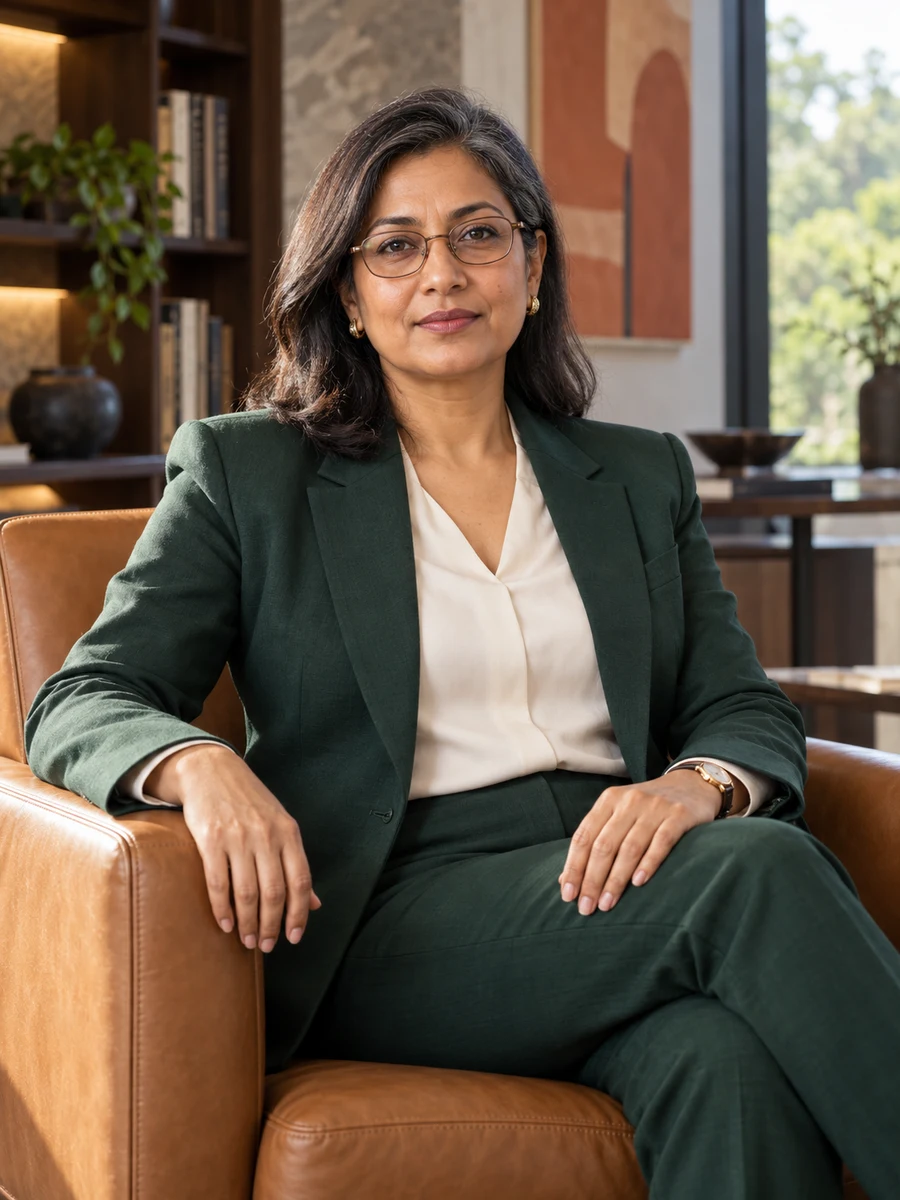
I run customer-support operations by keeping the caller’s unresolved need visible after a conversation ends, a queue changes or a summary replaces their own words.
Open toBoard appointments · Executive opportunities
A conversation can end before the customer’s need is resolved. Operations should keep the next responsibility visible without asking the customer to reconstruct the company’s internal handovers.
Bijoya Qenzavri
Operating organisation
204 colleagues
Five heads across customer contact and appointment coordination
Annual operating expense
₹48 crore
FY2026–27; ₹4.2 crore systems programme separately approved
Service career
28 years
Coordination assistant through operating leadership
Leadership, seen by others.
Bijoya brought the timing of incoming work into a staffing discussion that had become too comfortable with daily totals. She proposed a bounded pilot and kept its limits visible before we considered anything wider.
When I challenged the resolution figure, she reopened the records and acknowledged her approval. She wanted the customer’s remaining action visible even though the corrected report was less flattering.
In 2019 I approved a service report that treated ninety-six closed records out of 120 reviewed contacts as eighty per cent resolved. Meenakshi’s review found that twenty-four of those closed records still required action: twelve were transferred and twelve awaited a callback. Seventy-two of the 120 were supported as resolved, or sixty per cent in that selected review. I had accepted a system status as an account of the customer’s outcome. We reopened the twenty-four and spent ₹28 lakh over eight weeks changing the review process. The correction did not prove an enterprise-wide resolution rate.
I now lead operations at Drezqoni Customer Operations in Agartala. We provide managed customer contact and appointment coordination for business-equipment service companies, with 268 employees and ₹86 crore FY2025–26 revenue. My 204 operating colleagues work through five heads within ₹48 crore operating expense and a separate ₹4.2 crore systems programme. Hamid is our CEO, and Meenakshi leads service quality. Clients retain repair and contractual decisions; our role is to preserve the customer request and the next accountable action through the service we have agreed to provide.
Subsequent decisions concerned when incoming work arrived and whether an agent’s summary preserved what the customer had actually asked. A ten-day review showed repeated morning demand concentrations that a daily staffing average concealed. A separate forty-record language review found thirty-one summaries faithful to the request and nine that changed its meaning. We revised the operating account in each case without inventing a satisfaction improvement or claiming authority over the client’s repair outcome. My operating appointment carries no statutory directorship, and I have no personal ownership interest. A possible first outside-board contribution would require further governance learning, specific assessment and a realistic twenty-two-day annual commitment alongside executive work.
Closed records separated from supported customer resolution
Seventy-two of 120 reviewed contacts were supported as resolved; twenty-four closed records still required a transfer or callback action.
The arrival pattern changed the staffing discussion
A ten-day observation exposed repeated morning pressure that a daily average had hidden; coverage was revised for a bounded pilot.
Customer meaning checked after summarisation
Nine of forty reviewed summaries changed the request; thirty-one preserved it, and the nine were corrected before further reliance.
Operating ownership with clear client boundaries
Five heads coordinate 204 colleagues; clients retain repair and contractual decisions beyond our agreed service.
Current focus
Customer operations that preserve the unresolved need
Conversations I welcome
Operating leadership and a prepared first non-executive contribution
The leadership record
Trusted with consequential decisions.
Formation
Bachelor of Arts in SociologyDrezvoni Social Studies College · 1998