File sectionThe person behind the perspective
I wanted to stay with the meaning of the record after the handover.
The first telecom datasets I worked with looked precise because almost everything had an identifier. That precision could be deceptive. A subscription record did not necessarily identify one person, a telephone number could be assigned to different customers over time and several sector records could belong to one physical site. I became interested in the relationships behind those identifiers, especially when a concise management statement treated the count of one thing as evidence about another.
I completed information studies at the fictional Selvaren Institute of Information Studies in June 1990 and joined Temvarune Analytics in August. I worked in a nine-person analytical group without management or expenditure authority. The assignments taught me to ask what a source record represented before interpreting its volume. A large extract could be technically consistent and still be unsuitable for the conclusion a reader wanted to draw. Understanding the object and the observation became as important to me as checking the calculation.
I became an engagement lead in April 1997. By 2003 I led nineteen colleagues through three direct reports with S$860000 annual delivery expense. Temvarune’s S$31 million fee revenue and 170 employees described the advisory business around us. I wanted to stay with the consequences of a telecom definition after the assignment ended. Joining Navirelan Networks as head of usage data in July 2004 gave me continuing responsibility for the accounts that operating and commercial teams would reuse.
I made a consequential error in 2007. A delivery process had received eighty million usage records, and I approved that number as a traffic-event count. Daniel Varneshu’s review found seventy-four million distinct source-and-event identifier pairs, with six million replayed receipts following delivery retries. S$720000 supported review and correction. We kept the receipt log separate from the distinct-event view, without assuming that every similar-looking record was a replay. The change did not establish a billing refund or additional traffic; it corrected the meaning I had attached to the received count. I explained the revision to the same management recipients who had seen my earlier account, so the correction was not hidden inside a later extract.
The director of customer and network information appointment began in September 2012. It broadened the problem from events to identities across time and systems. A 2015 review followed eighty-four thousand number disconnections, with fifty-one thousand numbers reassigned during the review year. Joining records by telephone number alone could carry an earlier customer’s history into a later assignment. We retained assignment intervals rather than treat the number as a permanent person identifier, leaving permitted-use decisions with the responsible privacy and legal owners.
I became CDO in April 2019. My current function has 162 colleagues through seven direct reports and S$24.8 million delegated 2026 expense. Navirelan’s S$4.1 billion company revenue and 9100 employees are separate institutional context. Network engineering, operations, billing decisions, marketing, finance and cybersecurity do not become my authority because their work uses data. My CDO role includes executive board presentations, but this invented career contains no statutory-director appointment.
Recent work has examined the populations behind telecom claims. A 2023 account contained 7.8 million registered mobile-subscription records, of which 6.1 million met an internal ninety-day activity condition. Neither count established unique people. A network inventory needed twelve hundred physical sites distinguished from thirty-six hundred sector records. A voluntary testing account needed its twelve thousand observations described as a selected cohort rather than a representative statement about every subscriber’s experience. Each problem required its own relationship and definition; a universal instruction to remove duplicates would not have solved them.
I would bring these experiences to a possible first board role with preparation for collective responsibilities and the intended institution’s circumstances. I would help colleagues question what the population in a report actually represents and whether the public claim remains within that evidence. I would also expect them to challenge my own interpretation, as Daniel did. Every person and event here is invented. The narrative is designed to make a telecom CDO’s judgement visible through a coherent career, an owned mistake and bounded results, rather than imply that the data executive personally delivered every customer, network improvement or commercial outcome described by the company.
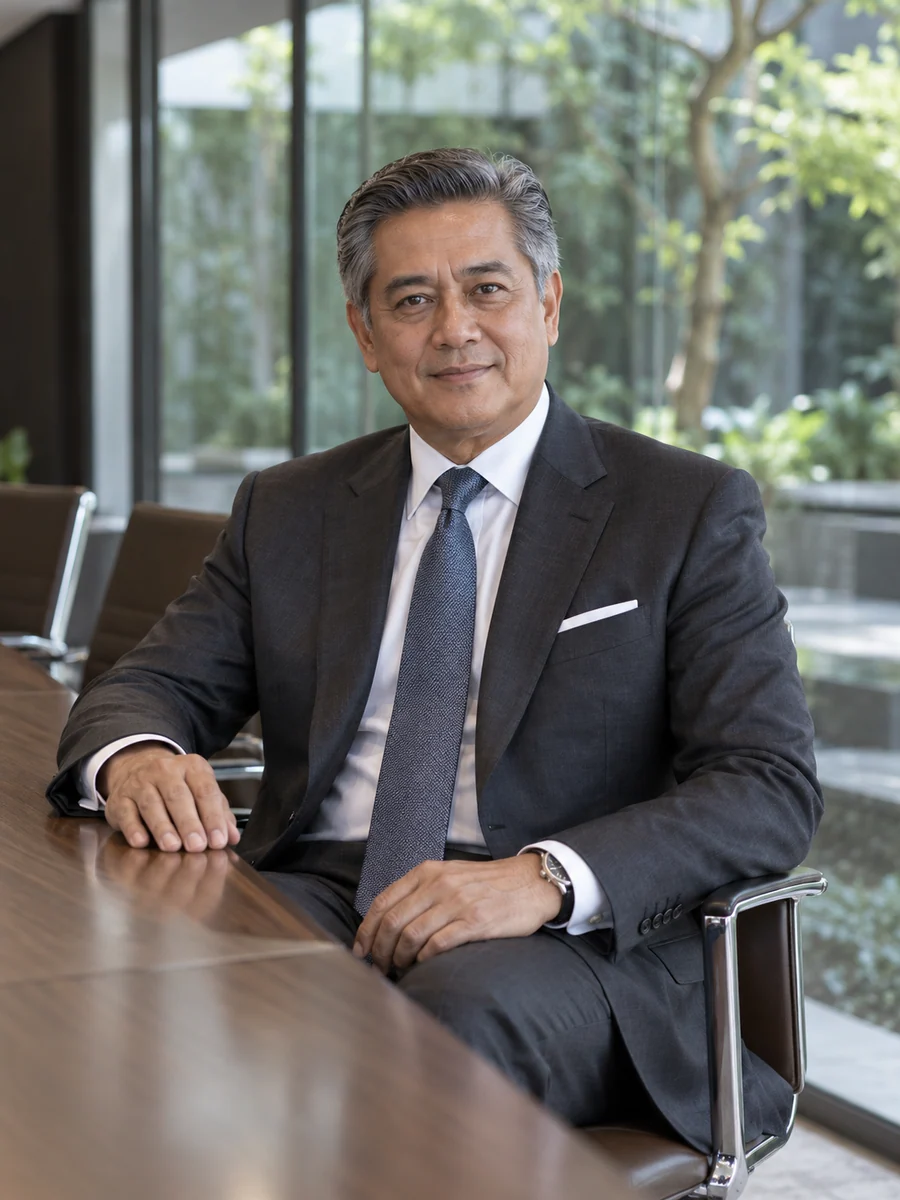
In my own words
I want a telecom record to retain the kind of thing it identifies. A subscription, a telephone number, a physical site and a person are related through the service, but they are not interchangeable. My data function makes those relationships visible so that a larger count does not quietly become a larger claim about reach, experience or the network itself.
Rizal Santoso
Career
Chapters of accountability
2019 — present
Chief Data Officer
Navirelan Networks
Keep subscription, network and experience claims within the populations their evidence supports.
2012 — 2019
Director of customer and network information
Navirelan Networks
Connect identifiers to their assignment periods and preserve the relationships behind the account.
2004 — 2012
Head of usage data
Navirelan Networks
Maintain the event account while learning from an owned error about delivery receipts.
1997 — 2004
Engagement Lead
Temvarune Analytics
Lead analytical deliveries and develop an interest in their continuing operating consequences.
1990 — 1997
Information Analyst
Temvarune Analytics
Ask what a source row identifies before using its volume as evidence.
Education
Formation
- Bachelor of information studiesSelvaren Institute of Information Studies1990
Working languagesEnglish · Bahasa Indonesia · Malay