Section · The person behind the perspective
Learning to recognise the work the enterprise requests
I work on the employment choices around professional judgement. The company may ask a colleague to examine another person's work, challenge an assumption or retain a difficult finding. Those responsibilities can be essential without appearing as a separate item on a customer invoice. My concern is whether the career and assessment system recognises the contribution it has asked for. I learned that question through a framework I helped approve, rather than arriving with a perfect answer about how technical work should be valued.
I grew up in Mysuru and completed a full-time MBA in People Management at the fictional Trezqami School of Management in May 1998. My first appointment began in July at Qezavmi Field Services. The business employed sixty-two people and recorded ₹12 crore FY1999 revenue. As personnel coordinator I worked under the people-services manager, without direct reports or spending authority. The role introduced me to the practical importance of an accurate employment record. A date, assignment or reporting relationship could affect how a colleague understood what the company had promised.
In June 2004 I became people operations manager. Qezavmi then employed 117 people and recorded ₹27 crore FY2005 revenue. I led five colleagues with ₹58 lakh annual function expense. The work required consistency, but I learned to distinguish consistency from treating unlike situations as if they were identical. A clear process should help an employee understand a decision. It should not make an incomplete record authoritative simply because everyone is asked to use the same form. That distinction later became important when acquired colleagues brought service histories from another employer.
I joined Zaqvermi in September 2011 as HR business partner. The survey and advisory enterprise had 164 employees and ₹39 crore FY2012 revenue. Four colleagues worked with me within ₹72 lakh annual function expense. Technical professionals described contribution in ways that a generic people framework did not always capture. Client-facing assignments were visible, while internal review, preparation and professional development could appear as time away from the main work. I needed to understand the actual responsibility before deciding how it should enter assessment or a career discussion.
The head-of-people appointment followed in January 2017. The company employed 226 people and recorded ₹58 crore FY2018 revenue; I led nine HR colleagues with ₹1.5 crore annual function expense. In that period I endorsed the appraisal design that overweighted billable assignment time. Latha challenged its treatment of instructed internal technical review. We revisited twenty-eight affected records, changed six ratings and confirmed twenty-two. The ₹18 lakh correction was specific to the resulting pay review. I accepted that the framework had made a contribution we requested harder to recognise.
I became CHRO in May 2021, reporting to Farhan. Today the fourteen-person HR team works through three leads in a 312-person enterprise. The company records ₹86 crore FY2026 revenue, comprising ₹64 crore survey/advisory and ₹22 crore asset-record services. My ₹2.4 crore FY2026–27 function expense is separate from the enterprise's ₹31 crore FY2026 employee expense. Founder professionals hold 46%, an employee vehicle 34% and a long-term private investor 20%. I have no personal equity and no statutory board seat. Those distinctions keep company scale, ownership and my authority from becoming interchangeable in the biography.
The subsequent cases examine different employment choices. An acquisition brought forty-two colleagues whose earlier service needed a proper response in a voluntary recognition programme. A principal-role discussion allowed nineteen professionals to consider technical or people-management responsibilities without assuming that advancement required the latter. A review of eleven client requests for assignment removal separated substantive issues, unsubstantiated personal pressure and unfinished enquiries. A portfolio process allowed some professional accounts to be shared while retaining authorship and confidentiality questions. None of these programmes made every case complete or every participant satisfied.
I do not assess the condition of a structure or confer professional authority through an employment decision. Qualified colleagues retain their responsibilities. My contribution is to make the working arrangements around those responsibilities more coherent: what the organisation asks, how it judges the employee and what it recognises in a career. I am also preparing for a possible first board role. IICA databank registration is recorded from August 2026, with assessment work unfinished and no exemption claimed. Twenty days is a preliminary annual capacity estimate. A real appointment would require the relevant preparation and relationship review, rather than treating this executive experience as proof that the transition is already complete.
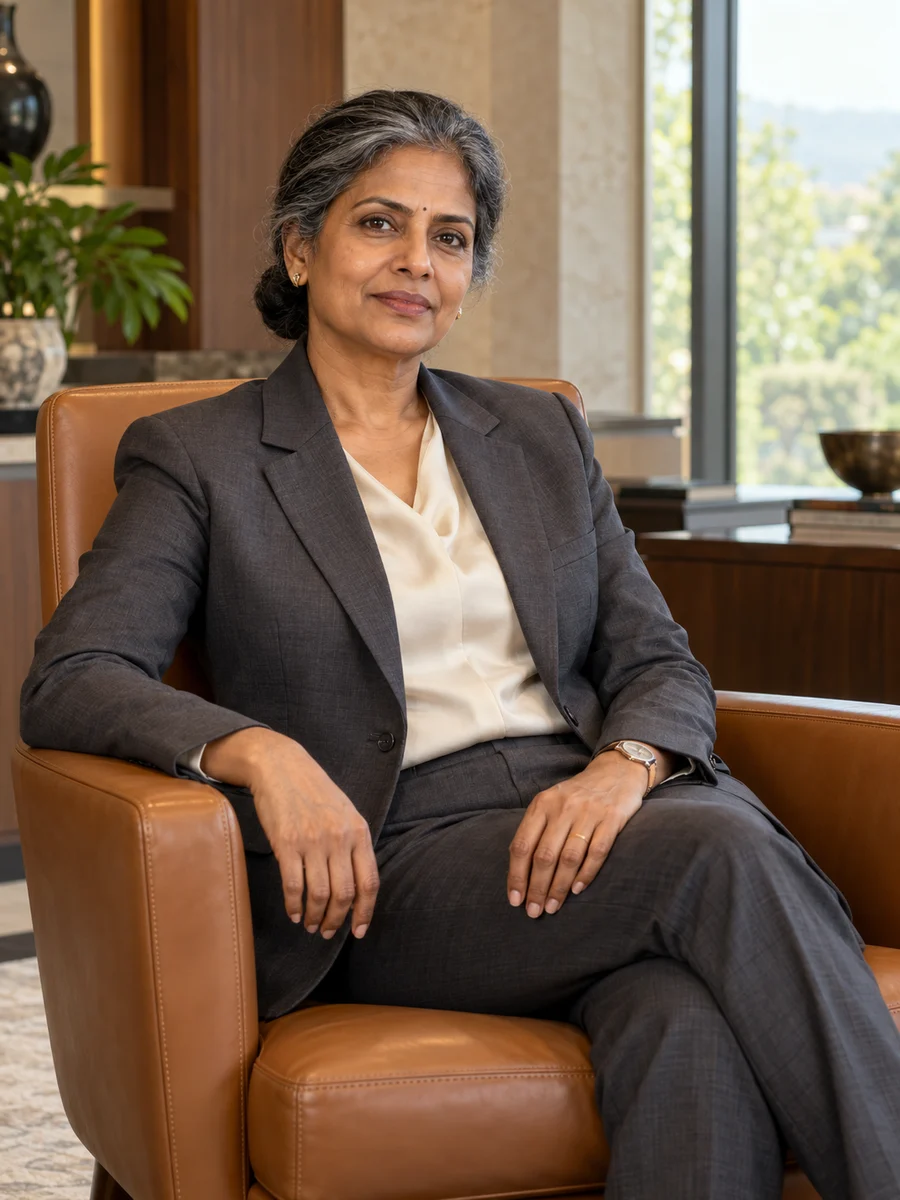
In my own words
I want the organisation to recognise the work it asks a professional to do, including the work that does not become a separate client invoice. A career should offer responsibility that fits the contribution, with an honest account of who can judge technical competence and who can decide the employment arrangement around it.
Rukmini Vezqavri
Education
Formation
- MBA in People ManagementTrezqami School of Management1998
Working languagesEnglish · Kannada · Tamil