Chief Financial Officer Singapore / Southeast Asia
Two exercise books, with more columns
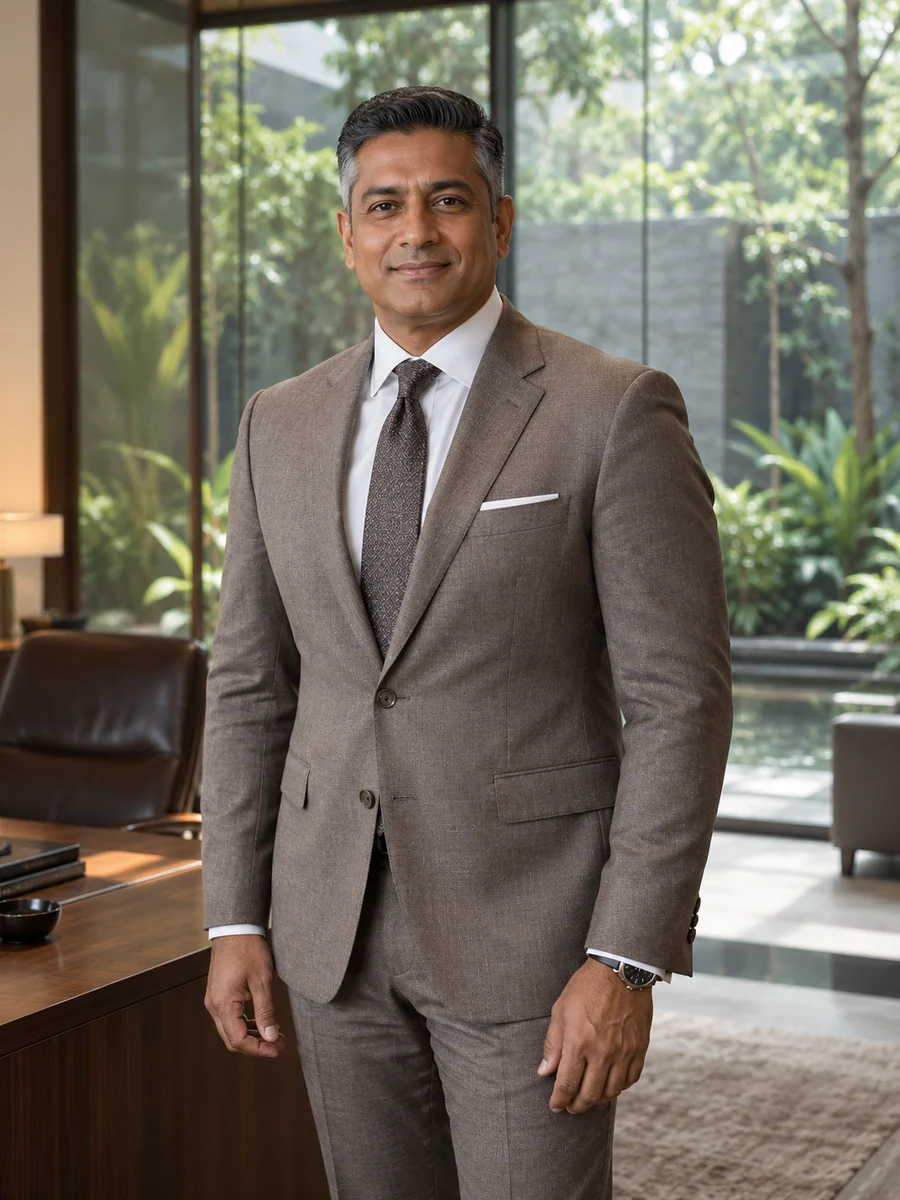
My mother ran a provision shop in Bedok for twenty-two years, and she kept two exercise books. One recorded what she owed the wholesalers, who expected payment within thirty days. The other recorded what neighbours owed her: some paid when their wages arrived at the month's end, some when a son working abroad sent money home, and a few never paid at all. When I was eleven she began trusting me to total both books. I had no word for maturity mismatch, but I understood why she slept badly in the weeks when the second book grew faster than the first. I have spent my career on the same two books, with more columns.
After national service I read accountancy at Bukit Teratai University in Singapore, graduating in 2000, and joined Seah Arumugam & Partners, an audit practice whose clients included finance companies, insurance brokers and the Singapore branch of a mid-sized foreign bank. I qualified as a chartered accountant in 2003. Audit taught me to read a credit file properly and to notice when a provision had been settled by negotiation rather than evidence. It also showed me that an auditor sees a bank as a still photograph. I wanted to watch it move.
In 2004 I joined Harbourfield Bank, a Singapore-listed regional lender, in its group treasury finance team. I verified the prices our dealers used and explained each day's trading result, and from 2006 I also reported the interest-rate exposure sitting in the banking book. The autumn of 2008 was my real education. Instruments that had always been quoted stopped being quoted, and our valuation committee met almost every day. I learnt that a model is useful only in the hands of someone who can say when to stop believing it, and that liquidity can vanish in a week and take years to return.
In 2009 Harbourfield asked me to move to Kuala Lumpur as head of finance for its Malaysian Islamic subsidiary, which had recently been carved out of the conventional bank. I knew the arithmetic of banking and very little of its Islamic form. The members of our Shariah committee were patient teachers. From them I learnt that a commodity murabahah deposit is a sale rather than a loan, that the order in which a contract's steps occur can decide whether its income may be kept, and that an Islamic bank's accounts must show what was permitted as well as what was earned. I studied in the evenings for a postgraduate diploma at the Bayumas Institute of Islamic Finance and completed it in 2011.
Sejahra Islamic Bank recruited me in 2013 to run balance sheet management: liquidity, profit-rate risk and capital planning for a domestic Islamic bank about four times the size of the one I had left. I prepared us for the liquidity coverage ratio when Bank Negara Malaysia introduced it in 2015, and became deputy CFO in 2016. In that role I led our adoption of MFRS 9 in 2018 and arranged our first subordinated sukuk in 2019. During 2020 I spent most of my time accounting for repayment moratoria and building the management overlays that would later become one of the hardest arguments of my working life.
I became chief financial officer in April 2021. The bank had grown to about RM38 billion of assets, and three habits worried me. We held a large book of fixed-rate personal financing funded by deposits that repriced within months. We depended on a handful of institutional depositors. And our listed parent had announced a payout aspiration without a capital plan beneath it. Most of my work since has been about those three habits. I hedged part of the rate exposure before the 2022 increases, let RM2.6 billion of expensive institutional deposits leave, recommended a smaller dividend than our parent wanted and held part of our credit overlays for a year longer than was comfortable.
I lead 240 people across financial reporting, management reporting, balance sheet management, capital, tax and zakat. I ask for workings that a Shariah reviewer, an external auditor and a branch manager could each follow, and I expect my team to tell me which assumption in a paper they trust least. I am not a director of the bank: I attend board and committee meetings as an invitee, present and answer questions. The Board Audit Committee and the Board Risk Management Committee have taught me that a good paper states on its first page the decision directors are being asked to take.
People in Malaysian Islamic banking probably know me for three positions. Salary-deduction financing is a rate exposure as much as a credit one. A bank's payout should come out of its stress test rather than its parent's shareholder register. And Shariah non-compliance usually begins in operations, not in contracts. I live in Kuala Lumpur and return to Singapore most months. I am now preparing for a non-executive role outside banking, on the other side of an audit committee table.
Open to Board appointments · Speaking invitations
Languages / English · Malay
A leadership conviction
A number I cannot trace to a contract, a depositor or a Shariah ruling is not ready to go in front of a board.
- Total assets, December 2025
- RM46.2bn
- 64 per cent of financing to households, 36 per cent to businesses
- CET1 ratio, December 2025
- 13.6%
- Up from 12.4 per cent in December 2023 under a stress-tested payout
- Current and savings accounts
- 31%
- Share of customer deposits, up from 24 per cent in 2021
- Finance colleagues led
- 240
- Reporting, balance sheet management, capital, tax and zakat
Board & advisory record
Current appointments
Sejahra Properties Sdn Bhd
Director of the bank's wholly owned property subsidiary, in an executive capacity
2021–present
Education & credentials
- Bachelor of Accountancy
- Bukit Teratai University · 2000
- Chartered accountant, after supervised audit experience
- Seah Arumugam & Partners · 2003
- Postgraduate Diploma in Islamic Finance
- Bayumas Institute of Islamic Finance · 2011
Perspectives from colleagues
When the parent wanted the whole overlay released, Darren came to the committee with three cohorts, a reason for each and a written test for letting go. We minuted his conditions and checked them every quarter. A year later two of those cohorts turned, and the provision was already there.
Darren never asks our committee to bend a ruling. He asks how his systems can carry out what we approved, and when they fail he brings us the full count, not the sample. That is rarer in a finance office than it should be.
In 2008, when half our marks were guesses, Darren wrote the valuation papers that told the committee which guesses they were. He was a junior officer then, and he already understood that saying what you do not know is part of the number.