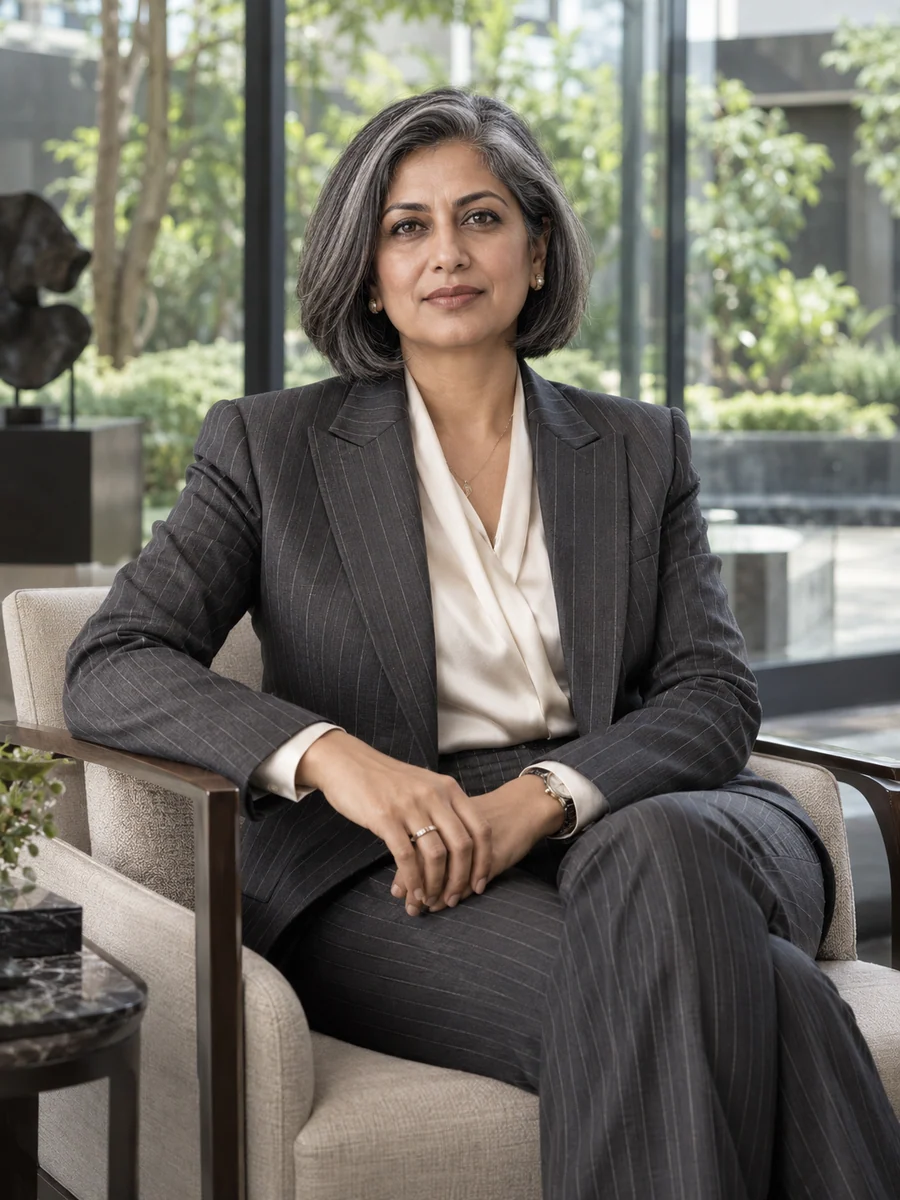
In Indian regional media, strategy is the discipline of holding one language's attention so deeply that distributors, advertisers and global platforms have to come to you.
I am the chief strategy officer of Ilavenil Media Networks Limited, a fictional Chennai-based broadcaster listed on the NSE and BSE and controlled by its founding family. We run eleven television channels in Tamil, Telugu, Kannada and Marathi, a streaming service called Ilavenil Play with 2.3 million paying subscriptions, and a library of about 2,600 films. Revenue for the year to March 2026 was ₹2,460 crore: ₹1,050 crore from advertising, ₹880 crore from the platforms that distribute our channels, ₹190 crore from streaming and ₹340 crore from licensing our films and series to others.
My work is to decide where the company should spend its attention and its capital as viewing moves from the living-room set to the phone. I came to it by an indirect route: six years counting viewers for a media research firm in Mumbai and Chennai, six years as an equity analyst covering Indian media and telecom companies, and five years in corporate development at an independent tower company during the upheaval that followed a new mobile operator's arrival in 2016. I joined Ilavenil in 2018 to rebuild our distribution agreements under TRAI's new tariff framework, and became its chief strategy officer in April 2021.
Three convictions run through the decisions I have argued for. A regional broadcaster is valued for how deeply it holds one language's audience, not for how many languages it touches. Content should be bought at a price justified by the hours people will spend with it over ten years, not by the star on the poster. And partnerships with global platforms are worth signing when we keep the rights that pay in the tenth year. Each conviction has cost us something visible, and I set out those costs on this site beside the results.
A Marathi broadcaster instead of a Hindi stake
In 2022 we bought Ghatmatha Entertainment, a Pune-based Marathi broadcaster, for ₹465 crore rather than pay ₹1,380 crore for 51 per cent of a loss-making Hindi channel cluster. Its revenue has grown from ₹128 crore to ₹236 crore and its share of Marathi entertainment viewing from 18 to 24 per cent.
Film rights priced by viewing hours
We value every new film by the hours it should earn across ten years of telecasts and streams. Film-rights spending fell from ₹310 crore in 2020–21 to ₹246 crore in 2023–24 while hours watched from films rose 9 per cent. We gave up two festival premieres to do it.
Series that come home after two years
Our 2023 agreement with a global streaming service pays ₹168 crore over three years for an exclusive two-year window on eighteen Tamil and Telugu series. We accepted ₹42 crore less than its offer for perpetual rights, and the first five series have returned to our channels and app.
Less exposure to the advertising cycle
Advertising fell from 54 per cent of revenue in 2020–21 to 43 per cent in 2025–26 as distribution, streaming and licensing income grew. When consumer companies cut regional budgets in 2024–25, our total revenue still rose 4 per cent.
Current focus
I am preparing the board's strategy session for February 2027, where the central question is whether Ilavenil Play should stay inside the channel business or be run as a separate unit with its own capital and, possibly, an outside investor. Alongside it I am leading our response to a proposed merger between two platforms that carry our channels across the South, which would change our negotiating position in three of our four languages.
Conversations I welcome
I am not seeking to leave Ilavenil. With my board's consent, I would consider one independent directorship at a listed company outside media, entertainment and telecom that faces a structural question: consolidation in its sector, dependence on a much larger partner, or expansion into new regional markets. Twenty-five days a year, preparation included, is what I can honestly offer. I also accept a small number of invitations to speak to strategy and governance audiences.
Contact
I am not seeking to leave Ilavenil. With my board's consent, I would consider one independent directorship at a listed company outside media, entertainment and telecom that faces a structural question: consolidation in its sector, dependence on a much larger partner, or expansion into new regional markets. Twenty-five days a year, preparation included, is what I can honestly offer. I also accept a small number of invitations to speak to strategy and governance audiences.
- Board appointments
- Speaking invitations