Chief Human Resources Officer Japan
The clerk who came back to run the company's people
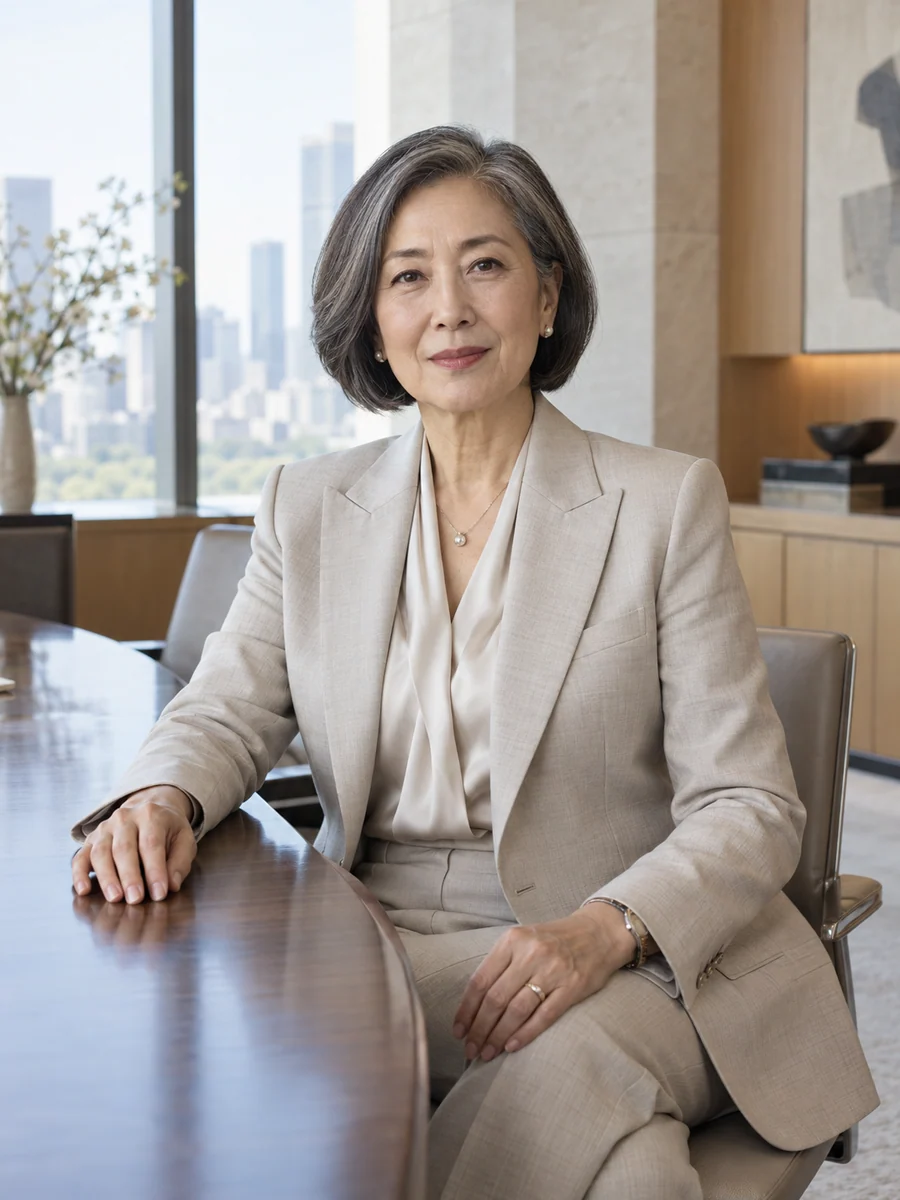
The first thing I learnt about construction was how many people a site office does not see. In April 1994 Asakage posted me, as a new clerical-track employee, to the site office of a chemical plant extension in Yokkaichi. My work was the daily report, the attendance book for our own engineers and the entry list for partner-firm workers. Our four engineers recorded their hours in a book that the site manager initialled each week. The partner-firm workers appeared only as headcounts against a trade: scaffolding, eleven; formwork, twenty-two; rebar, fourteen. I knew their faces, and some of their names, because they collected their safety briefing sheets from my window. In our records they did not exist as people at all.
I grew up in Yokkaichi, where my father worked shifts at a petrochemical plant, and I had studied sociology at Ikaruga University with a vague idea of working in personnel. In 1994 that idea met the two-track system many large Japanese employers then used for graduates. Men were hired on the career track and rotated through sites, estimating and head office. Most women were hired on the clerical track, which paid less and did not rotate. I asked twice to transfer to the career track and was told, politely, that transfers were for exceptional cases. By 1997 I had concluded that I would not be one.
I left Asakage in March 1998 and spent the rest of that year studying full-time for the examination to become a certified social insurance and labour consultant, a qualification that allows its holders to prepare labour and social insurance filings on behalf of employers. I passed that autumn and in January 1999 joined Hatsukari Labour Consultants, a ten-person practice in Nagoya founded by Fumiko Hatsukari. Most of our clients were the specialist firms I had seen as headcounts: scaffolders, formwork carpenters, electricians and plasterers with between five and sixty employees. I prepared their wage ledgers and working-hours agreements, enrolled their workers in health insurance and pensions, and handled their claims after accidents. I learnt that many small firms paid craftsmen by the day, that a rained-off week could cost a young worker a fifth of his month's income, and that social insurance was often the first cost to go when a general contractor squeezed a price.
In 2005 one of those clients, Mizukuma Civil Engineering, a family-owned contractor in Gifu doing river, road and erosion-control works for public clients, asked me to build its labour function. I became its labour affairs manager and later head of general affairs and human resources. In 2007 a scaffolder employed by one of our subcontractors died after a fall on a river revetment site. I handled the company's side of the investigation, the family's compensation claim and the conversations with his colleagues. The inquiry found that the crew had been working into the evening to recover a schedule the rains had disrupted. Nobody had decided that they should work late in failing light. Everyone had simply assumed the completion date could not move. I have thought about that site in every schedule discussion since.
At Mizukuma I also learnt how a family board works: a president who was also the largest shareholder, two relatives among the directors and decisions made over dinner as often as in meetings. Between 2009 and 2011 I studied for an MBA in the evenings at Chikusa Graduate School of Management, mainly to understand the financial side of arguments I kept losing.
In 2012 Asakage asked me back. A young site engineer's mental illness had been recognised as caused by overwork, and the company wanted someone from outside its own habits to run a new site workforce and labour relations department. Returning to a company that had once had no place for me was strange, and some colleagues who remembered me as a clerk found it stranger. My brief was narrow: make site hours visible and make sure our partner firms enrolled their workers in social insurance. Hours became visible through gate-entry and log-on records rather than self-reported books, which roughly doubled the overtime we could see. Partner-firm enrolment rose from 61% to 98% in four years, largely because we began paying for it explicitly in our subcontract prices.
I became head of human resources in 2017 and chief human resources officer in 2021. Much of the past decade has been preparation for April 2024, when the general overtime limits finally applied to construction after a five-year deferral, and an attempt to deal with what the deferral had hidden: an age-based pay ladder that made a thirty-five-year-old engineer wait a decade to lead a site, a skilled workforce whose average age on our sites had passed fifty, and women engineers who left in their late twenties because the transfer list sent them wherever a project happened to be.
I work closely with people who disagree with me. Our head of building construction has argued against most of my proposals at some point and improved several of them. Our employees' union and I negotiate every spring, and its leaders usually know where a policy will fail before I do. People who have worked with me would say that I ask where the hours went, that I trust gate records over opinion, and that I take the partner firms' side more often than an executive of a general contractor is expected to.
Open to Board appointments · Advisory roles · Speaking invitations
Languages / Japanese · English
A leadership conviction
I have stood on three sides of the site gate: in a site office filling in daily reports, in a small consultancy keeping the wage ledgers of scaffolding firms, and now at the head office that writes the schedules everyone else must live within. Most people problems on a construction site are decided somewhere else first, in a tender schedule, a pay table or a transfer list. I try to be in the room where those decisions are made, to bring the site's numbers with me and to say plainly what a decision will cost the people who carry it out, including the ones we do not employ.
- Group employees
- 4,620
- Asakage Construction, March 2026; about 14,000 partner-firm workers on its sites on a typical day
- Average monthly overtime of site engineers
- 34 hours
- FY2025, from gate and log-on records; 71 hours in FY2018
- Annual consolidated personnel expense
- ¥46.2bn
- FY2025; not the HR budget
- Craftsmen employed directly
- 212
- Asakage Craft Works, March 2026; average age 31
Board & advisory record
Current appointments
Owari Craft Training Foundation
Director; chair of the curriculum committee
Curriculum (chair from 2022); budget
June 2019–present
Education & credentials
- Bachelor of Arts in sociology
- Ikaruga University · 1994
- Master of Business Administration (evening programme)
- Chikusa Graduate School of Management · 2011
Perspectives from colleagues
When the committee reviewed officers' pay in 2023, Ayako's paper recommended deferring an increase that included her own, and she left the room for that item. We followed her reasoning on the partner rates. Few secretaries to a committee make its work harder in such a useful way.
We opposed the first version of the grade reform, and Ayako never pretended we were wrong about the older engineers. We spent most of a year at the table. The appeal panel and the yearly age-band review were our proposals, and she wrote them into the agreement as we drafted them.
Our association argued hard against Craft Works. Ayako came to our meeting herself, agreed not to take our people for three years and opened the training yard to our apprentices. Four of my young carpenters trained there. She knew how our wage books worked before she knew our names.