Chief Financial Officer India
From the lender's side of the table to the borrower's
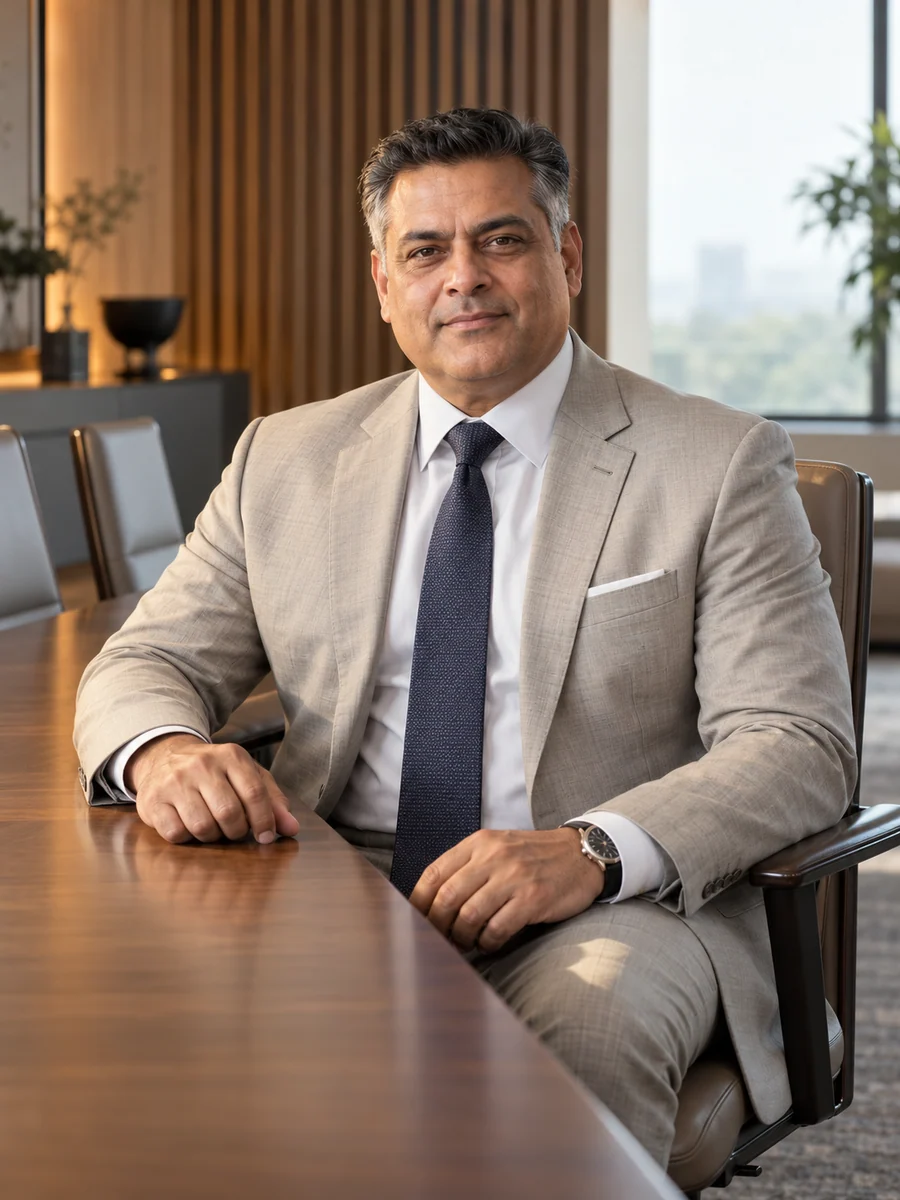
My father was a clerk in the sub-registrar's office in Pune's old city, where sale deeds are registered and stamped. His parents had come to Pune from Punjab after Partition, and he spent thirty years watching land change hands across his counter. At dinner he described buyers who came back months later holding receipts for half-built flats and with nobody left to ask. I did not understand what he was describing until I saw it from inside a builder's books.
I studied commerce at Ravikiran College of Commerce in Pune, graduating in 1995, and qualified as a chartered accountant in 1998 after three years of articled training with Bhide Karandikar & Co., a Pune practice whose clients included builders, cooperative housing societies and small construction contractors. In 1999, as a young audit senior, I traced booking advances received for one building in Kothrud to a land payment for another site across the river. Nothing was hidden; the money had simply been pooled, as nearly every builder's money was then. The buyers of the first building waited three extra years for possession. Almost two decades later RERA required developers to keep most of a project's receipts in a separate account, and I recognised the problem it was written to solve.
I wanted to see risk across many companies rather than one at a time, so in January 2003 I joined Nirdhar Ratings and Research, a credit rating agency in Mumbai, as an analyst covering construction companies, developers and road projects. Rating committees taught me to write a view that someone else could test, and the downturn of 2008 taught me how quickly a developer's cash disappears when buyers stop booking. I downgraded three developers that year. Two of them had told me, a few months earlier, that pre-sales were the safest number in their accounts.
In September 2008 I moved to Ashmaka Bank, a private-sector bank, to appraise infrastructure loans. For five and a half years I worked on road projects built under toll and annuity concessions, port terminals and two power plants. I learnt how a thirty-year traffic forecast is built, and later how far it can miss: across nine toll roads in our book, actual collections ran on average 27 per cent below the forecasts we had lent against. I sat through the restructuring of four of those projects. The experience left me suspicious of any projection whose author is rewarded when it is believed.
In April 2014 I joined Anvayi Finance, a listed NBFC, to build its developer-finance book in western and southern India. Over five years the book grew from ₹2,100 crore to ₹5,400 crore across 61 projects. We lent against escrowed project receipts, sent independent engineers to every large site each month and learnt to read a sales report for the cancellations it left out. Then came September 2018, when the default of a large infrastructure lender froze funding for NBFCs. We stopped new lending almost overnight and spent a year managing developers who could no longer refinance. I watched sound projects stall because their promoters had used project money for land elsewhere, and I wanted to work on the side of the table where those decisions are made.
Madhav Kirtane, who founded Mridvika in 1994, and his son Siddharth, its managing director, asked me to join as CFO in November 2019. The company had grown quickly since listing, mostly with NBFC money at 13 to 14 per cent, and its net debt reached ₹1,920 crore by March 2020. Four months after I arrived, the lockdown closed all nineteen sites we then had under construction and most of our contractors' workers went home. The decisions that followed, on withdrawals, on land and on borrowing, are described on my impact page. Each of them was shaped by what I had seen as a lender.
I lead 160 people in accounts, project finance, treasury, taxation, investor relations and customer collections, with seven direct reports. Each project has a finance lead who owns its designated account, its cost-to-complete estimate and its lender reporting, and who can tell me on any day how many weeks of construction the account can fund. Internal audit reports to the chair of our Audit Committee, not to me. I ask my team to treat a buyer's instalment as money held for a building and to bring me a bad number while it can still be fixed.
Inside the industry I am known for three positions that have cost money in the short run: that a developer should draw less from its escrow than the rules permit, that pre-sales guidance encourages launches the balance sheet cannot carry, and that land owned by a promoter family deserves more scrutiny than any other related-party transaction. I hold them because I have lent to developers who did the opposite. My next step is to serve, alongside my executive role, as an independent director on another company's board.
Open to Board appointments · Speaking invitations
Languages / English · Hindi · Marathi · Punjabi
A leadership conviction
A buyer pays us years before we hand over a key. Until then the money is held for one building, and our accounts should be read that way, project by project, before anyone adds them together.
- Pre-sales, year to March 2026
- ₹4,120 Cr
- ₹3,480 Cr collected from buyers; ₹2,960 Cr revenue recognised under Ind AS 115
- Net debt, March 2026
- ₹540 Cr
- Down from ₹1,920 Cr in March 2020; rated A by two agencies
- RERA-registered projects under construction
- 34
- Each with its own designated account, ledger and ninety-day cash floor
Board & advisory record
Current appointments
Mridvika Bengaluru Projects Private Limited
Director of a wholly owned project subsidiary, in an executive capacity
2022–present
Mridvika Panvel Developers Private Limited
Director of a wholly owned project subsidiary, in an executive capacity
2023–present
Education & credentials
- Bachelor of Commerce
- Ravikiran College of Commerce · 1995
- Chartered accountant, after articled training
- Bhide Karandikar & Co. · 1998
Perspectives from colleagues
Vikram writes a related-party paper as if he expects the minority shareholders to read it, which is what our committee needs in a promoter-led company. When the family land proposal reached us, his evidence made our decision straightforward, however awkward it made his next conversation with the founder.
As a lender, Vikram never accepted a developer's sales report without the cancellations. The monthly site and escrow review he designed for our developer book in 2015 is still the basis of how we monitor projects.
Most finance heads I have worked with released money to sites whenever the certificates said they could. Vikram asked how many weeks each site could fund itself if sales stopped. In April 2020 we found out, and none of my sites had to wait.