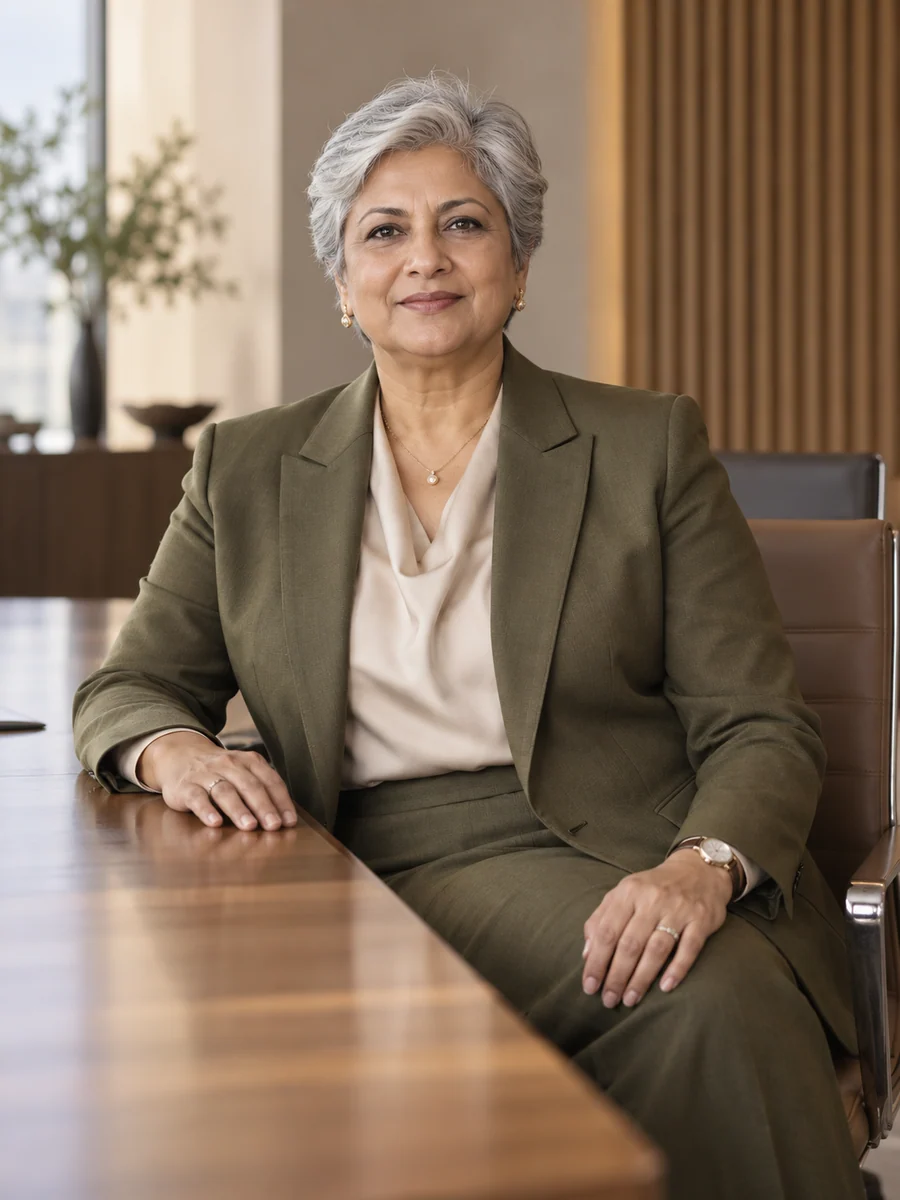
Meera KapoorChief Financial Officer · Essays & perspective
Operating solar and wind capacity, March 2026
4.2 GW
With a further 1.6 GW under construction
Revenue, year to March 2026
₹3,640 Cr
EBITDA of ₹3,120 Cr from 9.4 billion units generated
Receivable days, March 2026
64 days
Down from 238 days in March 2022

A renewable tariff is worth what the buyer actually pays, when it pays, so I judge every megawatt by the counterparty's cash.

I am the chief financial officer of Tejovan Renewables Limited, a fictional New Delhi-based renewable power producer listed on the NSE and BSE since March 2022. We own and operate 4.2 gigawatts of solar and wind capacity across Rajasthan, Gujarat, Karnataka and Maharashtra, and we are building another 1.6 gigawatts, including a 600-megawatt wind-solar hybrid. In the year to March 2026 our plants generated 9.4 billion units of electricity, and we earned revenue of ₹3,640 crore and EBITDA of ₹3,120 crore. Almost all of it is sold under long-term agreements at tariffs fixed in rupees for twenty-five years.

Those agreements are the reason lenders will finance us at all, and the reason I spend so much of my time on the organisations that signed them. Fifty-eight per cent of our capacity sells to central government intermediaries that resell power to state utilities, thirty-one per cent sells directly to state distribution companies under older contracts, and the rest goes to industrial customers. I learnt to read those counterparties first as a credit analyst at an infrastructure lender in Mumbai, then while raising debt for a coal plant that later struggled, and then as finance head of a wind developer whose largest customer paid eleven months late.

When I became CFO in April 2021, receivables were climbing towards 238 days of revenue, and within a year two state utilities owed us ₹1,710 crore of overdue bills. Bringing that figure down, without pretending in our accounts that unpaid surcharge was income, has shaped my view of the job. A renewable company sells a fixed price for a quarter of a century. Finance exists to make sure that price is collected, that the debt behind each plant can survive a slow payer, and that the board sees the difference between megawatts commissioned and cash earned.

Overdue utility dues cut from ₹1,710 crore to ₹180 crore

We accepted monthly instalments for legacy dues under the 2022 late payment surcharge rules and settled a disputed surcharge claim with the larger utility. Receivable days fell from 238 in March 2022 to 64 in March 2026; the ₹148 crore of surcharge we waived had never been booked as income.

Gearing reduced while the portfolio grew

Net debt fell from 7.4 times EBITDA in March 2023 to 6.5 times in March 2026 while operating capacity rose from 3.1 to 4.2 gigawatts. We held new bids to about one gigawatt a year and sold 49 per cent of a 900-megawatt solar cluster for ₹1,640 crore, keeping control.

A ₹1,500 crore rupee green bond

In August 2025 we issued ten-year amortising green debentures, listed on the NSE at 7.94 per cent, to repay construction loans, choosing rupee debt over a dollar issue that cost more once hedged. Our domestic ratings had risen from A+ to AA- in 2024.

Currency cover priced into every bid

Since 2023 no bid leaves the company without the cost of currency cover, or a rupee-priced module contract, inside the tariff. The rule cost us a 600-megawatt auction by three paise per unit. We have since won 900 megawatts on the same terms.

Current focus

I am preparing the board's decision on financing our 600-megawatt hybrid project, including how much of its construction debt should move into a second green bond after a year of operation. I am also rebuilding our counterparty scorecard so that each state utility's payment record since 2022, not its published rating alone, decides how much new exposure we take.

Conversations I welcome

I am not looking to leave Tejovan. With my board's consent, I would consider one independent directorship at a listed company outside power generation, where long-dated contracts and heavy borrowing make the Audit Committee's work demanding. I can give about twenty-five days a year. I also speak occasionally to lenders, rating analysts and audit committees on utility credit and project finance.

Beyond the page

The record behind the perspective.

In the boardroom

  • Tejovan Green Assets Private LimitedDirector in an executive capacity; also a director of three Tejovan project companies · 2021–present

Formation

  • Bachelor of Commerce (Honours)Amaltas College of Commerce · 1995
  • Chartered accountant, qualified through articleshipSehgal Narang & Co. · 1998
Meera's papers tell the committee what she is unsure of before they tell us what she recommends. When the bankers wanted our change-in-law claim in the pre-listing accounts, she set out the case for booking it as fairly as the case against, and then gave us her view. We have not had to reverse a judgement she brought to us.
Sudhanshu RatnaparkhiFictional independent director and Audit Committee chair, Tejovan Renewables Limited
The full record ↗

Contact

I am not looking to leave Tejovan. With my board's consent, I would consider one independent directorship at a listed company outside power generation, where long-dated contracts and heavy borrowing make the Audit Committee's work demanding. I can give about twenty-five days a year. I also speak occasionally to lenders, rating analysts and audit committees on utility credit and project finance.

  • Board appointments
  • Speaking invitations