Chief Executive Officer China
From the dispatcher's telephone to the station control room
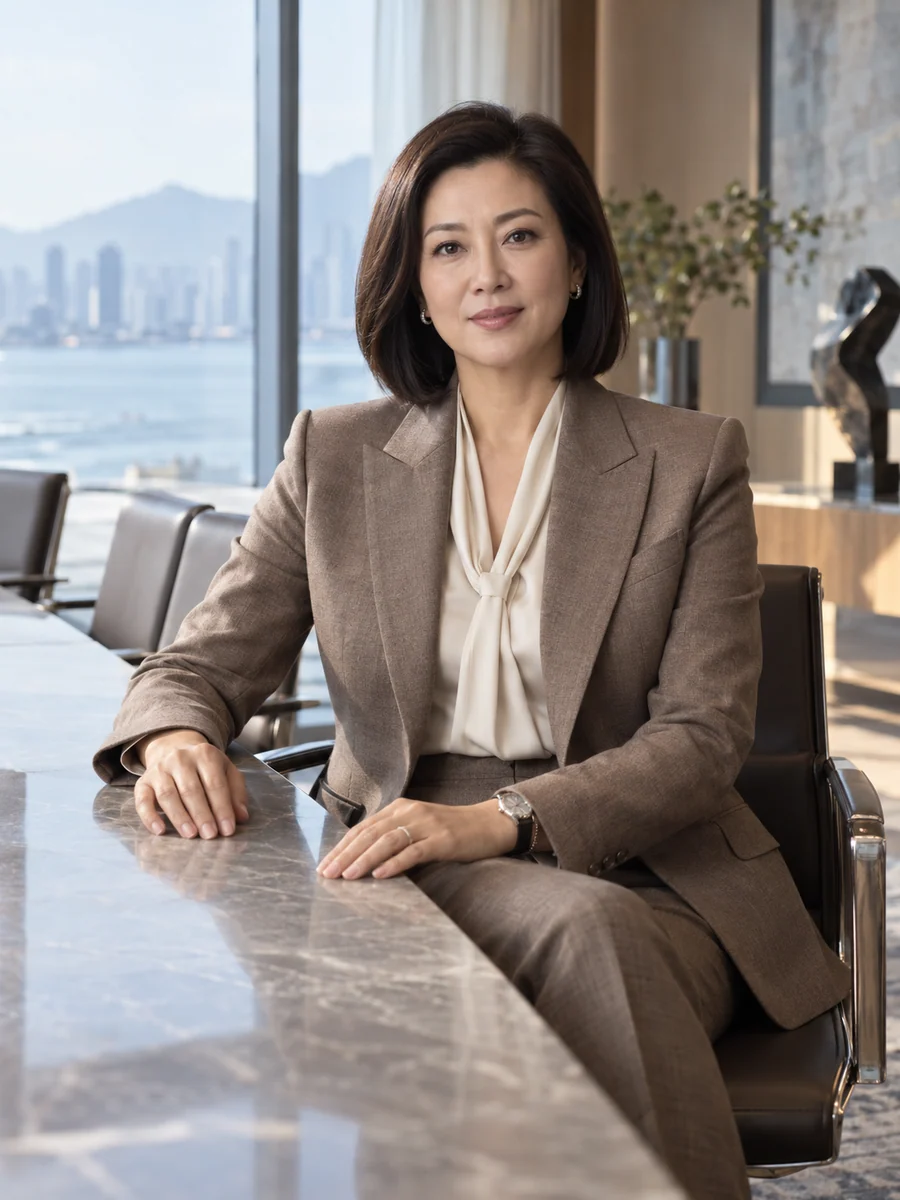
My father ran a night shift at a coal-fired power station outside Baotou, and the first thing I understood about electricity was that someone had to stay awake to make it. In the winters of the early 1990s, when the city's demand outran what the station could supply, he came home describing which districts had been cut so that the furnaces at the steelworks could keep running. I learnt early that a grid is a set of choices about who goes without.
I studied electrical engineering at Huaixi Institute of Technology, graduating in 1997, and took a master's degree in power systems at Jianhe University of Science and Technology in 2000, with a thesis on the stability of long, lightly loaded transmission lines. In July 2000 I joined Lianshan Electric Power Survey and Design Institute in Xi'an, a state-owned design institute, as a grid-planning engineer. For four years I ran load-flow and stability studies for the 330 kilovolt network of north-west China. The work taught me to see a grid as a collection of limits, most of them invisible until something trips.
In 2004 the institute asked me to manage substation and transmission projects abroad. Over four years I delivered two 220 kilovolt substations in Kazakhstan and design work for a transmission reinforcement in Pakistan, living on site for months at a time. A Chinese engineering firm abroad is judged less on its drawings than on whether its people are still there when commissioning goes wrong. I apply that lesson to every storage system we now export.
In 2008 I moved to the generation side, as head of grid integration for the north-west branch of Taolin New Energy, the renewable subsidiary of a central state-owned generating group. Our wind farms in the Hexi Corridor of Gansu were being built faster than the grid could carry their output. In 2011 a series of mass turbine disconnections on the regional grid forced every operator to retrofit equipment, and for several years curtailment cost us roughly a fifth of what our turbines could have produced. I spent many windy nights on the telephone with dispatchers, negotiating how many megawatts we could keep. I learnt that electricity has no value at the moment the grid cannot take it, and that the most useful asset in a wind region would be one that could wait.
That conviction took me to Wenlan Power Cell in Changzhou in January 2014. Wenlan, a Shenzhen-listed maker of lithium iron phosphate cells for buses, had spare capacity and no storage business. Its chairman, Shen Kaiwei, gave me twelve people and a mandate to build one. By 2018 the division employed 340 people and earned RMB 2.1 billion. We delivered systems in China and Australia, and we built a laboratory that cycled our own cells to failure so that we knew how they aged before our customers did.
In April 2019 Fang Dezhi, who had founded Qianyue Energy Storage in Jinan three years earlier, asked me to join as president and chief operating officer. He wanted someone to run a company that owned its stations, and I wanted to own the consequences of what I had been selling. I became chief executive in January 2021, when he became full-time chairman. Since then we have grown from four stations to 21, taken a provincial state-owned investor as our largest shareholder, refused to follow the 2024 price war to the bottom and rebuilt our station business after the 2025 reform removed the rule that had created much of its demand. In August 2023 a container at one of our stations caught fire during commissioning. No one was hurt. It changed how I think about almost everything we buy.
I lead 2,450 people through an executive committee of nine, and I meet our station operators every month, usually at a station rather than at headquarters. I ask for three habits: bring me the bad number first, show me the physical evidence behind a report, and write down what we would do differently before the next project starts rather than after the next failure. I completed a part-time executive MBA at Lingpu School of Management in 2017, mainly to learn how investors think; I use it most when explaining to them why we have chosen to be smaller.
I sit on our board as an executive director, between a founder, a state investor, growth funds and two independent directors. Serving owners with such different horizons has taught me more about governance than any course. Within the industry I am probably known for three positions: that a battery must earn from the grid rather than from a rule, that a bid below the full cost of a warranty quietly borrows from the buyer, and that safety begins when a cell arrives at our gate, not when the fire-suppression system activates. I am now preparing for a role on the other side of a boardroom table, as an independent director of a listed company outside storage.
Open to Board appointments · Speaking invitations
Languages / Mandarin Chinese · English
A leadership conviction
Electricity is worth only what the grid will pay for it at the moment it arrives, so a storage company should be judged by the hours it serves, never by the equipment it happens to own.
- Revenue in 2025
- RMB 5.45 bn
- System sales RMB 3.62 bn, owned stations RMB 1.32 bn, service RMB 0.51 bn
- Owned storage in operation, December 2025
- 5.6 GWh
- 21 stations in Shandong, Inner Mongolia and Gansu
- Station revenue from trading and compensation, first half of 2026
- 71%
- Up from 44 per cent in 2024, after the end of mandatory pairing
Board & advisory record
Current appointments
Qianyue Energy Storage Co., Ltd.
Executive director and chief executive
2021–present
Qianyue International (Hong Kong) Limited
Director of the wholly owned export subsidiary, in an executive capacity
2021–present
Education & credentials
- Bachelor of Engineering, Electrical Engineering
- Huaixi Institute of Technology · 1997
- Master of Engineering, Power Systems and Automation
- Jianhe University of Science and Technology · 2000
- Executive MBA (part-time)
- Lingpu School of Management · 2017
Perspectives from colleagues
When a generating company in our own group asked Qianyue for a discount, Lin put an independent benchmark in front of the directors we had not nominated and let them decide. I argued for the discount at the time. I now describe that meeting to other companies in our portfolio when they ask how a state shareholder ought to be treated.
I gave Lin twelve people and a corner of a bus-battery factory. She came back with a laboratory that ran our own cells to failure, and the first result she brought me from it was one our sales team did not want to hear. That habit built the division.
After the Dongying fire the easy decision was to replace one container and keep the schedule. Lin asked what I needed to be certain about the batch, accepted my answer and then spent two board meetings defending what it cost. I have stopped an energisation twice since then without needing to ask her.