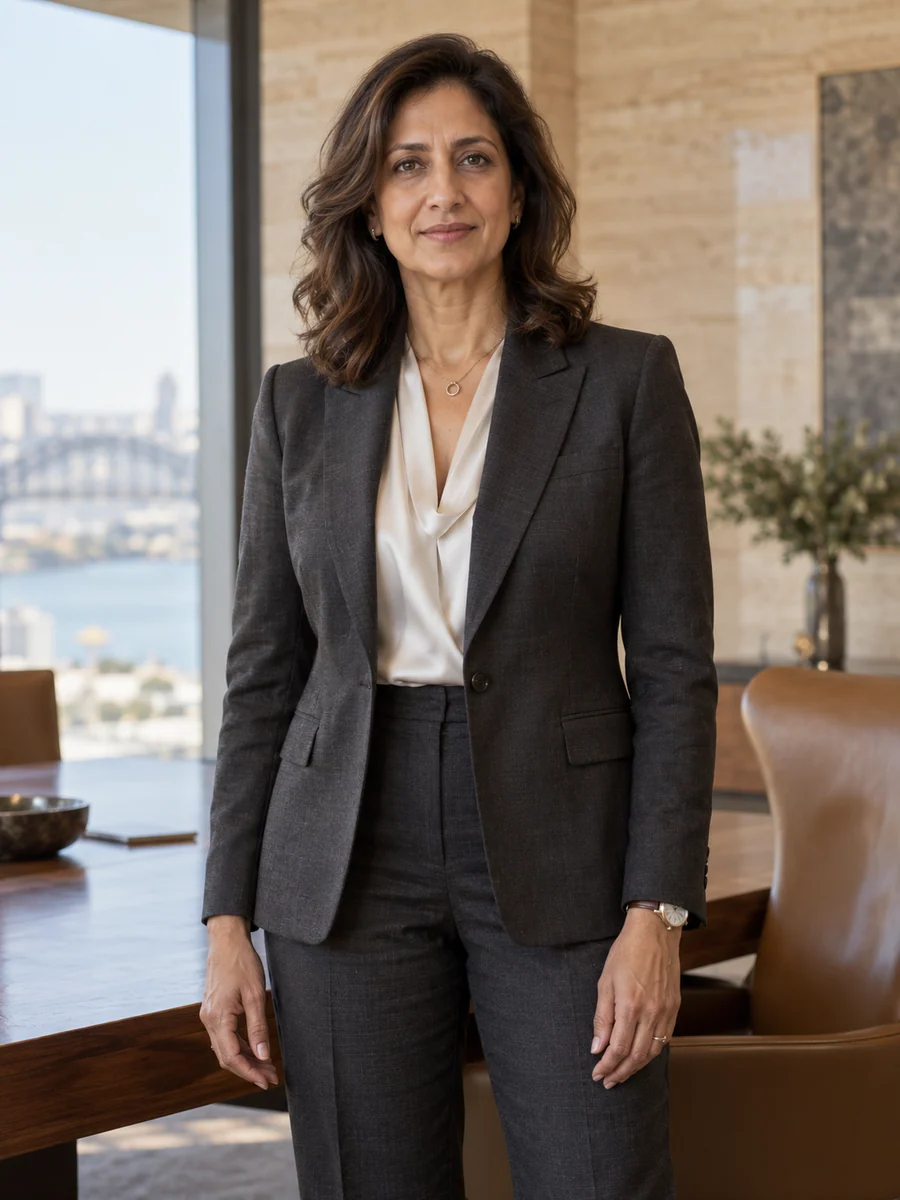
A customer can sign for hosting capacity in a week. The engineer who will administer it may wait seven months for a security clearance, and the technician who keeps the cooling running at night should have a colleague beside her before anyone has to ask. I try to put those clocks in front of the people who set the dates, so that our workforce is planned rather than hurriedly found.
Freya Wallace
Company revenue
A$238m
Year to 30 June 2026
Employees
910
Adelaide, Darwin and Canberra
Security-cleared staff
146
Up from 61 in 2022
Leadership, seen by others.
Freya told me the defence contract would start eleven weeks late if we did it her way, and that the delay would be worth it. She was right, and she brought me the evidence a year later without being asked.
Bernadette KilvarrowChief executive, Quenwarra Data Services
When the assistant took most of our tickets, she sat with the desk and explained what was coming and what it would cost. Some of us left; I trained into network operations. Nobody heard about it second-hand.
Matteo TeroviakNetwork operations engineer, formerly service-desk analyst, Quenwarra Data Services
On our board she reads the safety and placement reports more carefully than anyone, and she asks the question about the trainee who is working alone. She is also quick to admit when finance is outside her experience.
Annika DruvenhallChair, Pindarrow Skills Trust
Selected leadership work
Sponsoring clearances for our own engineers instead of renting cleared contractors
In early 2024 we were preferred bidder for a five-year, A$14.6 million contract to host an engineering environment for a defence supplier.
I plan an IT company's people around the lead times nobody can hurry: a security clearance, a technician's training and a night roster that is safe to work.
I am chief people officer of Quenwarra Data Services, a privately owned Adelaide company that runs two data centres in the city's northern suburbs and a third in Darwin. We host and manage systems for state agencies, health networks, mining companies and suppliers to the defence industry. Revenue for the year to 30 June 2026 was A$238 million, and we employ 910 people. I lead a people and culture team of 34, report to the chief executive and prepare the papers for our board's people and remuneration committee. I attend that committee as an executive and hold no seat on our own board.
My working life began in industrial relations, advising employers on awards and agreement negotiations in the late 1990s. That training still shapes how I read a workforce problem. Before discussing culture, I want to know what the agreement says, who works which hours, what the law requires us to consult on and what a change will cost the people who live with it. In a business that sells continuous availability, those questions decide whether a commercial promise can be kept by people who are rested, cleared and properly trained.
Three recent decisions show the approach. We sponsored clearances for our own engineers instead of renting cleared contractors for a defence supplier's hosting contract. We redeployed most of the service-desk analysts whose first-line work moved to an AI assistant. We ended single-person night shifts in Darwin. Each one cost money or time that colleagues reasonably wanted to keep, and I have tried to record those costs honestly.
Clearances grown inside the company
For a A$14.6 million hosting contract that needed 18 cleared administrators, we nominated 26 of our own engineers for clearance. Twenty-one were granted, with a median wait of seven months, and the customer accepted a go-live eleven weeks later than first proposed.
A service desk changed without a mass redundancy
When an AI assistant absorbed 38 per cent of first-line tickets, 19 analysts entered a paid 20-week conversion into level-two and network-operations work. Seventeen completed it; eight colleagues chose voluntary redundancy.
Nobody alone overnight in Darwin
Two-person overnight cover added five technicians and A$760,000 a year. Overtime hours fell 44 per cent and Darwin turnover dropped from 29 to 12 per cent within a year.
Current focus
I am building a two-year cadetship with Corrowin Technical College for critical-facilities technicians, and a clearance forecast that the sales team must consult before it commits a start date to any customer whose systems require vetted staff.
Conversations I welcome
I am open to a non-executive role on a technology, data-infrastructure or defence-supplier board, initially on a people and remuneration or safety committee, with about 24 days a year available subject to my chief executive's consent and a full review of commercial relationships.
The leadership record
Trusted with consequential decisions.
Formation
Master of employment relationsYorrandale University · 2004
Bachelor of arts (psychology and politics)Yorrandale University · 1996
I am open to a non-executive role on a technology, data-infrastructure or defence-supplier board, initially on a people and remuneration or safety committee, with about 24 days a year available subject to my chief executive's consent and a full review of commercial relationships.