Chief Marketing Officer Europe
A restore that took thirty-one hours
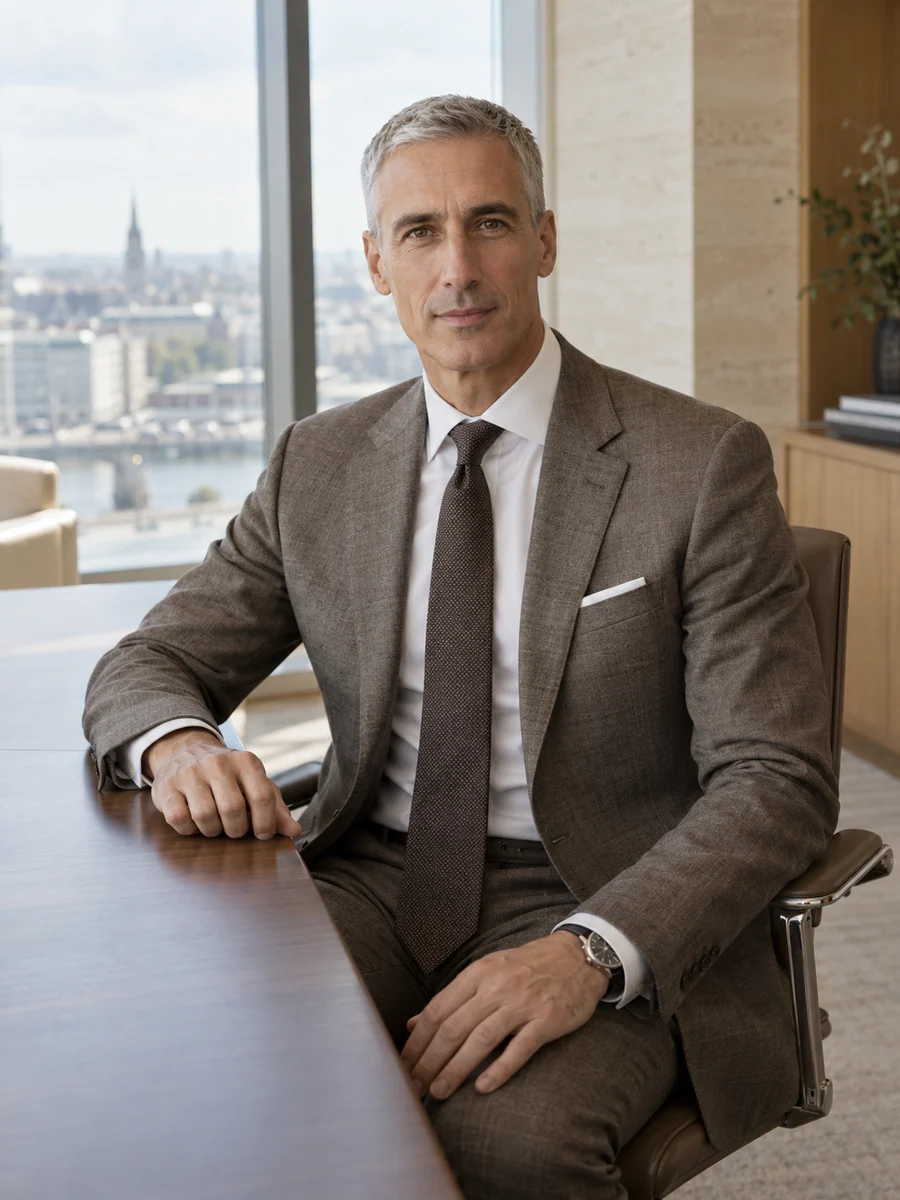
My father moved from Gothenburg to Turin in 1971 to work as an engineer for a components supplier, and he never quite stopped translating. At home he explained Italian contracts in Swedish and Swedish manuals in Italian, and he was particular about the difference between what a document promised and what it only implied. I studied business economics at Ateneo Varsellino in Turin and graduated in March 2000. Two months later I was in Stockholm, wanting to know my father's country as an adult rather than as a summer visitor.
Brennvik Nätverk distributed networking and firewall equipment to resellers across Sweden, Norway and Denmark. I started as a marketing coordinator, preparing price lists, event calendars and co-marketing claims, and became partner marketing executive in 2002. The reseller managers taught me that a partner rarely repeats your message as written. It repeats the part that helps close this month's order. If the claim needed a footnote to be true, the footnote disappeared somewhere between our brochure and the customer's office. I also learnt that Nordic buyers expected a price list to mean exactly what it said, and that a discount offered quietly to one reseller was known to the others within a week.
I returned to Italy in September 2004 to join Dravellini Distribuzione in Milan as channel marketing manager. The company supplied security and storage products to about 650 Italian resellers. I ran partner tiers, training days and a co-marketing fund of roughly €2.2 million a year. I learnt to write claims for second-hand use: short enough to survive repetition, and specific enough that a reseller could not stretch them into something the manufacturer would not support.
In January 2010 I became head of marketing at Custovale Servizi, a Bologna company providing managed backup and disaster recovery to small and mid-sized firms. It was my first services business, and my first serious failure. A client's restore took 31 hours when our brochure, which I had approved, spoke of recovery within the working day. The contract said something more careful. The client's managing director read the brochure, not the contract, and he was right to be angry. I rewrote every service description with the operations manager beside me, and I have not since approved a service claim without someone who delivers the service reading it first.
Scudalpe hired me in July 2014 as head of marketing. The company had €21.6 million of revenue, one operations centre in Turin and twelve partners. Its founders were engineers who distrusted marketing, with some justification. I asked to sit through a night shift with the analysts each quarter, a practice I still keep, and in 2016 I completed a part-time postgraduate certificate in information-security governance so that I could follow their reasoning rather than paraphrase it.
From January 2019 I led marketing and the partner programme together, and the network grew from 38 to 77 partners over three years. In March 2022 a private-equity fund bought a 40 per cent stake, the board was reconstituted with two independent directors, and I became chief marketing officer. The investors rightly asked for growth figures they could compare across their portfolio. My task has been to supply those figures without letting them decide what we say to clients.
Much of my useful work as chief marketing officer has consisted of refusing sentences. When competitors began describing their detection as autonomous, our sales team asked for similar language. I asked the head of the Turin operations centre to tell me, in numbers, what our triage model actually did, and we published those numbers instead. The same habit shaped our response to NIS2, our handling of client references and our decision to stop competing for the smallest firms. None of these was a marketing technique. Each was a judgement about which customers we could serve well and what we could honestly say to them, argued out with colleagues who had good reasons to see it differently.
I lead through the four heads who report to me, and I expect them to disagree with me in writing before a decision rather than in the corridor after it. I measure campaigns by what happens after signature: first-year renewal, scope disputes and the questions clients ask in their first incident. Sales colleagues do not always share that preference, and our arguments are usually useful.
Since 2021 I have served, unpaid, on the board of Fondazione Pontevigile, a Turin charity that teaches online safety in secondary schools. It has shown me the other side of the table: reading papers prepared by executives, deciding with incomplete evidence and accepting a collective decision I argued against. I would bring both perspectives to a company board.
Open to Board appointments · Advisory roles
Languages / Italian · Swedish · English
A leadership conviction
A company that buys a security service is buying a promise it hopes never to test. Marketing should describe that promise in terms the client's engineers, lawyers and directors can each check: who answers, how quickly, with what authority, and at which point the client must decide for itself. When a claim cannot survive that reading, I would rather lose the enquiry than win the contract.
- Scudalpe revenue
- €81.2m
- 2025; marketing programme budget €4.3m
- Partner resellers and service providers
- 92
- 46% of new detection contract value in 2025
- Client organisations
- 1,340
- Northern Italy and Ticino; mostly 100–2,000 staff
Board & advisory record
Current appointments
Fondazione Pontevigile
Non-executive director (unpaid)
Programme committee
2021–present
Education & credentials
- Laurea in business economics
- Ateneo Varsellino · 2000
- Postgraduate certificate in information-security governance
- Ateneo Varsellino · 2016
Perspectives from colleagues
We hired Matteo expecting to restrain him. Instead he spent his first winter on night shifts with our analysts and came back asking us to remove sentences we had written ourselves. He argues hard, then puts the losing side's case in the board paper as fairly as his own.
I disagreed with him about the NIS2 offer and said so loudly. He listened, kept his position, and later helped us explain the gap reports to our own customers. As a partner, I would rather have that than a brochure that makes promises my engineers then have to keep.
After the restore that went wrong, Matteo did not defend the brochure. He went to the client with me and then rewrote every description with our operations manager. Complaints about recovery times fell sharply the following year.