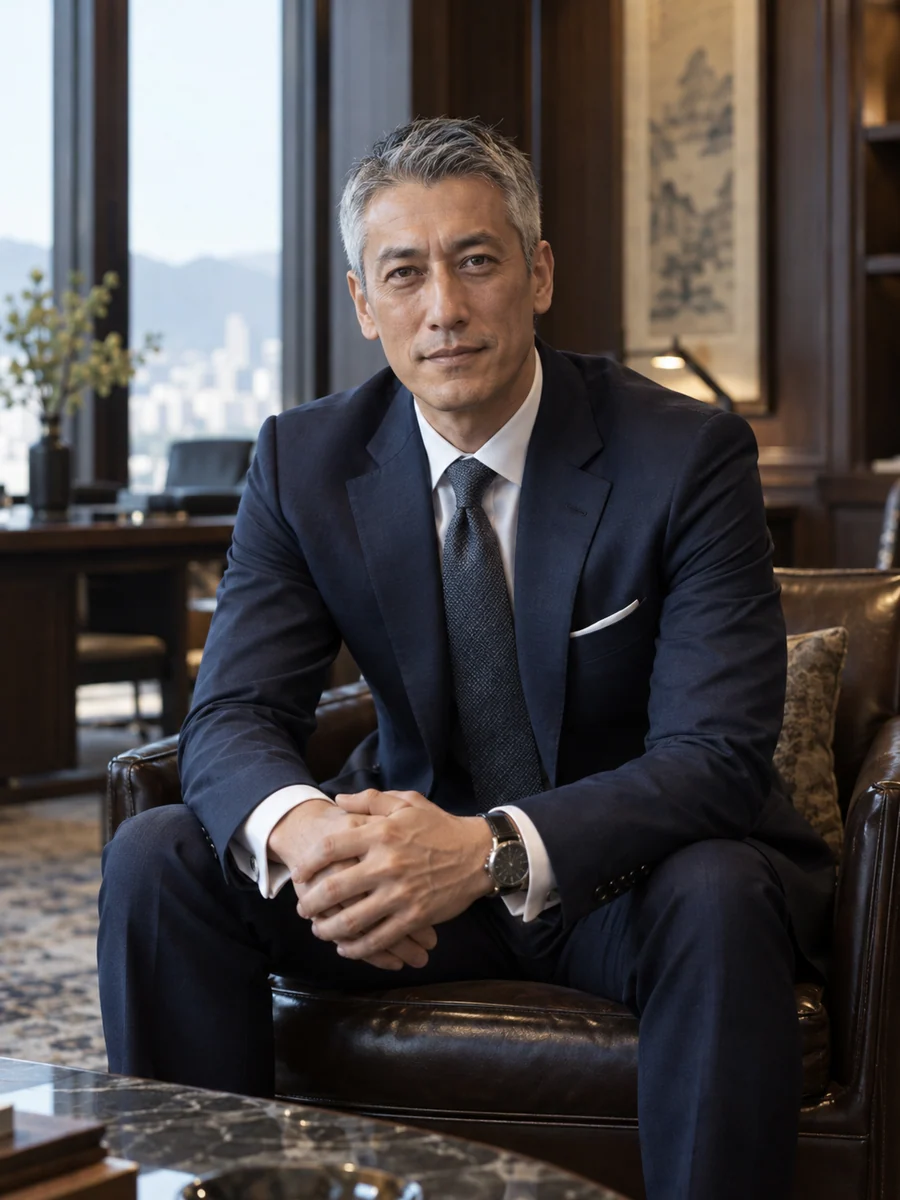
A contract manufacturer's plan is only as sound as the commitments it is prepared to decline.
01 / Chief Strategy Officer
Annual revenue
¥38.6bn
Year ended March 2026; contract manufacturing for 58 pharmaceutical companies
Products manufactured
420
Tablets, capsules, topicals and oral liquids across two plants
Employees
1,240
Plants in Toyama and Ishikawa prefectures and head office
+
Designed for consequence.
Our customers place their medicines in our plants because they cannot make them at the volume or cost they need. That trust is the asset I handle most carefully. When demand rises suddenly, I want Tateyukari to know which commitments its equipment, people and quality systems can honour for the full term of an agreement, and to say no plainly where they cannot. A smaller promise kept for a decade serves a patient, a customer and a shareholder better than a larger one renegotiated in its second year.
I decide which customer commitments our plants can honour for a full contract term before I decide which revenue Tateyukari should pursue.
I am executive officer and chief strategy officer of Tateyukari Pharmaceutical Manufacturing, a contract manufacturer listed on the Tokyo Stock Exchange Standard Market. We make tablets, capsules, topical preparations and oral liquids for 58 pharmaceutical companies, most of them generic manufacturers, from plants in Toyama and Ishikawa prefectures. Revenue for the year ended March 2026 was ¥38.6 billion, with operating profit of ¥1.9 billion and 1,240 employees. I lead sixteen colleagues in strategy, business development and alliance management, and I report to our president. I am not a director, although I present strategy proposals to the board.
I began as a hospital pharmacist in Toyama in April 1997, keeping the list of medicines the dispensary could not obtain. Ten years at an Osaka generic maker followed, first reviewing batch documentation and then planning its product range and supply. Five years in the healthcare unit of a Kobe trading company taught me how overseas ingredient sourcing and minority investments were priced. I joined Tateyukari in July 2016 to run business development and became strategy officer in April 2021, just as a shortage of generic medicines turned contract capacity into the resource every customer wanted.
The decisions on this site concern the boundaries of a contract manufacturer's business. We accepted fewer transferred products than customers requested in 2021. We declined a ten-year exclusive agreement with our largest customer group in 2024. In 2025 we licensed a film technology for manufacture rather than buy Japanese marketing rights that would have made us our customers' competitor. Each choice gave up revenue that colleagues and directors reasonably wanted. Annual NHI price revisions, an ageing patient population and pressure to consolidate generic production make those boundaries more important for a company like ours, not less.
Nine transfers accepted, fourteen declined
In 2021 customers asked us to take over 23 generic products after their own plants were suspended or overloaded. We accepted nine, with customers funding ¥240 million of validation work. Those nine earned ¥1.8 billion in the year ended March 2026; we gave up roughly ¥2.3 billion a year.
One customer group held to 27% of revenue
A merged generic group proposed ten years of exclusive production for 64 products, with our prices cut automatically after each NHI revision. We agreed five non-exclusive years for 31 products. The group now provides 27% of our revenue, not the 39% its full proposal implied.
A film technology licensed for manufacture only
We paid ¥260 million for the right to manufacture a Swedish developer's orally dissolving film in Japan, while a domestic customer took the marketing rights. We gave up an own-product margin that management had estimated at ¥700 million a year at peak.
Current focus
I am preparing our response to the consolidation of generic production in Japan: which customers' product ranges we can absorb, which of our products should leave our plants, and how a second film line could be funded without stretching our quality function.
Conversations I welcome
I would consider one outside directorship at a Japanese eldercare, home-care or care-supply company with no commercial tie to Tateyukari, allowing twenty days a year once our president has approved it.
The leadership record
Trusted with consequential decisions.
Formation
Bachelor of Pharmaceutical SciencesMizukagura College of Pharmacy · 1997
Takumi brought me the Kurenaigawa proposal with the case against it written as carefully as the case for it. I disagreed with him at first. The second board discussion changed my mind, and the five-year agreement has held.
Yoshiko MatsukazariPresident and representative director, Tateyukari Pharmaceutical ManufacturingThe full record ↗
Contact
I would consider one outside directorship at a Japanese eldercare, home-care or care-supply company with no commercial tie to Tateyukari, allowing twenty days a year once our president has approved it.