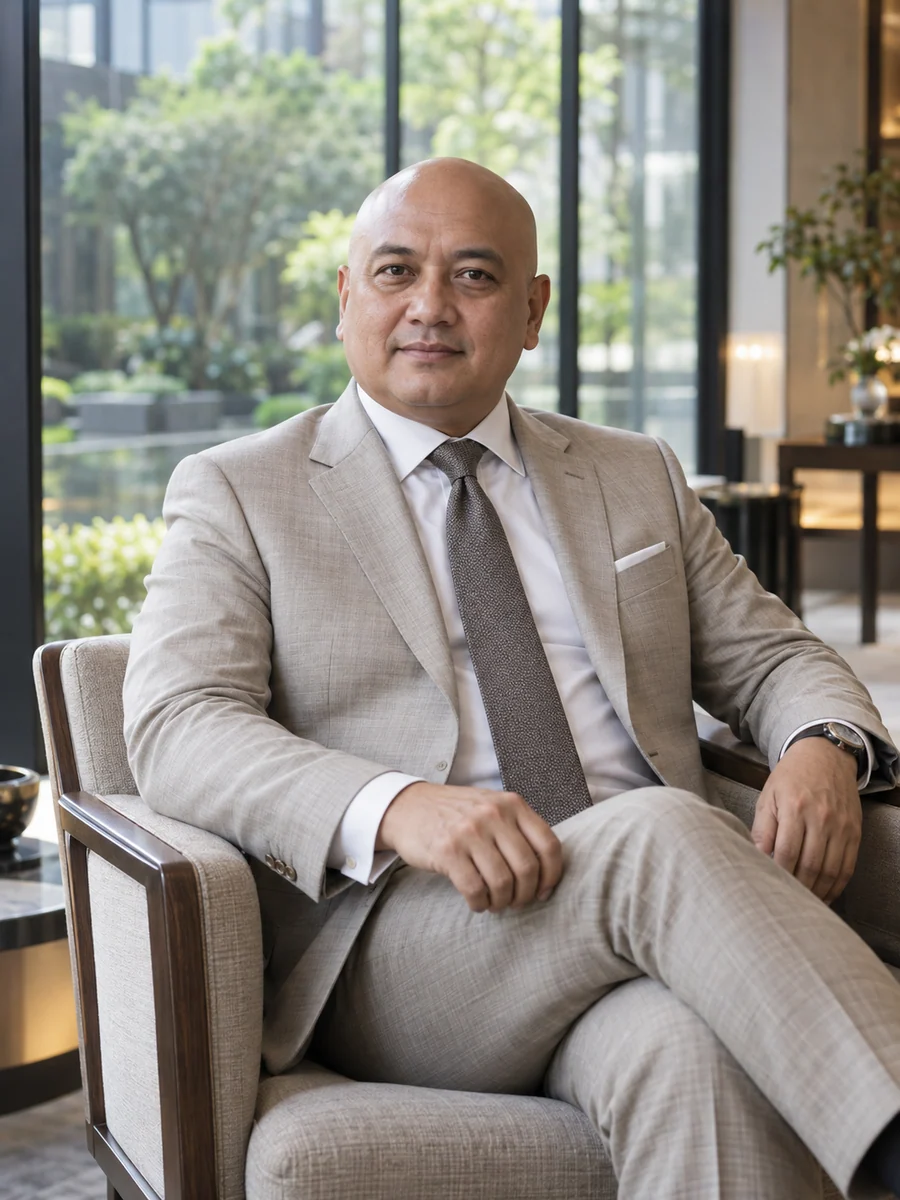
Chief Executive Officer / Singapore / Southeast Asia
Reza Wiraatmaja
A solar portfolio must work with the buildings, people and demand beneath it.
01 / Chief Executive Officer
Owned solar capacity
148 MWp
315 roofs at June 2026; capacity is not energy delivered
Company revenue
US$31m
2025 electricity, installation and service income
Colleagues
280
Company-wide at June 2026
+
Designed for consequence.
The roof is part of someone else’s working business. Our asset plan has to respect that fact over its whole life, not just during installation. I want the access arrangement, production assumption and maintenance responsibility discussed while the project can still change. A smaller committed programme can be more credible than a larger one whose difficult conditions have been postponed.
I connect the investment case for distributed solar with the practical obligations that remain after commissioning.
I lead Suryavellan Energy from Singapore, with operating teams supporting commercial and industrial rooftops in Southeast Asia. At June 2026 the company owned 148 MWp of solar capacity across 315 roofs and employed 280 colleagues. Consolidated 2025 revenue was US$31 million, combining electricity sales with separately contracted installation and service work. Capacity describes the equipment portfolio; it is not the same measure as energy delivered or income earned. I became CEO in January 2020 after five years directing projects and an earlier career in electrical engineering and commercial services.
A rooftop portfolio joins assets with different owners, operating calendars and expectations. The building owner may be planning roof repairs, the occupier may change its production pattern and the maintenance team may need access when a factory is busiest. Those conditions are central to the investment. I work with engineering, commercial and operating colleagues to bring them into the proposal before an attractive capacity figure becomes a public commitment. My role is to make the company’s choices coherent, not to substitute executive confidence for the specialists who assess each site.
Our recent decisions include reducing a proposed twenty-two-roof programme to fourteen ready sites, funding a monitoring review that distinguished lost communication from equipment faults, and resizing a factory package around a lower daytime demand assumption. Each required us to report less flattering detail. Eight roofs did not proceed in the first programme, fourteen monitoring alerts remained unclassified at review, and the factory package’s first-year output was below forecast. I regard those facts as part of the leadership record because they show what we learnt and which responsibilities continued after the decision.
Fourteen roofs ready to commit
A twenty-two-roof proposal became fourteen committed sites after ownership, access and roof-work reviews. Five required further preparation and three were declined. US$390,000 of assessment and legal work preceded approval of US$12.6 million for the ready portfolio.
Monitoring that admitted what it could not yet explain
A six-month review across ninety-two sites classified 121 alerts as seventy-six communication interruptions, thirty-one equipment issues and fourteen still unresolved. The US$240,000 programme improved diagnosis; it did not establish a measured generation gain.
Less capacity, with the assumptions visible
We reduced a proposed factory package from 24 to 16 MWp and the planned capital commitment from US$16.8 million to US$11.2 million. Its first operating year delivered 18.4 GWh against a 19.6 GWh forecast, a shortfall retained in the review.
Current focus
I am examining whether our portfolio reviews give enough attention to changes in the host business: roof renewal, tenant moves and shifts in daytime consumption. Installed equipment does not make those relationships static.
Conversations I welcome
I welcome a considered board conversation with an asset-owning or technical-service business that needs experience connecting investment assumptions with continuing operating obligations. Any outside appointment must fit my existing executive duties and commercial relationships.
The leadership record
Trusted with consequential decisions.
In the boardroom
Suryavellan EnergyExecutive director · 2020–present
Formation
Bachelor of Electrical EngineeringKertavelle Institute · 1998
Reza separated the roofs we could commit from the opportunities we still needed to prepare. That made the capital discussion smaller, but much more useful.
Mira SuryaneliNon-executive chair, Suryavellan EnergyThe full record ↗
Contact
I welcome a considered board conversation with an asset-owning or technical-service business that needs experience connecting investment assumptions with continuing operating obligations. Any outside appointment must fit my existing executive duties and commercial relationships.