I wanted the acquisition to work. Twelve benefit arrangements appeared to offer a faster way to expand Tezmavi than winning each relationship individually. The proposed price was ₹14 crore. After ₹45 lakh of diligence, we could reconcile the administration record for eight arrangements but not four. I had initially treated those four as work we could absorb after completion. Our operating colleagues asked why an unresolved starting point should become their obligation simply because the growth story suited me. We declined the transaction. That decision cost time and money; it did not produce a ₹14 crore saving or prove that the seller had concealed a loss.
I grew up in Goa in a Christian family and completed commerce at the fictional Qemrali Commerce College in June 1989. I joined Vevzori Business Administration that July as a benefit-records analyst. The enterprise had thirty-six employees and ₹3.2 crore revenue for FY ending March 1990. I worked in a five-person group under the records supervisor, without reporting staff or delegated spending authority. My first lesson was that a clear entry and a valid entitlement were different things. Our work could help an authorised owner examine a record without giving us the right to decide its consequence.
In April 1995 I became service manager. Vevzori employed eighty-two people and recorded ₹11 crore FY 1996 revenue. I led thirteen colleagues through two supervisors within ₹64 lakh annual expense, reporting to the head of operations. The role brought me into discussions with employer teams whose priorities changed during a long administration relationship. A new finance or people leader could inherit an arrangement without inheriting the earlier conversations. I learned to make the basis of our own work recoverable rather than rely on someone being available to explain it.
Regional director followed in September 2002. The business then had 190 employees and ₹29 crore FY 2003 revenue. I led forty-eight colleagues through four managers, with ₹4.2 crore annual regional expense, and reported to the managing director. I moved to Bhubaneswar and became responsible for service capacity and commercial choices across an eastern India portfolio. A transaction-heavy price could look attractive when new records were being created, then leave the less visible work around quiet arrangements underfunded. I did not yet have a satisfactory answer, but I began to see pricing as part of service design rather than a separate sales decision.
I co-founded Tezmavi in March 2009 and became COO and an executive statutory director. In FY ending March 2010 the company had twenty-four employees and ₹4.8 crore revenue. Twelve service colleagues reported through two leads; my operating remit was ₹1.1 crore annual expense under the founding CEO. Building a small company made personal reassurance useful. Customers could reach a founder who knew the history. It also created an institutional weakness: the easier it became to answer through me, the less pressure there was to make that answer available through the organisation.
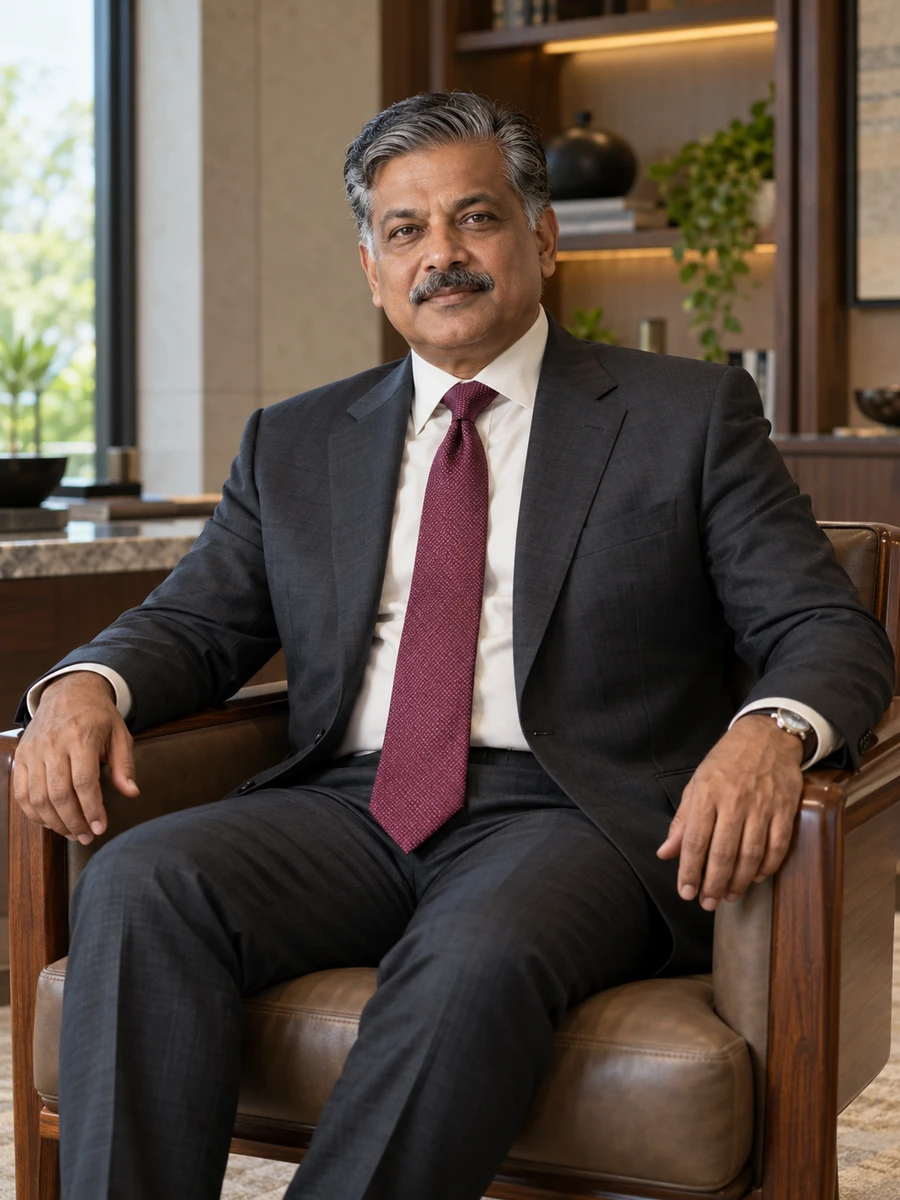
I became CEO in September 2016. Our current ownership is 14%mine, 31%other founders, 20%an employee vehicle and 35%a strategic investor; I have no additional vehicle allocation. Tezmavi employs 340 people, supports 31 employers across 47 benefit arrangements and recorded ₹78 crore FY 26 revenue. Seven executive leads report to me within a ₹68 crore FY 2026–27 approved operating budget and a separate ₹4 crore capital programme. Leela Qaznuri chairs the board and Nikhil Vezthani is COO. I remain accountable for the enterprise while those colleagues retain their own authority.
Our work is administration of records and supporting service. We do not hold the benefit funds, determine entitlements, choose investments, value the employer's obligations or authorise beneficiary payments. Employers, trustees and qualified professional owners retain those responsibilities. That boundary became commercially uncomfortable when a buyer asked us to include actuarial valuation in a ₹1.8 crore annual bid. We declined that combined scope and offered administration separately. The awarded administration contract had a ₹72 lakh annual value; actual revenue in its first financial year was ₹54 lakh because the service began partway through the year.
In 2022 we spent ₹18 lakh examining the work around quiet records and offered a base-fee structure at ten renewals. Six accepted and four declined. I would not describe the result as universal customer endorsement. It established that some customers would pay for the continuing work explicitly, while others would not take that offer. The decision forced us to explain the service and its cost more clearly instead of depending on future activity to cover attention that was already required.
In 2024 six service leaders began taking responsibility for ten relationships through a ₹46 lakh succession programme. Seven completed the agreed handover by review and three still needed me. The programme was not a declaration that founder dependence had disappeared. The following year, nine customers reached a portability discussion: four renewed and five left. We spent ₹36 lakh on the five exits. Leaving customers were not failures to be hidden, and the four renewals were not proof that a generous exit policy had caused loyalty.
I speak English and Konkani, with working Odia. My fictional IICA databank registration began in February 2026 and I passed the proficiency assessment in August 2026; I claim no exemption. I hold one executive directorship and no external seat, with twenty-four provisional days for a suitable first external contribution. I would bring the judgement of a founder who has had to make his own role less central. I would also bring the memory of an acquisition I wanted too quickly, and the expectation that other directors should be able to challenge my preferred story before the company inherits its unfinished work.