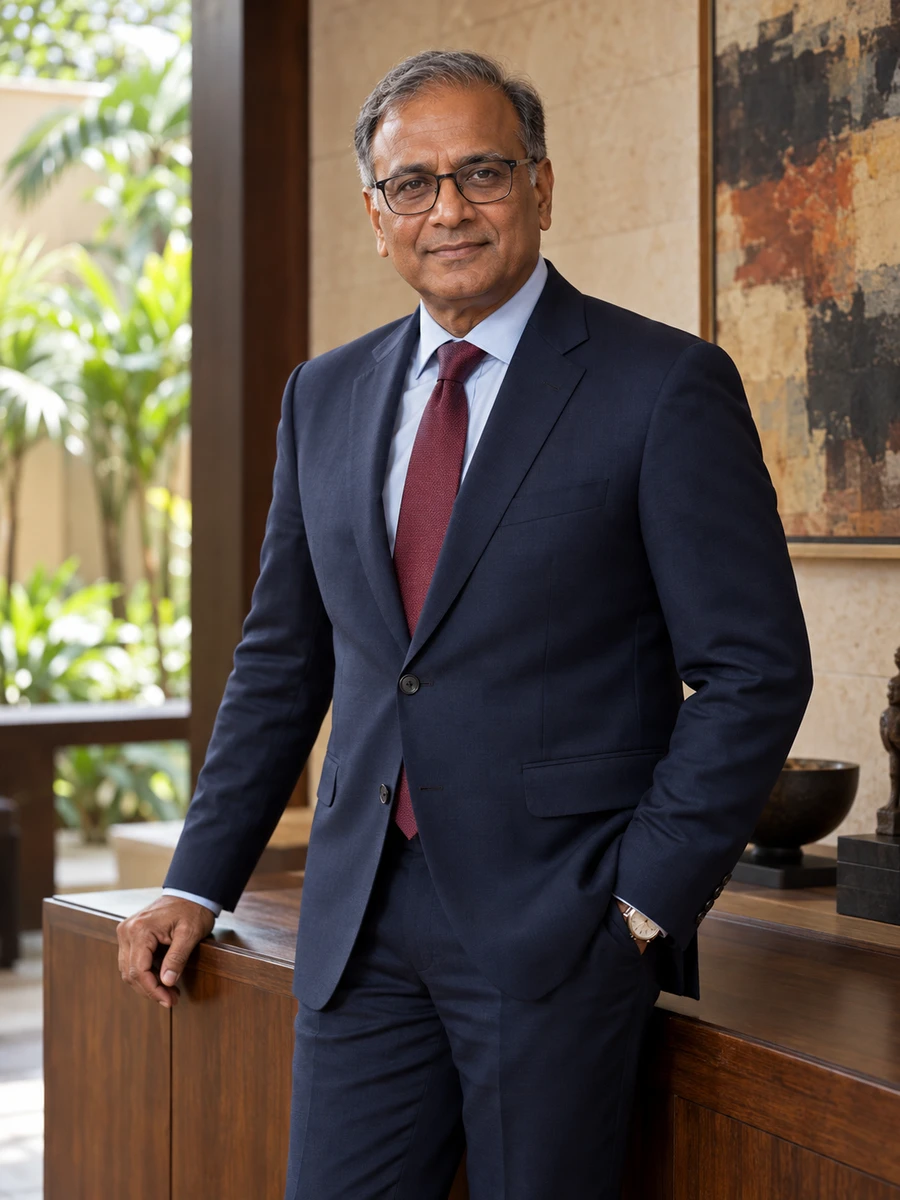
I lead strategy at Tevqoshi Biomedical Service Workshops in Thrissur. We employ 440 people and serve 64 hospital customers, with ₹92 crore revenue and ₹8.1 crore operating profit for FY ending March 2026. My function comprises fourteen colleagues through three leads and ₹4.9 crore annual expense. I develop proposals with operating, technical and finance colleagues for the CEO and board; I do not approve clinical use, authorise every repair or treat a commercial agreement as evidence of technical competence.
My career began in service planning in 1989. I learned to examine the work beneath a network map, but I did not always apply that lesson well. In 2018 I supported a remote-workshop proposal built around 250 monthly jobs. The first six months averaged ninety. We eventually closed the workshop after eighteen months, retaining ₹62 lakh of unrecovered startup cost and arranging customer-agreed transfers of responsibility. That failure remains part of my account of strategic judgement.
The later decisions concern a proposed acquisition whose permissions were not all transferable, a customer-owned spare-stock model, a service agreement narrowed to supported equipment and a primary-equity round compared with a full-company sale. These are different choices with different cash flows, obligations and limits. I want a reader to see which business each proposal would create, who retained approval and what we gave up when we chose a more bounded path.
The network proposal met a different pattern of work
I supported a workshop expecting 250 monthly jobs; its first six months averaged ninety. We closed after eighteen months, with ₹62 lakh of startup cost unrecovered. Customer-agreed transfers preserved an orderly transition, but did not make the original investment successful.
Buying the workshop would not automatically carry every permission
Of 26 reviewed service permissions in a proposed ₹32 crore acquisition, eighteen required fresh counterparty consent under the fictional agreements and eight were transferable. We declined the transaction and retained ₹74 lakh of diligence cost. The case describes those terms, not a universal legal rule.
Growth cash and an owner's exit were different offers
The board chose ₹12 crore of primary equity for 40%, leaving the founder family with 60%, over a separate ₹27 crore full-acquisition proposal. The recipient and purpose of the cash differed. Planned proceeds of ₹3.6 crore for parts, ₹3.4 crore for tools and ₹5 crore for working capital were allocations, not reported earnings.
Current focus
I am making the post-decision operating model clearer before a proposal reaches approval. That means specifying service scope, access to the required support, ownership of spare stock and the responsibilities an agreement leaves with others. A narrower contract or a different funding route can be the right choice without being described as universally superior or producing a saving merely because its headline amount is smaller.
Conversations I welcome
I would consider one first outside board contribution in specialist services or equipment businesses, subject to employer consent and a qualified review of relationships and eligibility. I have no statutory directorship. The fictional preparation record includes March 2026 IICA registration and a September assessment pass. Twenty-four days is a provisional annual commitment, including induction and unusual demands, rather than an assumption that every role will fit.