Renewal received capital before another retail proposal
A ₹4.8 crore roof-renewal programme went ahead after specialist review. A separate ₹3.2 crore retail-gallery proposal was deferred, with its prospective income still unearned.
A leadership monograph
Nafisa Rehzavthi
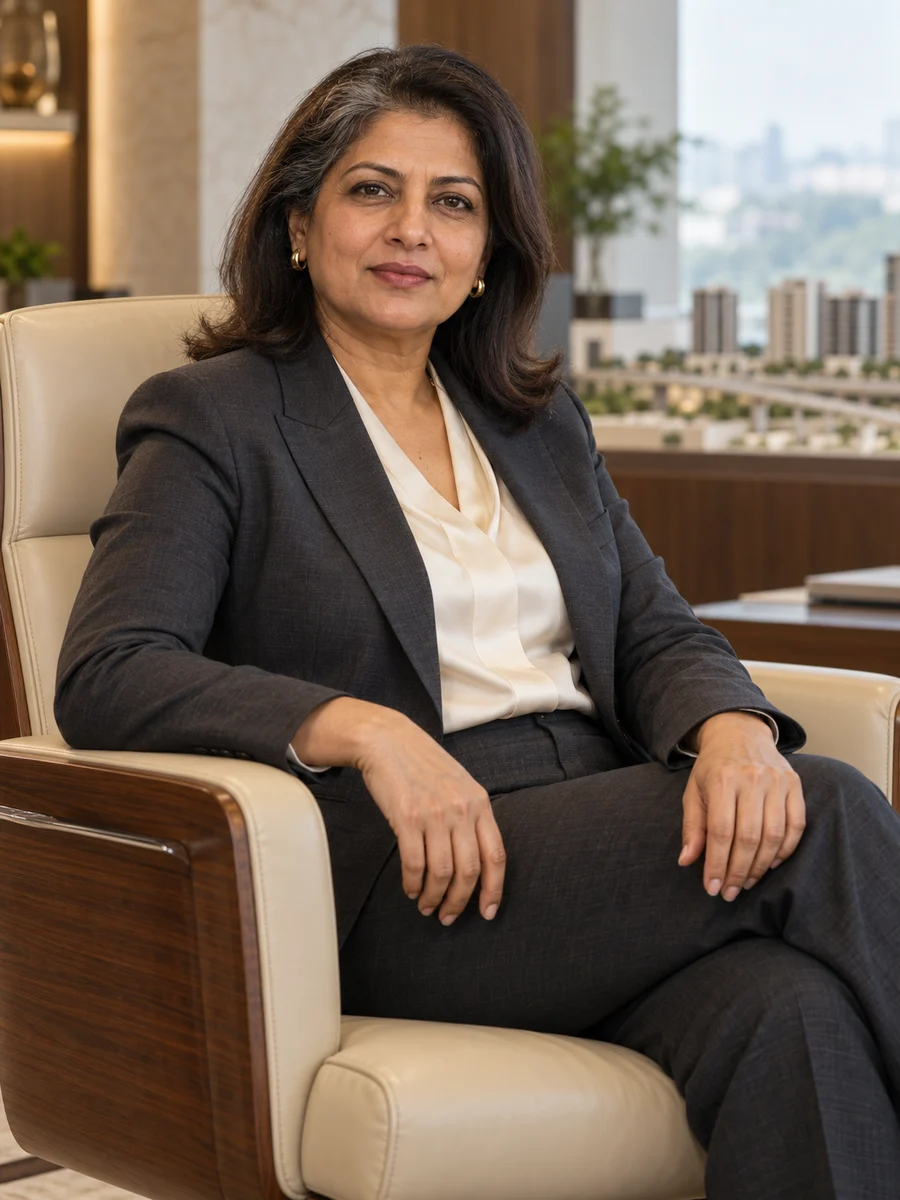
Chief Executive Officer · India · Volume I · 2026
Chapter I
I lead a terminal business by asking what we have undertaken to provide before deciding how the place should earn. I grew up in Moradabad and studied commerce at the fictional Merzavthi Institute of Commerce, graduating in May 1994. My first employment began that July in facilities coordination. The work was less about a building considered in isolation than about the different undertakings taking place inside it. A contractor, an occupier and the person arriving at the door might describe the same interruption differently. I learned to find out whose decision was needed before assuming that a broadly worded service promise made everything our responsibility.
Treqzami Public Facilities employed fifty-five people and recorded ₹11 crore revenue in FY1995. I worked within a supervised team, without direct reports or delegated expenditure. My contribution was to arrange work information and follow up agreed actions, while experienced facilities and technical colleagues retained decisions. It was a practical education in how a service undertaking becomes a series of handovers. A completed task could still leave another party waiting. That did not make the completion false; it meant that the next responsibility needed to be identified and accepted.
In June 2000 I became contract services manager. The company then employed ninety people and recorded ₹24 crore FY2001 revenue. I led twelve colleagues with ₹1.1 crore annual function expense. Contract language entered the daily conversation more directly. It mattered whether a request was within an agreed service, needed the owner's authorisation or belonged to another provider. I did not want those distinctions used merely to send somebody away. I wanted them understood early enough to produce an answer that the organisation had authority and resources to carry out.
I joined Vezqamthi in September 2008 as regional manager. The terminal-services enterprise had 110 employees and ₹31 crore FY2009 revenue, while my remit involved thirty-eight colleagues and ₹8.2 crore of operating expenditure. A bus terminal brought together public access, transport operators, retail licensees and facilities work. The company did not own the passenger's entire journey simply because its name appeared on the place. Nor could it treat each commercial activity as an isolated business without considering what the combination did to the terminal.
The functional director of operations appointment came in January 2015. Four site and central managers reported to me under a ₹32 crore operating plan; the company employed 176 people and recorded ₹52 crore FY2016 revenue. The title did not carry a statutory directorship. I was responsible for joining up operating decisions across the enterprise, and in 2018 I made the retail-fitout approval described in the cases. I gave too much weight to the commercial frontage account. A review of passenger movement and access led to two of six kiosk frontages being relocated, with ₹1.7 crore correction expense including ₹40 lakh of licensee remedies.
Faisal's objection was uncomfortable because it concerned the question I had chosen to ask. The people presenting the retail case had not invented their commercial need. I had allowed that need to become the main way the space was understood. Supporting the correction meant changing an approved proposition, involving the relevant professional and contractual owners and retaining the cost in the account. It did not mean claiming that I could personally certify access or that the new arrangement proved a universal result for every user.
In April 2020 I became chief executive and took one executive statutory seat on Vezqamthi's board. Asha Qezvamri chairs separately. I now lead six executives in a 238-person enterprise, with ₹78 crore FY2026 revenue and the stated operating and capital plans. Domestic infrastructure investors hold 47%, a regional promoter 33% and an employee vehicle 20%. My personal 0.1% is included within the employee allocation. Ownership, executive responsibility and public contractual authority are different relationships; none should disappear into a convenient statement that we own the terminal.
The decisions since appointment reflect that distinction. We funded roof renewal ahead of another retail proposal, expanded staffed overnight assistance at a disclosed annual cost, moved part of a retail renewal programme towards direct licensee relationships and developed a referral arrangement for enquiries belonging to participating bus operators. Each choice left something unresolved or gave something up. Renewal expenditure did not establish a return; assistance did not certify personal security; direct relationships required more administration; a referral did not make us the merchant responsible for a bus fare.
I am considering what this experience could contribute outside the company. I have no outside statutory seat. Databank registration is recorded from September 2026, with assessment preparation unfinished and no exemption claimed. Eighteen days is an initial capacity estimate, including preparation and travel, that needs scrutiny against my executive responsibilities and the demands of a particular appointment. I would bring experience of a commercial enterprise operating within a public place, together with a clear account of the mistake that taught me to examine the place before accepting the commercial drawing.
Chapter II
I want the commercial discussion to begin with the place we have agreed to provide. Rentable frontage, advertising and other income matter, but they cannot define a terminal without the people travelling through it. I also want the boundaries to remain honest: our responsibility for a place does not make us the operator of every bus or the owner of every transaction inside it.
Nafisa Rehzavthi
Chapter III
Chapter IV
§ 1
In 2018 I approved a commercial fitout on the strength of its retail frontage and expected use of the concourse. The presentation made the proposed kiosks look like a productive addition to space through which passengers already moved. It did not give equal weight to that movement as a purpose of the place. Faisal Deqverthi challenged the proposal from the operating account: the route between arrival, information and boarding needed to be understood before a retail position was treated as settled. I had signed off a proposition without asking for those accounts to meet.
The commercial sponsor wanted to retain the approved frontages. Licensees had planned their own work around the positions, and moving them would involve both expense and a difficult conversation about commitments. I did not treat that objection as merely defensive. We had created an expectation on which other businesses could reasonably act. The relevant facilities, access and contractual specialists reviewed six kiosk frontages. Their work supported retaining four and relocating two under the appropriate conditions; I did not substitute my own design judgement for theirs.
We incurred ₹1.7 crore in correction expenditure: ₹1.3 crore for the defined rework and ₹40 lakh in agreed licensee remedies. The remedy was included in the total, not a separate sum to be added again. I retained responsibility for the original approval and supported the revised commitments. The change did not establish an injury count, a universal accessibility result or a quantified improvement in retail trading. Those would have required different evidence. It established that the commercial layout we had accepted needed alteration after a fuller examination of the terminal's purpose.
The cost mattered beyond the budget. We had asked licensees to reconsider plans after presenting the frontage as decided, while operating colleagues had to reopen a question that should have shaped the first proposal. I would bring the passenger route and the relevant professional review into the initial commercial discussion next time. The purpose is not to make every retail proposal subordinate to an unexamined objection. It is to ensure that income and movement describe the same place before the company gives either account the force of an approved commitment.
§ 2
A 2021 capital discussion placed a retail-gallery proposal beside a roof-renewal requirement at one of our terminals. The gallery concept carried an estimated ₹3.2 crore development commitment and a commercial argument for broadening the offer. Specialist review of the roof supported bringing forward a defined renewal programme costing ₹4.8 crore. These were not alternative ways of doing the same work. One concerned an additional commercial proposition; the other concerned the condition of the place we were already operating under its concession.
The gallery sponsor argued that a new income source could make later renewal easier to fund. Finance wanted both proposals considered within the enterprise's available resources rather than assume that every technically supported programme had to happen at once. I asked for the actual condition assessment, concession requirements and sequencing options to be examined together. Relevant engineering and contract owners retained the assessment and permissions. The board needed a recommendation on priorities, including the consequence of postponing the commercial proposal, rather than a claim that one specialist opinion settled every allocation question.
We approved the ₹4.8 crore renewal programme and deferred the gallery. The decision retained the gallery's work as an unapproved future proposition; it did not turn the unspent ₹3.2 crore estimate into a realised saving. Nor did we claim a specific extension of roof life or an assured economic return without the corresponding evidence. The programme proceeded through the responsible professional arrangements, while the terminal's operating obligations continued. The commercial team still had a credible idea, but it did not receive capital in that sequence.
The choice clarified how I wanted the concession period represented in investment discussions. The remaining commercial term matters, yet it does not by itself describe the condition duties the company has accepted. Those come from the actual arrangements and their assessment. I would put the recurring condition account beside commercial development earlier, so renewal does not arrive as an unexpected opponent to growth. The outcome was a funded priority and a deferred opportunity, with the trade-off visible. It was not evidence that every renewal proposal should outrank every new use of capital regardless of the asset, contract or available alternatives.
§ 3
In 2023 we considered an expanded staffed waiting-assistance offer during selected overnight periods. The commercial discussion initially followed shop opening hours, because retail activity provided a familiar indication of use. Operating observations across twelve evenings described eight late-arrival sequences and four evenings without those sequences. That small observation set was enough to raise a question about the proposed service, not enough to establish a representative arrival rate for the year. People could need a place to wait when there was little immediate shopping demand.
Commercial colleagues challenged the recurring expense. They could not show that overnight retail trading would cover it, and they did not want a trial service to become a permanent commitment without review. Faisal wanted the account to distinguish required baseline facilities from the additional assistance under discussion. I supported that distinction. Existing required services continued; the proposal concerned an expanded offer, with the relevant operating and public-authority arrangements assessed before implementation. It was not a decision to withdraw a required service on quiet evenings or make essential access depend on a purchase.
The board approved ₹1.05 crore annual expenditure for the defined additional scope. We kept the staffing and coordination cost visible instead of presenting the offer as a commercial improvement that would pay for itself. The account did not claim a reduction in crime, an incident-free environment or a universal personal-security outcome. Those claims could not be inferred from a funded assistance arrangement. Responsible facilities and security professionals retained their actual duties, and the company continued to assess what the additional service required in practice.
The resulting offer recognised a use of the terminal that retail spending had represented poorly. It also gave the enterprise another recurring responsibility, so the decision needed continued examination rather than a celebratory opening announcement. I would involve people waiting during those hours earlier when framing the service, alongside the colleagues expected to deliver it. A passenger place has to understand when and why it is being used. That does not mean every observed need belongs to the concessionaire or that every proposed service is affordable. It means the commercial proxy should be questioned before it becomes the answer to a different public-facing obligation.
§ 4
Sixteen retail units entered a renewal discussion in 2024. A single intermediary offered a comparatively simple commercial route, with one main relationship through which several unit-level matters could be handled. Our commercial team valued that simplicity, particularly where central managers already had a large operating agenda. Site discussions nevertheless showed that decisions about permitted use, changes and day-to-day responsibilities were easier to understand when the people actually running a unit could be part of the conversation. I wanted that difference examined as an enterprise choice, rather than treated as a minor preference in contract administration.
The intermediary model had legitimate advantages. It could consolidate communications and carry work that we would otherwise need to organise. I asked finance, commercial and site teams to cost a direct-licensee alternative for the relevant units, with legal and public-authority owners retaining the actual permissions and terms. Direct contact would not create rights the concession did not provide. It also would not remove the need for clear obligations or make every disagreement easier merely because fewer organisations stood between the parties.
We adopted direct arrangements for twelve units. Four remained unresolved at the review date and were kept outside the completed account. The transition cost ₹22 lakh, with a further ₹34 lakh in annual administration for the chosen scope. Those are different kinds of expenditure and were reported separately. We did not claim that the change had already increased retail income, improved every trader's profitability or eliminated all unit-level issues. It established a different set of relationships, supported by resources to manage them.
The decision gave site and commercial colleagues a clearer route to the people operating the twelve units, but also more individual arrangements to maintain. I accepted that administrative consequence rather than ask teams to absorb it invisibly. I would examine the full organisational cost at the start of a future renewal, before a direct model acquires an automatic association with responsiveness. An intermediary is not inherently an obstacle, and a direct licence is not inherently a better service. For this reviewed group, the board accepted the closer relationship and its cost, while leaving the four unresolved units as work still to be completed.
§ 5
A 2025 review examined 210 enquiries received through terminal-facing channels. Of these, 138 concerned bus fares or refunds, forty-seven concerned terminal services and twenty-five remained unresolved in their classification. A traveller could see one terminal identity even when the transaction behind the enquiry belonged to a separate bus operator. Our company was not the merchant for those fares. Simply repeating that distinction, however, left the public-facing team with little useful answer and did not address the matters that were clearly ours.
The service team wanted a single response desk with authority to settle more questions. Finance and legal colleagues were concerned that broad language about taking care of a journey would imply obligations the enterprise had not accepted or powers it did not hold. Both concerns were reasonable. I supported developing an agreed referral arrangement with participating operators while retaining a separate account of the forty-seven terminal-service matters. The twenty-five unresolved enquiries stayed open for further examination; they were not assigned to another party merely to make our own total look cleaner.
We spent ₹44 lakh establishing the defined coordination and referral arrangements. Participating operators had to agree their part, including appropriate treatment of personal details and the actual route through which a fare question could be considered. The programme did not include every operator, transfer all fare liabilities to Vezqamthi or promise an automatic payment. The stated figures describe the reviewed enquiries and their initial responsibility categories. They do not describe how many complaints were resolved or how satisfied travellers became after the change.
The useful outcome was a more honest service proposition: ownership of our terminal matters, a practical route for some operator matters and an explicit unresolved group. That is less sweeping than saying that one desk solves everything, but it can be resourced and explained. I would develop these relationships earlier in the concession's public-facing design, before a shared name invites an assumption of shared authority. The chief executive needs to care about the whole experience without claiming to control every transaction within it. A boundary should identify the next accountable party, not become the final sentence offered to someone still trying to understand where their question belongs.
Chapter V
My retail-fitout approval privileged a convincing commercial drawing over the passenger journey through the same space. The correction changed two kiosk positions, cost ₹1.7 crore and altered commitments we had already made. I examine how a chief executive can keep the income case serious without allowing it to become the only description of a public place.
Read the essayA roof-renewal programme and a proposed retail gallery were competing for capital, but they answered different questions. I explain why the commercial term, the condition assessment and the actual concession duties need to meet in the board's investment discussion, without treating a deferred proposal as a saving or a technical recommendation as the whole allocation decision.
Read the essayA traveller sees a place; the organisations inside it see separate transactions and duties. Our enquiry review exposed that difference. I examine how a terminal enterprise can retain responsibility for its own service, build useful referral relationships and avoid implying that a shared public identity gives it authority over every fare or complaint.
Read the essayAn invitation
Infrastructure leadership conversations and a possible first outside board contribution, subject to preparation and a realistic capacity review.
office@nafisarehzavthi.example