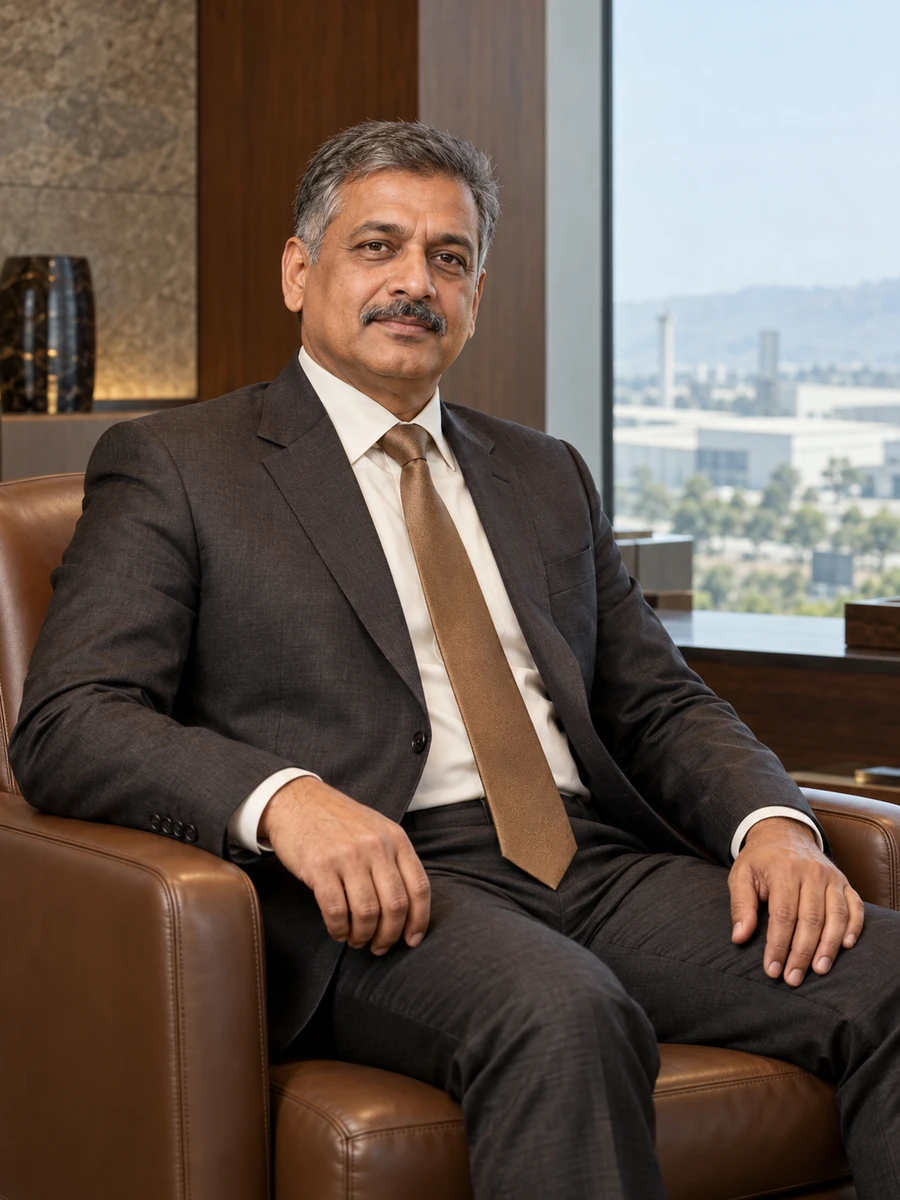
I lead Vezqoshi Industrial Screens from Kolhapur, with manufacturing sites here and in Sangli. We make woven-wire and fabricated industrial screening panels, employ 520 people and recorded ₹228 crore revenue with ₹19.4 crore operating profit for FY ending March 2026. I have six executive direct reports and enterprise profit responsibility within a ₹24 crore annual capital envelope approved by the board. I am a professional CEO with no direct equity and one executive board seat, reporting to non-executive chair Mira Qezthavi.
My career began in production engineering in 1992. As COO in 2016, I supported outsourcing a tensioning process by comparing a ₹2.4 crore annual outside fee with ₹3.6 crore of internal expense. The apparent ₹1.2 crore difference did not describe equivalent responsibilities. A nine-month trial brought ₹78 lakh of additional freight and rework, and we returned the process in-house. That extra cost was not a complete calculation of net loss, and the original comparison was not an achieved saving.
Later decisions required the same attention to what a headline concealed: secondary-sale proceeds paid to owners rather than the company, a customer forecast that was not a firm order, a shift whose positions were not all filled and automation demonstrated on a simpler product mix. I work with finance, commercial and operating colleagues to make those distinctions visible before the enterprise commits. Technical release remains with authorised specialists, and a revised proposal still needs evidence of delivery.
The outsourcing quotation did not carry the whole process
The nine-month tensioning trial incurred ₹78 lakh of additional freight and rework alongside its other costs. We brought the process back and planned the return of 22 redeployed colleagues. I retain my approval and the incomplete comparison rather than turn the later correction into an outsourcing success.
New ownership did not put the sale proceeds into our factory
A 55% secondary transfer paid ₹96 crore to selling founders. The resulting ownership was founder family 30%, investor 55% and employee trust 15%. A separate ₹18 crore capital proposal needed its own company funding assessment and board approval; the transaction proceeds were not available enterprise cash.
A single-product demonstration was not our mixed-production rate
A demonstration at 240 panels an hour did not describe accepted output across twenty models. The reviewed mixed-production rate was 140 accepted panels an hour. We selected an ₹8.4 crore cell instead of a ₹15 crore full-automation proposal with different scope, without claiming a like-for-like ₹6.6 crore saving.
Current focus
I am connecting investment and commercial decisions more closely with the production conditions they create. That means explaining the process retained after outsourcing, the company funds available after an ownership change and the people and product mix behind a capacity proposal. I want a smaller, supportable commitment to be understood on its own terms rather than presented as an equivalent result at a lower price. Actual delivery must still be assessed after the decision.
Conversations I welcome
I would explore one outside board contribution in manufacturing or industrial services, with employer consent and a qualified review of commercial relationships and my existing executive seat. The fictional preparation record includes April 2026 IICA registration and an August assessment pass, with no exemption claimed. Twenty-two provisional days must be tested against preparation, travel and exceptional demands before a role is accepted.