Razia Nevqetzi

A leadership monograph

Razia Nevqetzi

Make the institution ready for the promise it invites

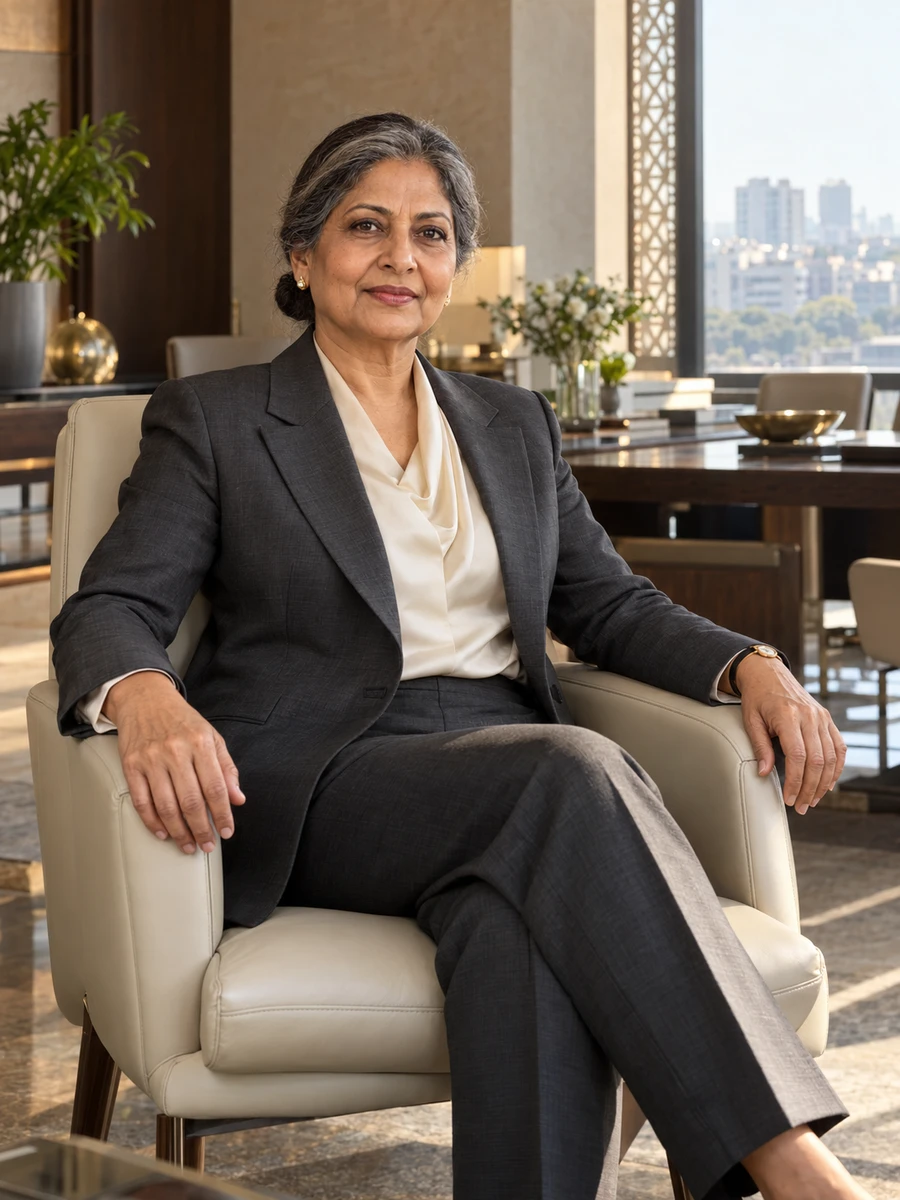
Portrait of Razia Nevqetzi

Chief Executive Officer · India · Volume I · 2026

Make the institution ready for the promise it invites

I lead Zelqevni General Assurance, an invented regional general insurer based in Ahmedabad. Our 620 employees work across thirty-two branches and supporting functions, serving smaller enterprises in property and inland transit. Nine executives report to me. The board-approved annual operating expense is ₹168 crore; FY ending March 2026 gross written premium of ₹1,470 crore describes written business, not revenue or money available to spend.

My forty years began in underwriting support and continued through branch management, regional responsibility and enterprise operations. That experience has made me interested in what sits behind a visible sign of readiness. A branch can have premises but lack an assigned specialist. A delegation can exist while colleagues still wait for the CEO. A proposal can describe an attractive market while leaving simultaneous service demands to one person.

In 2021 I announced twelve branch openings before the specialist-servicing assignments had been completed. Seven were ready; five were not. We revised the timetable and opened seven, retaining ₹2.1 crore of standby expense for the deferred locations. I owned the premature announcement. The useful change was to connect each opening with named servicing capacity, rather than make the launch count stand in for readiness.

Separate sites can carry a shared interruption

Thirty-seven insured industrial sites included twenty-four using the same two access roads and one power substation. Their combined sum insured was ₹486 crore across all thirty-seven, not an estimate of loss. An ₹86 lakh mapping and engineering review made the shared dependencies visible to the relevant specialists.

Written authority was waiting for an unwritten permission

During a ten-working-day CEO-absence rehearsal, thirty-one of forty-six routine decisions stalled while colleagues waited for my personal approval. We funded eight weeks of delegation coaching at ₹64 lakh, retaining reserved matters and specialist mandates. The account does not claim that a successor was thereby ready.

A proposed market required a credible response organisation

A cyber-insurance proposal carried a ₹120 crore first-year premium ambition but assumed one incident coordinator. Three concurrent fictional scenarios exposed four distinct response roles. I held the proposal and sanctioned ₹1.6 crore of readiness design, without claiming a launch or a completed service capability.

Current focus

Joining expansion decisions to servicing responsibility, examining correlated obligations and making delegated authority usable without substituting the CEO for professional judgement. I want the unfinished capability to remain visible after a promising presentation.

Conversations I welcome

A carefully assessed outside non-executive contribution alongside my employer's executive seat. Databank registration is complete; assessment remains unfinished. Eighteen provisional days, employer consent, conflicts and company-specific eligibility all require review before an appointment.

Chapter I

Preface

I announced twelve new branches before I could explain who would provide the specialist servicing behind every opening. The premises and launch plans were visible, and I allowed them to carry more weight than the unfinished assignments. In 2021 seven locations were ready while five were not. We revised the timetable, opened seven and retained ₹2.1 crore of standby expense for the deferred locations. The original announcement was mine, so the correction needed to include my decision rather than describe the problem as a disappointing execution detail elsewhere.

The lesson was not that expansion should stop whenever an organisation encounters uncertainty. It was that I had treated a count of openings as a sufficient account of what the institution could support. Assigning a specialist required more than putting a name beside a location. The person needed the relevant remit and workable capacity alongside existing obligations. We changed the opening discussion to include that service account. The fictional case does not invent denied claims, regulatory breaches or a later financial recovery to make the correction look more dramatic.

I grew up in Lucknow and completed commerce at Zheqetmi Commerce College in May 1986. In July I joined Velqezri Insurance Services as an underwriting-support assistant. The invented risk-inspection and underwriting-support firm, which did not issue insurance, had eighty-eight employees and ₹2.8 crore service revenue for FY ending March 1987. I worked in a seven-person support team without direct reports or delegated spending. The client insurers retained underwriting decisions; I learned how supporting records help them understand a proposed obligation and why assistance must not quietly become authority it has not been given.

In July 1994 I became a branch manager. Velqezri had grown to 210 employees and ₹18.4 crore service revenue for FY ending March 1995. My branch had seventeen colleagues and ₹1.1 crore annual operating expense, reporting through the regional head. I became responsible for coordinating people whose work met the customer at different moments. A branch manager could not settle every technical question by offering a confident assurance. The role taught me to make the route to an authorised decision understandable while keeping the responsibility with the right person.

I moved to Zelqevni in September 2003 as regional head. The company employed 230 people and recorded ₹320 crore gross written premium for FY ending March 2004. Six branch managers led seventy-five regional employees within ₹14 crore annual expense under the CEO. I began to see the connections between locations: the same specialist could appear in several plans, and apparently separate customer sites could share a physical dependency. Regional leadership required an account of those connections rather than a simple addition of branch summaries.

From April 2011 I served as chief operating officer. Zelqevni had 460 employees and ₹890 crore gross written premium for FY ending March 2012. Seven functional heads worked within ₹72 crore annual enterprise-operations expense under the CEO. This was an executive management role without a statutory seat. It broadened my responsibility for how operating arrangements survived absences, unusual demand and handovers. It also made me aware that a formal process can coexist with a different practical habit, especially when people have learned to seek informal reassurance from senior management.

I became CEO and an executive director in January 2018. Today nine executives report to me across a 620-person, thirty-two-branch insurer with ₹168 crore annual enterprise operating expense approved by the board. Gross written premium of ₹1,470 crore for FY ending March 2026 is not described as revenue or cash. Three domestic corporate shareholders hold 46%, 34% and 20%; I own no shares. Dev Teqvezri chairs the board separately, and Anjali Qevzemi leads risk. Technical disciplines retain their professional mandates within collective enterprise responsibility.

Recent decisions have addressed shared industrial-site dependencies, routine decisions that waited for my personal approval, an outsourced service script that exceeded its proper authority and a proposed new insurance line whose response plan depended on one coordinator. These accounts contain costs, unfinished work and decisions to hold a proposal. They do not claim that a funded programme proves capability or that a rehearsal predicts every real event.

I live in Ahmedabad and work in English, Hindi and Gujarati. My independent-director databank registration was completed in June 2026, while proficiency assessment remains unfinished and no exemption is claimed. One employer seat does not establish independence elsewhere. I would explore an outside contribution only after qualified review of eligibility, conflicts and eighteen provisional days alongside current duties. The experience I would bring is a habit of asking whether an institution can carry the obligations its own growth story invites.
Chapter II

A Philosophy of Leadership

A branch sign, a policy proposal and a delegation letter each announce something the organisation intends to do. I ask who can actually do it when the expected person is unavailable or several obligations arrive together. Growth becomes more credible when the service, authority and concentration assumptions are exposed before the institution relies on them.

Razia Nevqetzi

Chapter III

Areas of Practice

  1. IEnterprise readiness for insurers
  2. IIRisk concentration across operating boundaries
  3. IIIDelegated executive authority
  4. IVService mandates and expansion decisions

Chapter IV

Selected Work

§ 1

I announced twelve branches before five had a servicing assignment

In 2021 I approved the announcement of twelve branch openings. Premises, launch arrangements and dates were sufficiently advanced to create confidence, and I accepted that visible progress as an account of readiness. Seven locations had the necessary specialist-servicing assignments; five did not. The gap belonged in my decision before the announcement, not merely in an operating update afterwards. I had allowed the number of planned openings to become more persuasive than the organisation behind them.

The commercial preference was to preserve the public timetable. We instead revised it, opened the seven ready locations and deferred the other five. Standby expense of ₹2.1 crore remained in the account. We did not describe it as an avoided loss or assume that an eventual opening would recover it. The revised discussion required a named service assignment, its actual remit and workable capacity alongside existing duties. Adding a person's name to several location plans would not by itself resolve competing demands on that person.

I explained the correction to the board and retained ownership of the premature announcement. Branch, people, finance and technical leaders then worked through their respective responsibilities. The case does not invent a customer claim that was denied, a legal finding or a regulatory breach. It describes an enterprise commitment that had run ahead of readiness and the cost of correcting its timing. The later opening dates and commercial performance of the deferred locations are not supplied.

My judgement changed from asking whether a branch could open to asking what the institution was equipped to support once it did. That distinction is practical rather than rhetorical. It can change an assignment, a timetable or a decision to proceed. It also requires the chief executive to accept that a more accurate account may make a previously confident announcement look premature. Preserving that admission is more useful than writing a success story in which the original decision disappears.

§ 2

Thirty-seven insured sites did not mean thirty-seven independent dependencies

In 2022 our industrial-park review examined thirty-seven insured sites. Twenty-four relied on the same two access roads and one power substation. Their addresses were distinct, but part of their operating exposure was connected. The combined sum insured across all thirty-seven sites was ₹486 crore. That amount was not a probable loss, a reinsurance recovery or a calculation of the capital required. The important finding was the dependency that a location-by-location account had made difficult to see.

I approved ₹86 lakh for mapping and engineering review. Risk head Anjali Qevzemi coordinated the enterprise question with the relevant technical owners. Underwriting, actuarial, engineering and reinsurance colleagues retained their assessments and decisions. The executive task was to ensure that the connection received attention and resources, not to derive terms from a map or declare every site equally vulnerable. The roads and substation could matter differently to individual operations, and that difference required work rather than an assumption.

There was a real tradeoff in adding another layer of investigation to business that appeared geographically dispersed in routine reporting. Colleagues needed time to reconcile site accounts and understand the shared infrastructure. We retained that cost and the limits of the available evidence. No actual catastrophe, claim total, premium saving or avoided financial loss is included in this fictional case. A fuller map is useful, but it does not by itself establish the frequency or severity of an interruption.

The result was an explicit concentration question in the enterprise account. Directors could ask how technical owners were examining common dependencies without substituting their own judgement for those disciplines. I learned to treat distinct locations as the beginning of a diversification discussion, not its conclusion. What connects sites may be as consequential as the count of sites, and the CEO must help the organisation see that connection before separate summaries make it disappear.

§ 3

The delegation existed, but routine decisions still waited for me

In a 2023 rehearsal of a ten-working-day CEO absence, we tracked forty-six routine decisions. Thirty-one stalled while colleagues waited for my personal sign-off, although formal authority sat elsewhere. This was not evidence that colleagues lacked ability or that every delayed decision should have been made faster. It showed a gap between the written allocation of responsibility and the practical permission people believed they needed. My own habits were part of that gap.

We funded an eight-week programme of delegation coaching and escalation practice at ₹64 lakh. The work examined the circumstances in which I had offered extra reassurance, revisited decisions or become the safest route through uncertainty. Reserved matters remained reserved, and underwriting, actuarial, claims, risk and other technical mandates were not reassigned through an executive workshop. Colleagues needed to understand both the authority they could use and the limits that still applied.

The tempting response would have been to issue a stronger instruction to act independently and then count decisions closed. I wanted the programme to examine why a person might reasonably expect a second approval despite the document. Senior behaviour had to support an authorised decision even when the CEO would have preferred another defensible option. Coaching could clarify that expectation, but it could not establish by itself that every future absence would be handled well or that a particular successor was ready.

The observed result remains thirty-one stalled decisions in the initial rehearsal and a funded change in practice. No later completion rate or operating saving is invented. The lesson for me was that delegation is partly an account of the chief executive's conduct. An institution cannot become less dependent on one person if that person continues to reward the habits that make personal permission feel necessary. The work therefore included changing how I participated, rather than asking everyone else to become more confident around an unchanged centre.

§ 4

After-hours acknowledgement had acquired an unauthorised coverage promise

In 2024 we reviewed an outsourced after-hours service arrangement involving six supplier agents alongside our internal team. Sixty simulated notices were used to examine first-contact conversations. Eighteen responses wrongly promised coverage before an authorised assessment. The exercise was simulated; it does not establish eighteen affected customers, denied claims or actual settlement delays. It did show that the service conversation could create an assurance the person answering was not authorised to provide.

I sanctioned a ₹48 lakh programme covering the script, supervision and the route to our responsible internal colleagues. The supplier could acknowledge a notice, explain what would happen next and help the caller reach the proper process. It could not decide the contract's coverage by sounding reassuring. Claims and legal professionals retained their assessments, while operating leaders owned a workable handover. A caller should not have to infer those responsibilities from a vague disclaimer added after a confident promise.

The decision accepted more work in service design and supervision. We did not assume that removing one sentence would make every conversation appropriate, or that an outsourced colleague should provide no useful help. The revised brief required clarity about what could be said, what remained undecided and who would take responsibility for the next step. Its effectiveness would need further evidence. The funding was not presented as a measured reduction in complaints or a financial return.

For me, the case concerned the enterprise boundary of an outsourced service. A contract can describe that boundary without making it easy to respect during an anxious conversation. The CEO has to ensure that the operating arrangement, incentives and supervision support it. That is different from taking over a claims decision. I wanted an honest and useful first response whose reassurance came from a clear next step, rather than from a premature conclusion about an obligation that had not yet been assessed.

§ 5

A new insurance line had one coordinator for work that needed four roles

In 2025 a proposed cyber-insurance line carried a ₹120 crore first-year gross written premium ambition. Its service plan assumed one incident coordinator. We examined three concurrent fictional scenarios and identified four distinct response roles that could not credibly be treated as one person's interchangeable tasks. The proposal had described the commercial opportunity more fully than the organisation needed to respond when obligations arrived together.

I held the proposal and sanctioned ₹1.6 crore for readiness design. The work had to distinguish coordination, technical incident response, legal advice and customer communication, including the professional responsibility retained by authorised providers. One coordinator might connect those activities, but the title could not supply every competence or create simultaneous capacity. The exercise did not use an actual attack, expose customer records or claim that the organisation had already delivered the proposed response.

The tradeoff was to postpone a visible commercial opportunity while investing in the conditions on which it depended. The ₹120 crore figure remained an ambition, not booked premium, revenue or a forecast validated by the exercise. The ₹1.6 crore was a funded programme, not the full cost of an operating service or evidence that the gap had closed. Product, underwriting, risk, actuarial, legal and operating owners retained the further work necessary before any actual market decision.

I regard the outcome as a more demanding proposal rather than a successful launch. The board could now examine a service organisation alongside the opportunity, including what concurrent demand might require and which capabilities were still unproven. The case does not imply that a small provider is always unsuitable or that four roles necessarily mean four permanent employees. It asks whether the work and professional boundaries have been understood before a headcount or job title is used to make a complex promise look ready.

Chapter V

Essays

An invitation

Contact

A carefully assessed outside non-executive contribution alongside my employer's executive seat. Databank registration is complete; assessment remains unfinished. Eighteen provisional days, employer consent, conflicts and company-specific eligibility all require review before an appointment.

Open to
  • Board appointments
  • Advisory roles
  • Speaking invitations

office@razianevqetzi.example