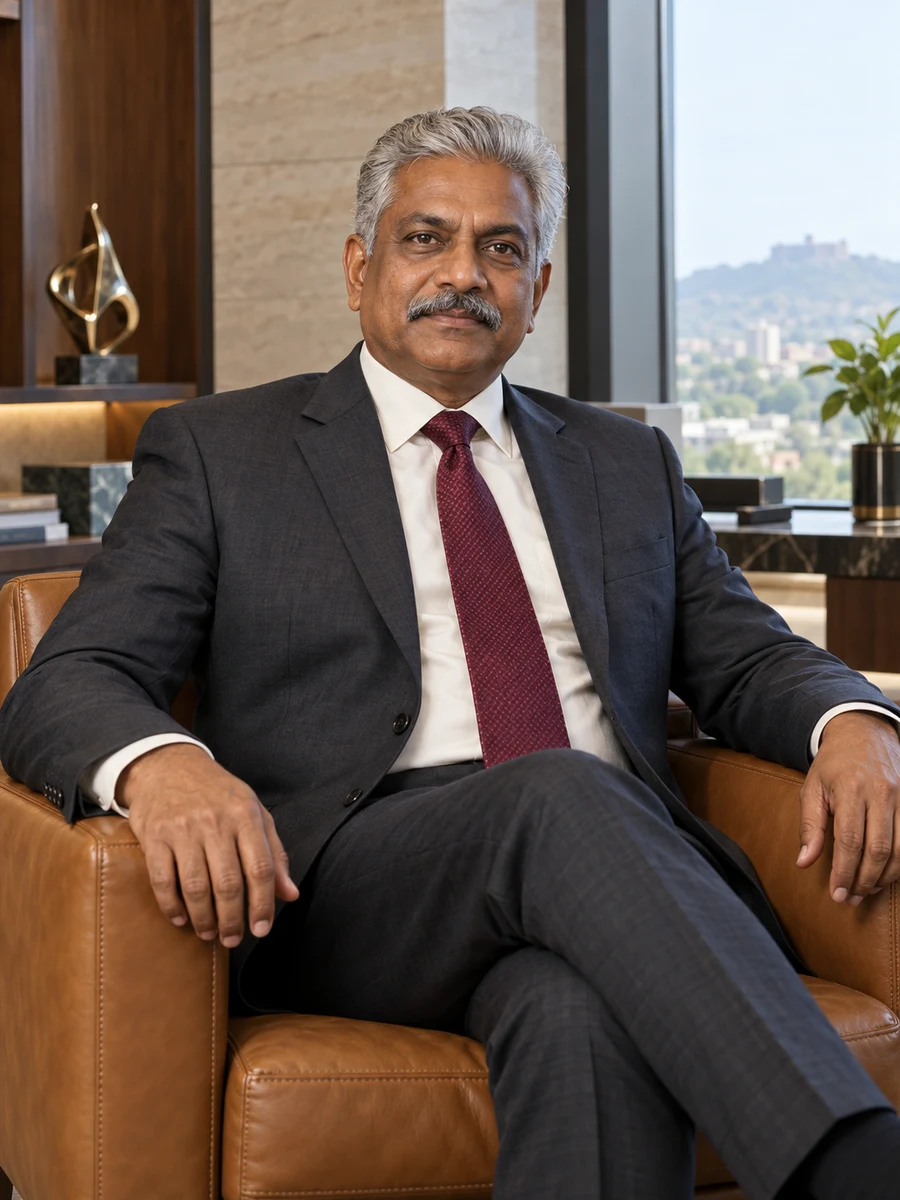
I lead technical development for demountable office interiors, testing how parts meet, which generations can work together and whether later maintenance can be performed as promised.
Repeating a component is not the same as proving the assembly.
Open toBoard appointments · Executive opportunities
Separate approved development programme ₹3.1 crore
Fabrication, methods and technology
35 years
Continuous progression from June 1991
A career in chapters.
Scroll to explore →
2021-04 — present
01
Chief Technology Officer
Drezqalni Interior Systems
Make repeatable technical promises depend on the interfaces and later tasks actually supported
2015-04 — 2021-03
02
Head of Technical Methods
Drezqalni Interior Systems
Define which assembly configurations the technical evidence permits us to support
2007-04 — 2015-03
03
Engineering Development Manager
Drezqalni Interior Systems
Connect component definitions with rearrangement, replacement and later access
1999-04 — 2007-03
04
Design Coordination Lead
Qavzelni Fabrication Services
Keep component versions and fabrication constraints connected before repetition
1991-06 — 1999-03
05
Engineering Trainee, later Development Engineer
Qavzelni Fabrication Services
Preserve the connection between an individual part and the assembly it must serve
A broader perspective.
Assembly interfaces across handed configurations / Compatibility across product generations / Maintenance access in development acceptance / Technical evidence for modular-interior commitments
In 2017 I approved a connector concept on the assumption that a mirrored arrangement would preserve the fit demonstrated in the original orientation. Twenty agreed bench mock-ups challenged that assumption: twelve fitted and eight did not. We stopped release of the unsupported configurations and revised the interface. Sixteen mock-ups then met the agreed criterion, while four remained held. I had treated visual symmetry as technical equivalence, and the correction needed to begin with the claim I had accepted.
I lead technology and methods at Drezqalni Interior Systems in Kolhapur. The enterprise develops non-structural demountable office interiors, with 342 employees and ₹186 crore FY2025–26 revenue. Four heads coordinate forty-three technical colleagues within ₹8.4 crore annual function expense and a distinct ₹3.1 crore approved development programme. I report to CEO Renu Zeqvalthi and work with practice head Joseph Qavzerli. My beneficial holding is 0.06%, included within the employee allocation, and I have no statutory directorship. Project design, installation and safety approvals remain with their qualified owners.
Later work examined replacement requests spanning different product generations and maintenance tasks that looked accessible in a component view but required unplanned disturbance of adjacent panels. Those reviews made us narrow some promises and change others before presenting them as supported. A first outside-board contribution would require unfinished governance preparation and appointment-specific assessment. Twenty-three proposed annual days need to be tested against executive work and the actual board calendar. I could help colleagues ask which detail makes a modular proposition repeatable in practice: the interface that must fit, the version that must match and the route by which the item can later be serviced. A repeatable design earns its value when those conditions remain true beyond the first convincing demonstration.
Mirrored configurations withheld when fit was not established
Twenty bench mock-ups moved from twelve supported configurations to sixteen after revision; four remained held.
Replacement requests checked against product generation
Thirty-seven of forty-five reviewed requests had a supported route after examination; eight remained unresolved.
Maintenance access tested as a complete task
Twenty-two of twenty-four agreed scenarios met the service-access criterion after redesign; two remained outside release.
Technical development with explicit project boundaries
Assembly evidence supports a defined claim without becoming a blanket building, installation or safety certificate.
Current focus
Interfaces, replacement compatibility and maintainable interior systems
Conversations I welcome
Technical leadership and a prepared first outside-board contribution
The leadership record
Trusted with consequential decisions.
Formation
Bachelor of Engineering in Mechanical EngineeringTevqazni Engineering College · 1991
Nandkishor narrowed a connector claim he had supported when the alternative configurations did not fit. He made the remaining boundary part of the commercial decision.
Renu ZeqvalthiFictional CEO, Drezqalni Interior SystemsThe full record ↗
Contact
Technical leadership and a prepared first outside-board contribution